
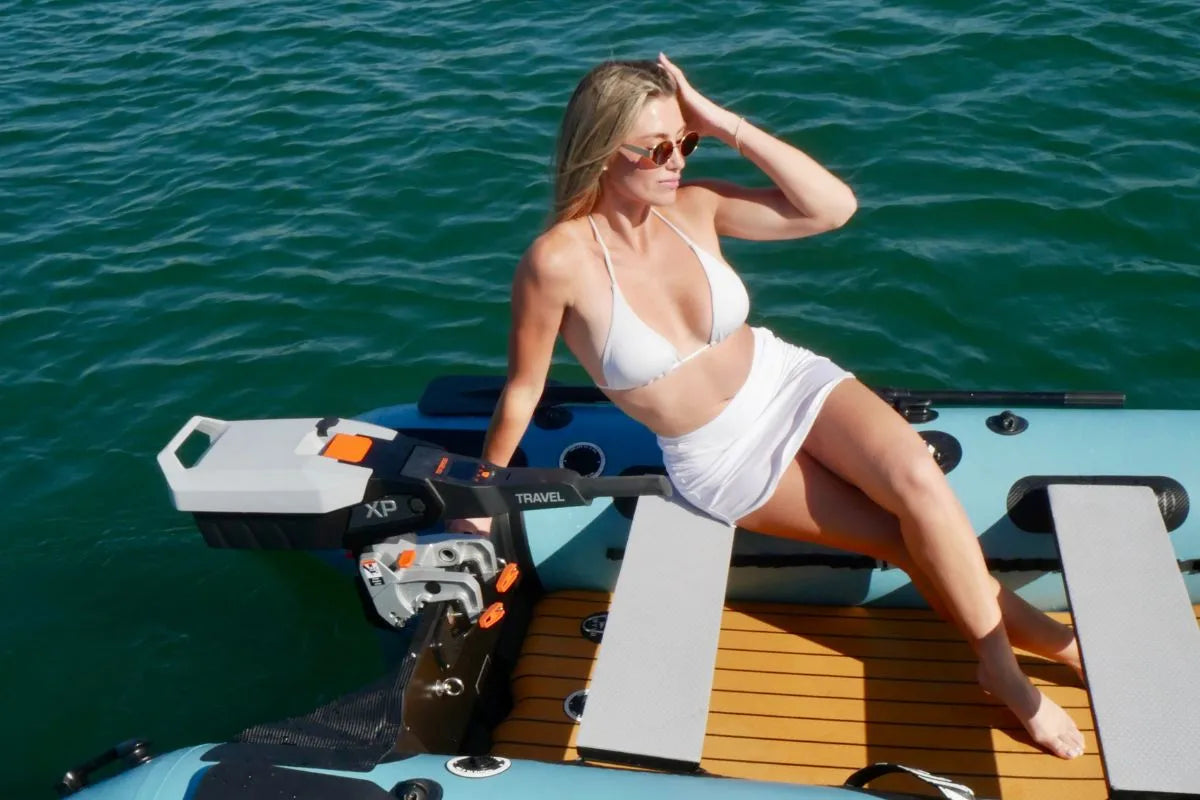
Rover Marine portability guide
Three completely different boats share one search term
Type "blow up boat" into a search bar and you get a vinyl pool raft, a recreational river float, and a 10-foot inflatable that folds down, carries real weight, and can hang an outboard off a rated 15-inch transom. Same search phrase. Very different products.

That ambiguity is the biggest source of disappointment in this category. Somebody buys a big-box raft expecting to bolt a 6 hp outboard to the back of it. Somebody else writes off portable inflatable boats entirely because the only one they handled was a pool toy with oar locks molded into the vinyl.
We build these boats, so we get this question weekly, usually phrased as "is this thing a real boat." This guide sorts the category into rungs so you can find the one you are actually standing on, then gives you the real numbers on the top rung. Deflated size. Dry weight. What one person can carry. What setup honestly takes. And what you give up when you decide to live without a trailer.
The category ladder, honestly
There are three rungs. They are separated by construction, rated capability, floor design, and whether the product is truly built as a boat.
The pool toy
Thin single-layer vinyl, low-pressure chambers, a molded plastic oar, no structural transom, and no real boating hardware. These are fine for floating close to shore or in a pool, but they are inflatable furniture, not a portable boat.
The recreational vinyl raft
This is the confusing middle. A few hundred dollars, dinghy-shaped, sometimes with a plastic mounting bracket that the marketing copy calls a transom. Useful on calm protected water, but not the same class as a rated inflatable dinghy.
The true portable inflatable boat
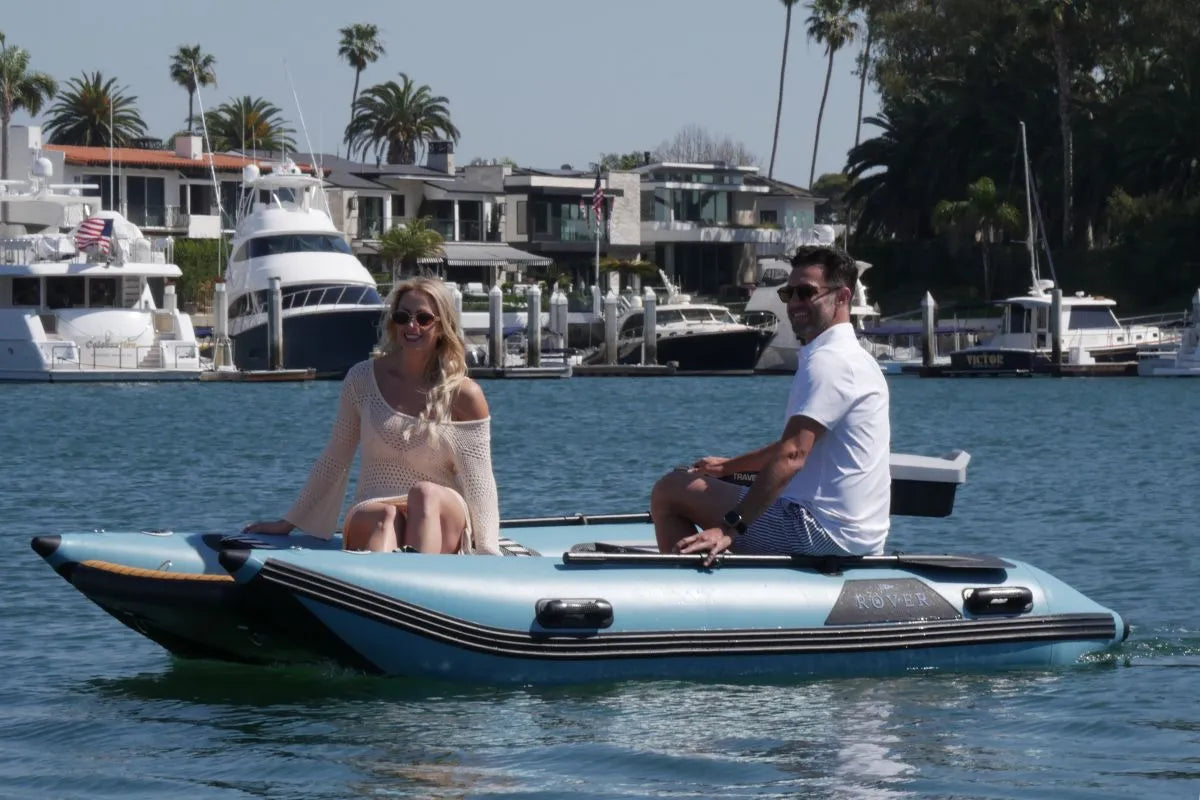
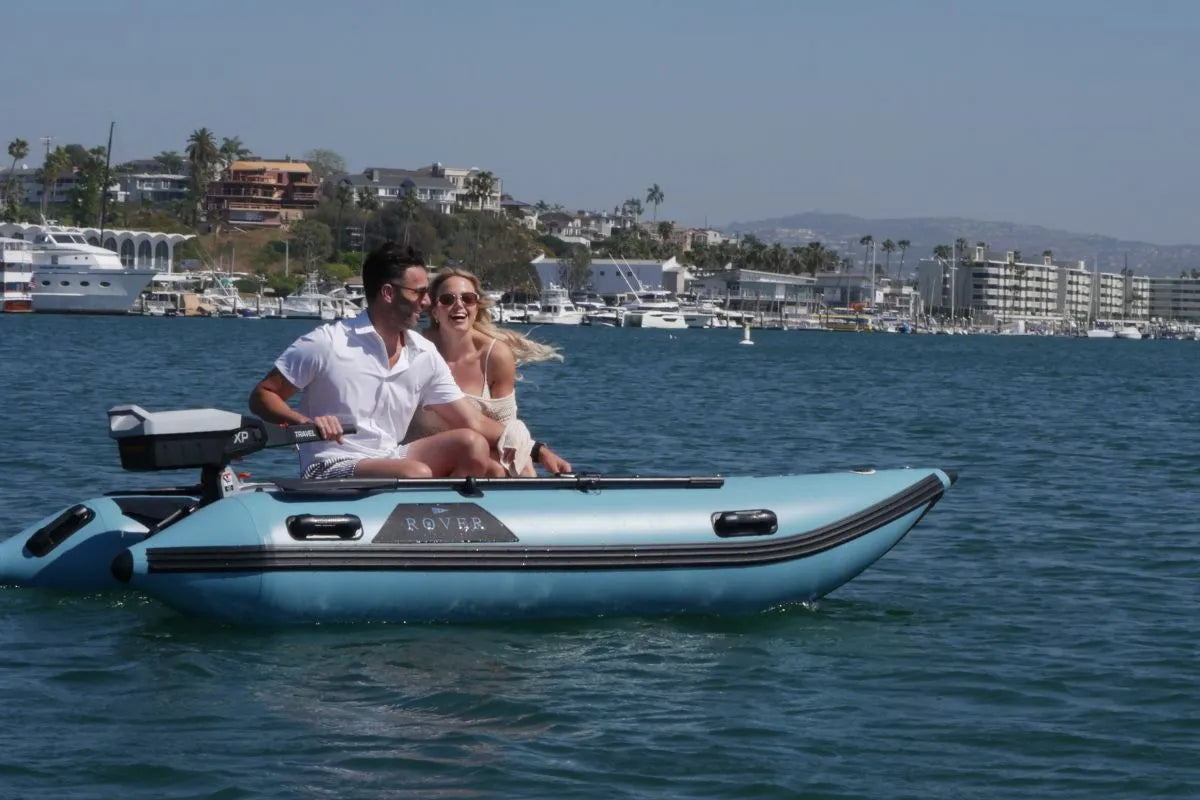
This is the rung where the specs get specific: rated transom, published capacity, high-pressure floor, real chambers, real hardware, and actual use as a small boat, tender, lake boat, or fishing platform.

What makes it a real portable inflatable boat?
On the true portable boat rung, the specs get specific because they have to be. A real portable inflatable boat in this class should give you structural information, power compatibility, capacity, floor pressure, and a way to register the boat where required.
Rated transom
Rover Marine boats use a 15-inch transom across sizes, which matches the short-shaft outboard standard. That is a structural part of the hull, not an accessory bracket.
Drop-stitch floor
The floor inflates to 10 PSI, compared with 3.5 PSI in the tubes. That pressure difference is the reason you can stand and walk on air. Learn more in what drop-stitch flooring actually is.
Independent chambers
Multiple air chambers help the boat keep buoyancy if one chamber is compromised. The chamber layout can vary by size and model, so confirm the current product page and printed spec for your exact boat.
Published capacity
Rover Marine lists 2 people and 600 lb at 8 ft, 4 people and 1000 lb at 10 ft, and 4 people and 1200 lb at 12 ft.
On this rung you are shopping a boat. The Battle Boat and catamaran-hulled Battle Cat are built for real small-boat use, not pool-floating. Check the live product pages for current pricing, included equipment, and operating limits before purchase.
What portable costs you and what it buys you
Every design is a trade. Portable inflatable boats are not trying to be 21-foot center consoles. They are solving a different ownership problem.
What you give up: top speed first. A soft hull with a 6 to 20 hp ceiling will not outrun a hard boat and should not try. Range second, because a small tank or a battery pack sets your radius. A dry ride in heavy chop third. Inflatable tubes ride over waves rather than knifing through them, which can feel comfortable at moderate speed and wet when the fetch builds.
What you get back: a portable inflatable may remove the need for a dedicated trailer, slip, or commercial winter storage, depending on how and where you use it. Registration, safety equipment, motor care, launch access, and suitable storage can still create costs.
That last one is the argument nobody makes loudly enough. A trailered boat generally needs ramp access. A foldable dinghy can reach many water access points you can safely and legally carry it to.
The trunk-fit reality, in inches and pounds
Marketing loves the phrase "fits in your trunk." Here are the actual figures so you can measure your own vehicle before you order.
8 ft
Deflated size38 x 24 x 15 in
Battle Boat dry weight86 lb
Battle Cat dry weight84 lb
Vehicle realityMeasure the vehicle opening. Often workable in larger trunks or cargo areas.
10 ft
Deflated size45 x 28 x 18 in
Battle Boat dry weight100 lb
Battle Cat dry weight98 lb
Vehicle realityMeasure the opening and the usable cargo area before ordering.
12 ft
Deflated size48 x 32 x 20 in
Battle Boat dry weight135 lb
Battle Cat dry weight130 lb
Vehicle realityUsually requires a large cargo area. Measure before purchase.
Measure the opening, not just the volume. A trunk may have enough cubic space on paper and still fail because the opening is too narrow or too short. Boat weights range from 84 to 135 lb before the motor and gear. Use a team lift or suitable cart whenever weight, distance, terrain, or ability makes a solo lift unsafe. Never drag the hull across abrasive ground.
Plan on 10 to 15 minutes of setup with a high-output pump, floor to 10 PSI and tubes to 3.5 PSI. Anyone promising a tiny setup number may not be counting the transom, seats, motor, and launch check. A good pump is the difference between a clean setup and a workout. Our step-by-step is in how to inflate and set up an inflatable boat.
The no-trailer, no-slip argument
The purchase price of a boat is only one part of boat ownership. What drains the account is often the infrastructure around it.
A trailered hard boat generally carries some combination of trailer purchase, trailer registration, tires, bearings, slip or mooring, winter haul-out, shrink wrap or indoor storage, and bottom paint if it sits in the water. Individually, each cost may be manageable. Together they recur every year, for as long as you own the boat.
Portable inflatable boats can remove much of that column. Your storage can be a bag in a garage corner, a boat locker, or a lazarette. Your launch point can be a beach, cabin shoreline, small dock, or hand-carry access point where allowed.
You still owe the real obligations. State registration where required, required safety gear aboard, maintenance on your outboard, and local launch rules. Check your own state's rules, because they differ meaningfully.
Portable class vs trailered hard boat vs kayak or canoe
This comparison is built as responsive cards so it stays readable on desktop and mobile without broken table columns.
Portable inflatable
- Ownership infrastructureMay avoid a dedicated trailer, slip, or commercial storage.
- Launch processInflate and assemble before launch.
- CapacityRover Marine: 2 to 4 people and 600 to 1200 lb by size.
- Water accessMany non-ramp access points, subject to weight, terrain, permission, and safety.
- StorageDeflated package sized by model.
Trailered hard boat
- Ownership infrastructureOften includes trailer, ramp, slip, or storage considerations.
- Launch processHitch, ramp, launch, and retrieve.
- CapacityVaries widely by model.
- Water accessCommonly ramp-dependent.
- StorageDriveway, yard, marina, or paid storage.
Kayak or canoe
- Ownership infrastructureUsually minimal.
- Launch processCarry and launch.
- CapacityUsually lower. Check exact rating.
- Water accessMany carry-in access points.
- StorageRack, wall, garage, or outdoor storage.
Read that by category, not by row. The trailered boat wins speed and capacity. The kayak wins cost and simplicity. The portable inflatable class is the only one that gives you a powered, load-carrying boat without the same infrastructure commitment, and that is the problem it exists to solve.
How to transport an inflatable boat without damaging it
Portability only helps if you do not chew the boat up in the car. Four rules cover almost everything.
- Deflate fully, then fold along the same lines each time. Creasing a new spot every trip works the coating harder than it needs to be worked.
- Get the sand out before you fold. Grit between folded layers is abrasive under vibration, and a highway drive is hours of vibration.
- Do not fold it wet and leave it. Dry the deck and the tube undersides. A bag that sits damp for two weeks smells like a bad decision.
- Carry the motor and hard parts separately. Letting hard components ride loose against folded PVC is how people scuff a new boat.
If you are still deciding between sizes before you worry about transport, compare the Battle Boat and Battle Cat, then measure the vehicle you will actually use.
Frequently asked questions
What are portable inflatable boats, exactly?
Portable inflatable boats are rated boats with a structural transom, a high-pressure floor, and multiple air chambers that deflate and fold for storage and transport. Rover Marine boats pack to between 38 x 24 x 15 in and 48 x 32 x 20 in and weigh 84 to 135 lb dry, depending on size and model.
Will an inflatable boat actually fit in a car trunk?
It depends on the size and the vehicle opening. The 8-foot models pack to 38 x 24 x 15 in at 84 to 86 lb. The 10-foot packs to 45 x 28 x 18 in. The 12-foot packs to 48 x 32 x 20 in and usually needs a large cargo area. Measure the opening, not just the cargo volume.
How long does it take to inflate a portable inflatable boat?
Plan on 10 to 15 minutes with a high-output pump. Rover Marine floors inflate to 10 PSI and tubes inflate to 3.5 PSI. Packing down afterward takes roughly 10 minutes once you have practiced the fold a few times.
Is a blow up boat the same thing as an inflatable dinghy?
No. "Blow up boat" is a casual phrase people use for everything from a pool raft to a rated inflatable dinghy. A true inflatable dinghy has a published capacity, maximum horsepower rating, rated transom, and real boat construction details.
How much motor can a portable inflatable boat take?
It depends on the hull length and the rating for that exact boat. Rover Marine lists the 8 ft at up to 6 hp, the 10 ft at up to 10 hp, and the 12 ft at up to 20 hp. All three use a 15-inch short-shaft transom, so short-shaft gas and electric options may be used when matched to the boat rating.

Leave a comment
This site is protected by hCaptcha and the hCaptcha Privacy Policy and Terms of Service apply.