
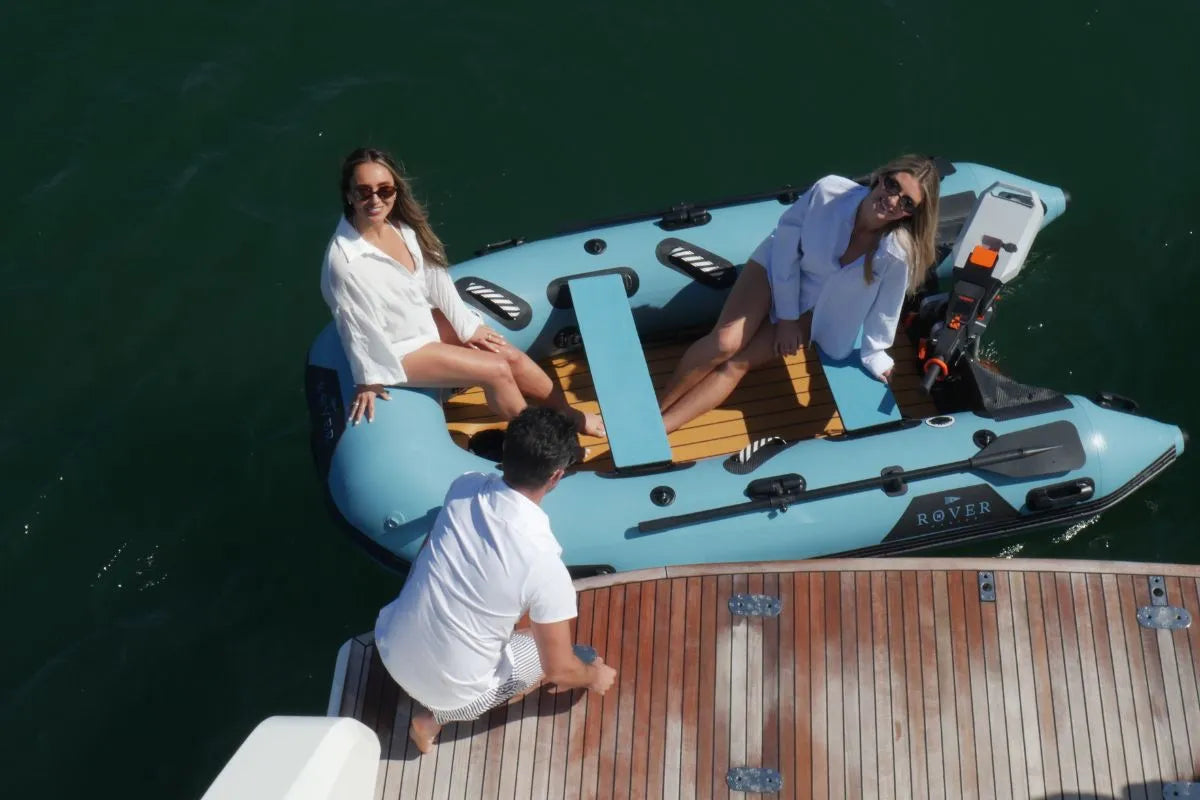
Rover Marine tender guide
Choose the tender around the mothership, not the showroom
Storage dimensions, lifting weight, passenger load, transom fit, and boarding height decide whether a tender becomes useful or frustrating.

Start with six measurements
Stowed space
Measure the locker, deck, platform, or vehicle space and compare it with the exact deflated package dimensions.
Lifting plan
Current hull weights range from 84 to 135 lb before motor, battery or fuel, safety gear, and cargo.
Passenger and load needs
Count people and total weight. Include provisions, bags, pets, motor, battery, and all tender equipment.
Motor and range
Decide between electric and gas power based on distance, charging or fuel access, waterway rules, and mothership storage.
Boarding geometry
Check how passengers step between the tender, swim platform, dock, and beach. Plan handholds and a ladder.
Sea conditions
Match the hull, size, load, and power to the actual harbor, coastal, and anchorage conditions you expect.
Battle Boat and Battle Cat compared

Battle Boat
A fully inflatable tender with a traditional dinghy profile and high-pressure floor. It suits familiar tender handling, harbor hops, beach runs, and compact cruising.
Battle Cat
A fully inflatable dual-pontoon catamaran with a wider stance and open deck utility. It suits boaters who prioritize deck access, tracking, and an alternate layout.
Current size and power guide
| Size | Deflated size | Capacity | Recommended power |
|---|---|---|---|
| 8 ft | 38 × 24 × 15 in | 2 people / 600 lb | Up to 6 hp |
| 10 ft | 45 × 28 × 18 in | 4 people / 1,000 lb | Up to 10 hp |
| 12 ft | 48 × 32 × 20 in | 4 people / 1,200 lb | Up to 20 hp |
Every current Rover Marine boat uses a 15-inch transom. A short-shaft outboard is the normal match, but confirm the specific motor and installation before ordering.
Electric or gas?
Electric
Quiet operation, no fuel smell, simple starting, and less routine engine maintenance. Plan charging, battery weight, realistic range, and reserve.
Gas
Higher power options and quick refueling where fuel is available. Plan ventilation, spill prevention, service, storage, and the mothership's fuel policies.
Before the first tender run
- Confirm state registration, titling, and operator education requirements.
- Carry properly sized wearable life jackets and all required equipment for the operating area.
- Secure the motor, attach the kill-switch lanyard, and use a suitable motor safety line.
- Protect the yacht with clean fenders and correctly sized painter lines.
- Set a conservative passenger limit for the route and conditions, even when below the printed maximum.
- Practice boarding, beaching, towing, lifting, and storage before relying on the tender away from home.
Tender questions
What size tender should I buy?
Choose the smallest size that safely carries the real crew and load while fitting the measured storage and lifting plan. For many buyers, 10 ft is the versatile middle option.
Can I use it as a yacht tender?
Yes, when the size, load, motor, boarding plan, equipment, and operating conditions are suitable. Rover Marine boats are fully inflatable, not fiberglass RIBs.
What warranty applies?
The live Rover Marine warranty lists 5 years for qualifying hull manufacturing defects, 3 years for tubes and seams, and 2 years for covered attached accessory components. Motors and third-party equipment may follow the manufacturer's warranty.

Leave a comment
This site is protected by hCaptcha and the hCaptcha Privacy Policy and Terms of Service apply.