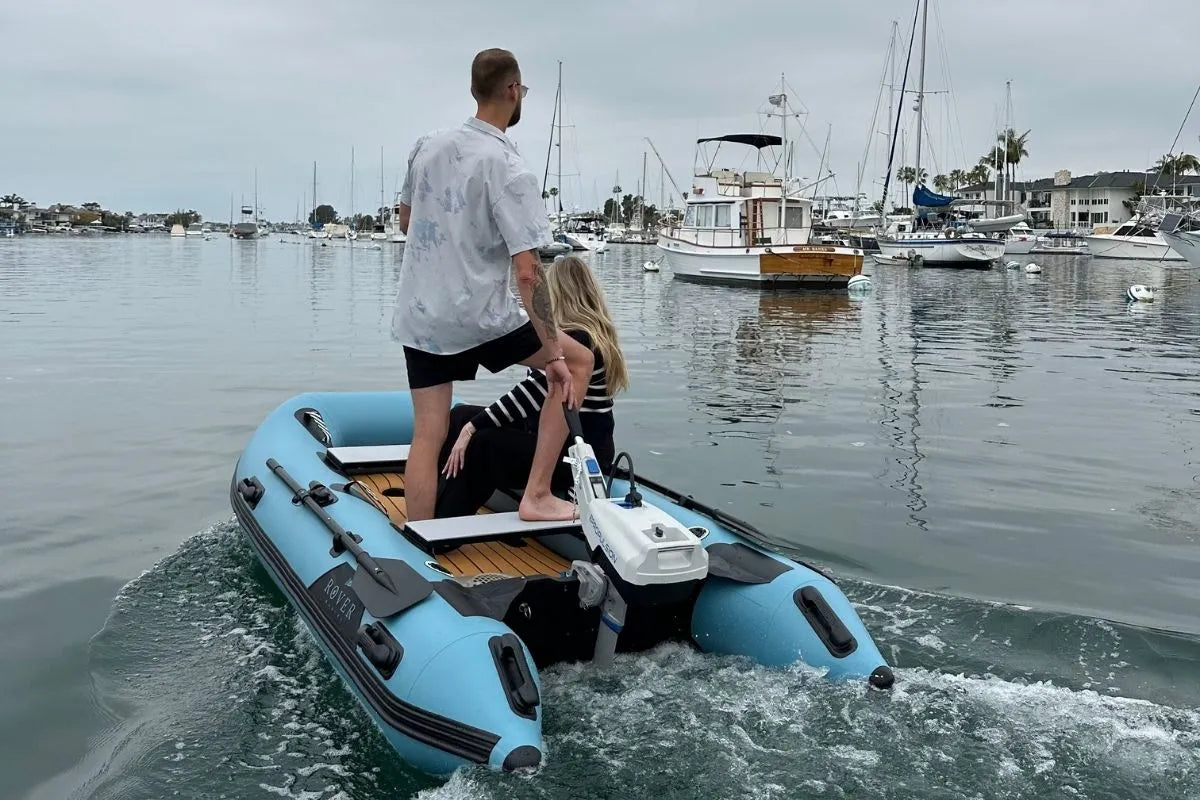
The best inflatable boat is the one that fits how you actually spend time on the water. A solo fishing setup has different requirements from a family cruiser, yacht tender, dive platform, or boat carrying several people and a full load of equipment.
Rover Marine offers two fully inflatable hull layouts. The Battle Boat provides a traditional dinghy profile, while the Battle Cat uses two parallel inflatable pontoons to create a catamaran-style platform.
Both models are available in 8-foot, 10-foot, and 12-foot sizes. This guide compares their layouts, capacities, motor limits, storage needs, and common uses so you can choose around your real boating plans.

Battle Boat vs. Battle Cat
Neither model is automatically better for every owner. The Battle Boat provides a familiar inflatable dinghy layout. The Battle Cat provides a wider dual-pontoon platform.

Battle Boat
The Battle Boat uses a traditional inflatable dinghy profile with a high-pressure drop-stitch floor. It can work well for yacht tender trips, fishing, diving, family cruising, and recreational use.
- Traditional inflatable dinghy layout.
- Available in 8-foot, 10-foot, and 12-foot sizes.
- High-pressure drop-stitch floor.
- 3.5 PSI tubes and 10 PSI floor.
- 15-inch transom on every current size.
- Gas and electric outboard compatibility.

Battle Cat
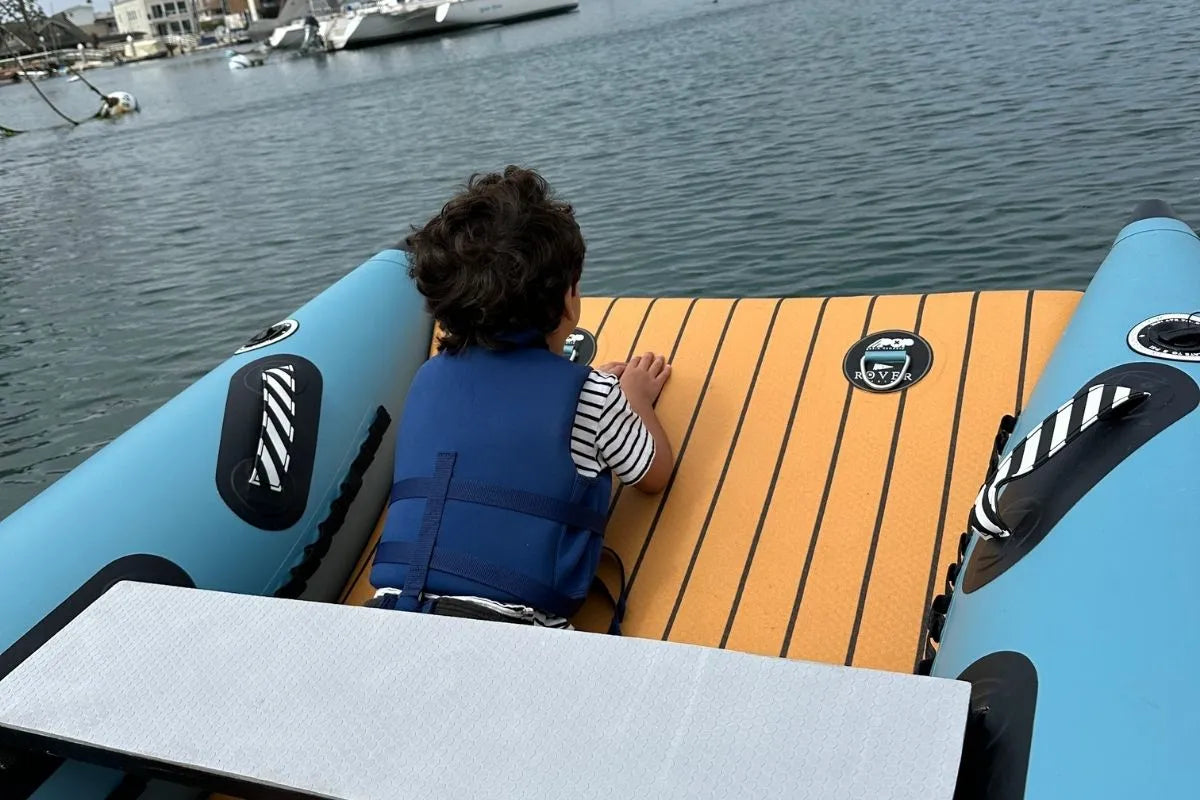
The Battle Cat uses two parallel inflatable pontoons to create a wider catamaran-style stance. It may appeal to owners who prioritize deck width, initial stability, fishing room, or space for dive gear.
- Dual-pontoon inflatable catamaran layout.
- Available in 8-foot, 10-foot, and 12-foot sizes.
- High-pressure drop-stitch floor.
- 3.5 PSI tubes and 10 PSI floor.
- 15-inch transom on every current size.
- Gas and electric outboard compatibility.
| Decision Factor | Battle Boat | Battle Cat |
|---|---|---|
| Hull layout | Traditional inflatable dinghy profile | Dual-pontoon catamaran-style profile |
| Common priorities | Tender use, general cruising, fishing, and diving | Deck width, initial stability, fishing, and equipment space |
| Available sizes | 8, 10, and 12 feet | 8, 10, and 12 feet |
| Maximum capacity | Up to 4 people and 1,200 lb, depending on size | Up to 4 people and 1,200 lb, depending on size |
| Maximum motor | Up to 20 HP on the 12-foot model | Up to 20 HP on the 12-foot model |
| Storage | Fully inflatable and packable | Fully inflatable and packable |
Choose the Right Length
The three available lengths provide different balances of portability, capacity, boat weight, deck room, and maximum motor power.
| Size | Capacity | Maximum Motor | Common Fit |
|---|---|---|---|
| 8 Foot | 2 people / 600 lb | Up to 6 HP | One or two people, compact tender trips, solo fishing, and owners prioritizing smaller packed dimensions. |
| 10 Foot | 4 people / 1,000 lb | Up to 10 HP | Family cruising, yacht tender use, fishing, diving, and general recreational boating. |
| 12 Foot | 4 people / 1,200 lb | Up to 20 HP | Owners needing more deck room, additional load capacity, or compatibility with a higher-power motor. |
Boat Weight by Model
| Model | 8 Foot | 10 Foot | 12 Foot |
|---|---|---|---|
| Battle Boat | 86 lb | 100 lb | 135 lb |
| Battle Cat | 84 lb | 98 lb | 130 lb |
Capacity Includes the Complete Load
Passengers, motor, battery, fuel, seats, anchor, safety equipment, cooler, fishing tackle, dive gear, and personal items all count toward the published load limit.
Should You Automatically Buy the Largest Boat?
Not necessarily. The 12-foot models provide more room and capacity, but they are heavier and require more transportation and storage space.
An 8-foot boat may be the better fit for one or two people who prioritize portability. A 10-foot boat may provide the best balance for owners who need four-person capacity without moving to the largest package.
Choosing an Inflatable Boat for Fishing
Fishing puts specific demands on a small boat. Consider deck room, load distribution, anchor placement, tackle storage, battery weight, motor control, and how sharp equipment will be handled.
Battle Boat for Fishing
The traditional dinghy layout may fit anglers who want a familiar interior shape for seats, tackle, a cooler, and general equipment.
Battle Cat for Fishing
The wider dual-pontoon stance may appeal to anglers who prioritize initial stability and room to organize equipment.
Fishing Setup Questions
- How many anglers will normally be aboard?
- How much tackle and electronic equipment will be carried?
- Will an anchor, cooler, or portable fish finder be used?
- Can hooks, knives, and tools be stored securely?
- Will the boat be carried, trailered, or kept inflated?
- What wind, current, and travel distance are expected?
Inflatable Fabric Is Not Puncture-Proof
Keep hooks covered, knives secured, anchors controlled, and sharp tools away from the tubes and floor. Avoid dragging the boat over rocks, shells, pavement, and rough docks.
Choosing an Inflatable Boat for Diving
Diving adds substantial equipment weight. Tanks, weights, fins, safety gear, passengers, motor, battery or fuel, anchor, and personal equipment must remain within the published capacity.
Deck and Equipment Space
The 10-foot and 12-foot models provide more room than the 8-foot boats. That additional space may help when arranging tanks, fins, weights, and boarding equipment.
Boarding and Load Balance
Divers should plan how they will enter and reboard without shifting excessive weight to one side or overloading the stern.
Dive Boat Checklist
- Add the actual weight of every diver and all equipment.
- Keep tanks and weights from rubbing against inflatable surfaces.
- Secure equipment so it cannot roll or shift.
- Plan a practical entry and reboarding method.
- Maintain fuel or battery reserve for the return trip.
- Carry communication and emergency equipment appropriate to the area.
The Battle Cat may appeal to divers who prioritize deck width. The Battle Boat may appeal to owners who prefer a traditional tender layout.

Choosing an Inflatable Boat for Family Outings
Family use involves more than fitting the published number of passengers. Consider the ages and weights of everyone aboard, movement inside the boat, boarding, shade, coolers, life jackets, and distance from a safe landing point.
Which Size Works for a Family?
The 8-foot models are rated for two people. The 10-foot and 12-foot models are rated for four people.
The 12-foot models do not add passenger capacity over the 10-foot models. They provide more total load capacity and additional deck room.
- Use a properly fitting life jacket for every person.
- Keep passengers positioned appropriately.
- Balance coolers, batteries, fuel, and equipment.
- Review weather and wind before departure.
- Carry communication and emergency equipment.
- Keep the route appropriate for the operator and crew.
What About Watersports?
Do not assume a boat is approved for tubing, waterskiing, or wakeboarding because it accepts a certain motor size.
Towing a person requires a suitable boat, approved tow point, motor, hardware, steering system, operator, and operating environment. Confirm the intended towing use directly with Rover Marine before adding tow equipment or pulling a rider.
Adding an Electric Outboard
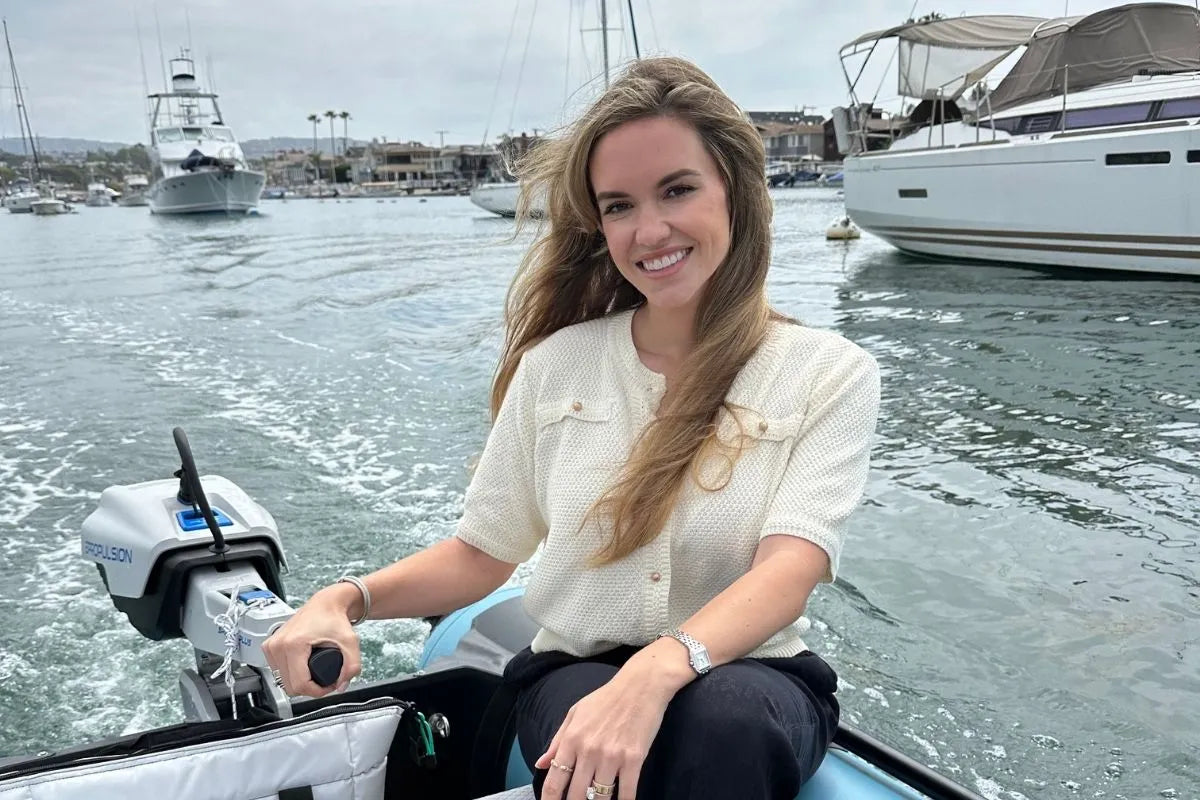
Electric outboards can fit tender trips, fishing, marina cruising, protected water, and family outings where quiet operation and avoiding onboard gasoline are priorities.
Electric Advantages
- Quieter than small gas outboards.
- No direct combustion exhaust at the motor.
- No onboard gasoline required.
- Simple starting and low-speed control.
- Fewer gas-engine maintenance tasks.
Electric Considerations
- Range depends on battery capacity and throttle.
- Charging access must be planned.
- Motor and battery weight count toward capacity.
- Wind, waves, current, and load affect range.
- Battery care must follow manufacturer instructions.
Current Rover Marine Electric Options
Rover Marine currently offers short-shaft electric options through its electric outboard motor collection .
The collection includes ePropulsion Spirit 1.0 Plus and Torqeedo Travel 1103 S packages. Compare the motor, battery platform, controls, package weight, and expected route before choosing.
All Current Rover Marine Boats Use 15-Inch Transoms
A compatible short-shaft motor is the normal fit for the current Battle Boat and Battle Cat models. Confirm the exact shaft length and package before ordering.
How Far Will an Electric Motor Travel?
There is no universal range. Runtime and distance depend on battery capacity, throttle, boat size, passenger and equipment weight, wind, current, waves, temperature, propeller condition, inflation pressure, and battery health.
Plan a return reserve rather than assuming the full battery capacity will remain available in every condition.
Construction and Care Features That Matter
Rover Marine boats use reinforced inflatable construction, high-pressure drop-stitch floors, multiple air chambers, traction flooring, reinforced transoms, and removable outboard systems.
Reinforced Inflatable Material
The inflatable construction balances marine durability with the ability to deflate and pack the boat for storage.
Reinforced Seams
Seams are a critical part of every inflatable structure and should be inspected regularly for pressure loss, movement, or visible damage.
10 PSI Drop-Stitch Floor
Internal threads help the floor maintain a firm, flat shape while allowing it to be deflated for transportation and storage.
3.5 PSI Tubes
Correct tube pressure helps maintain hull shape, support the transom, and provide the intended handling characteristics.

Basic Boat Care
- Rinse the boat after saltwater use.
- Use mild, material-compatible cleaning products.
- Dry the boat before extended packed storage.
- Avoid dragging it over rough or sharp surfaces.
- Keep hooks, knives, tools, and anchors secured.
- Check pressure before each trip.
- Inspect valves, seams, floor, and transom regularly.
- Follow the motor manufacturer's care instructions.
Inflatable Boat Buying Checklist
- Decide whether you prefer the traditional Battle Boat layout or the dual-pontoon Battle Cat layout.
- Add the actual estimated weight of passengers, motor, battery or fuel, accessories, safety equipment, and gear.
- Confirm the passenger count and total load remain within the published capacity.
- Measure the vehicle, yacht locker, garage, or other storage area.
- Confirm the boat can be lifted and moved safely at its published weight.
- Choose a motor within the 6, 10, or 20 HP maximum for the selected length.
- Use a compatible short-shaft motor for the 15-inch transom.
- Consider the expected distance, weather, current, waves, and return reserve.
- Plan where the boat will be rinsed, dried, inspected, and stored.
- Review the warranty, registration rules, and required safety equipment.
Do Not Choose From Lifestyle Photos Alone
A photo cannot show whether a boat fits your passenger weight, equipment, motor, storage opening, lifting system, water conditions, or required range.
Use the published specifications and contact Rover Marine when the complete setup remains uncertain.
Frequently Asked Questions
Which Rover Marine boat is best for fishing?
The Battle Boat may fit anglers who prefer a traditional dinghy layout. The Battle Cat may fit anglers who prioritize a wider dual-pontoon stance. The better choice depends on the number of anglers, equipment, storage, motor, and water conditions.
Which model is better for diving?
Both models can support diving when divers, tanks, weights, motor, battery or fuel, safety gear, and other equipment remain within the published capacity. The Battle Cat may appeal to divers who prioritize deck width.
Which size is best for a family?
The 8-foot models are rated for two people. The 10-foot and 12-foot models are rated for four people. Choose between the 10-foot and 12-foot sizes based on total load, storage, boat weight, motor, and desired deck room.
Can the Battle Cat carry more people than the Battle Boat?
No. Battle Boat and Battle Cat models share the same published passenger and load capacities by length.
What motor can the 8-foot models use?
The 8-foot Battle Boat and Battle Cat support motors up to 6 HP. Each is rated for two people or 600 pounds.
What motor can the 10-foot models use?
The 10-foot Battle Boat and Battle Cat support motors up to 10 HP. Each is rated for four people or 1,000 pounds.
What motor can the 12-foot models use?
The 12-foot Battle Boat and Battle Cat support motors up to 20 HP. Each is rated for four people or 1,200 pounds.
Can I use an electric outboard?
Yes. Rover Marine currently offers short-shaft electric options. Confirm shaft length, motor package, total weight, and expected range before ordering.
How long will an electric outboard run?
Runtime depends on battery capacity, average power draw, throttle, boat size, total load, wind, current, waves, temperature, propeller condition, and battery health.
Can Rover Marine boats be used in rough water?
Suitability depends on the boat, operator, motor, load, pressure, wind, waves, current, route, and distance from shelter. No small boat should be chosen for rough conditions based on material or hull layout alone.
Can these boats tow a tube or wakeboard?
Do not assume towing is approved from horsepower alone. Confirm the boat, motor, tow point, hardware, steering system, operator, and intended activity directly with Rover Marine before towing a person.
Where can I read current owner feedback?
Visit the Rover Marine reviews page and compare owner experiences with your intended boat size, motor, storage plan, and operating conditions.
Choose the Boat Around the Adventures You Actually Take
Start with passenger and equipment load, storage, transportation, route, and water conditions. Then choose the size, hull layout, and motor that fit those needs without exceeding the published limits.
Built for Water. Designed for Freedom.

Leave a comment
This site is protected by hCaptcha and the hCaptcha Privacy Policy and Terms of Service apply.