
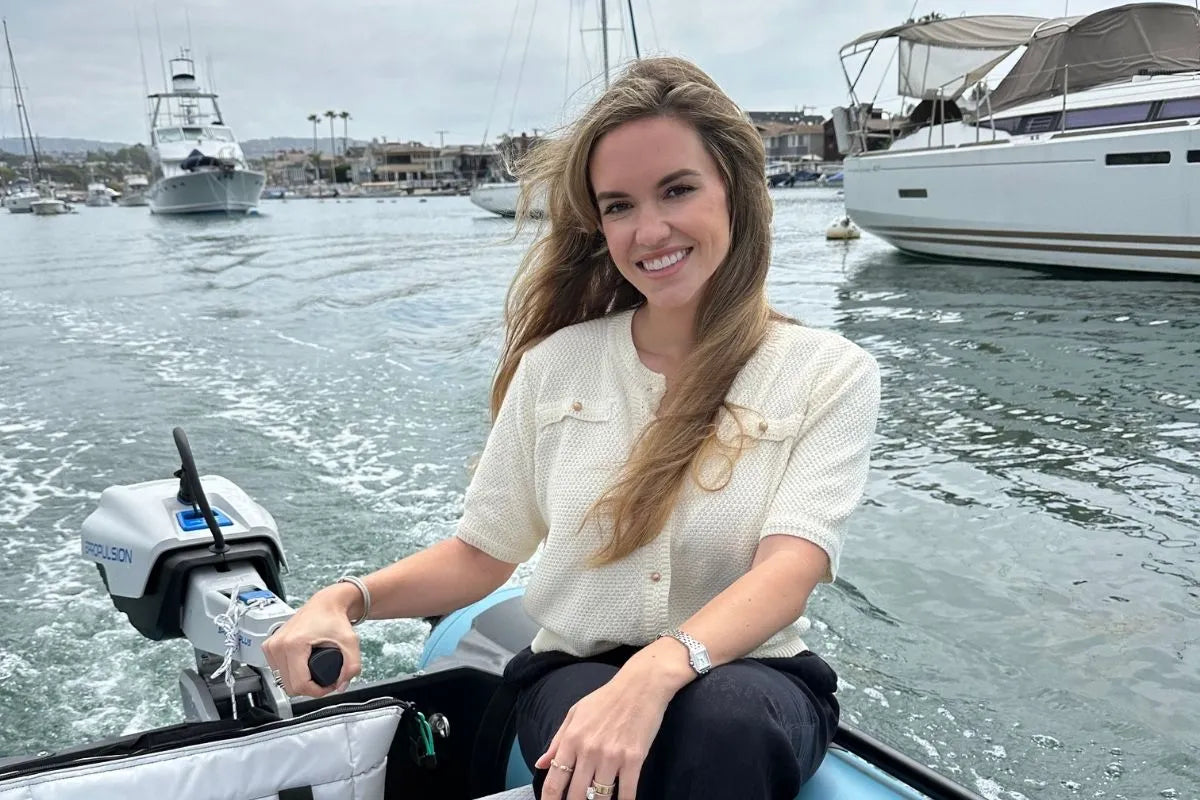
Choosing an engine for an inflatable dinghy starts with the boat, not the motor. The correct setup must stay within the published horsepower and load limits, fit the transom, support the trips you actually take, and remain manageable during transportation, mounting, and storage.
Rover Marine Battle Boat and Battle Cat models are available in 8-foot, 10-foot, and 12-foot sizes. Every current model uses a 15-inch transom, while the maximum motor rating increases from 6 HP to 20 HP depending on boat length.
This guide explains how to compare electric and gas outboards, account for motor weight, match the shaft length, and plan realistic range without relying on generic speed or runtime promises.

Start With the Dinghy Specifications
Before comparing motor brands, confirm the exact boat model and size. Those specifications establish the upper power limit and help determine whether the complete motor package fits your load and transportation plan.
- Exact Battle Boat or Battle Cat size.
- Maximum motor rating.
- Published passenger and load capacity.
- 15-inch transom compatibility.
- Boat weight before adding the motor.
- Passenger and equipment weight.
- Expected distance and conditions.
- Charging or refueling access.
Maximum Horsepower Is a Ceiling, Not a Requirement
A boat rated for a 20 HP motor does not require a 20 HP motor. A lower power option may be a better fit for tender trips, fishing, harbor cruising, protected water, or owners prioritizing portability.
Current Rover Marine Motor Limits
Battle Boat and Battle Cat models share the same published passenger capacity, load capacity, maximum motor rating, transom height, and inflation pressure by length.
| Boat Size | Capacity | Maximum Motor | Transom | Pressure |
|---|---|---|---|---|
| 8 Foot | 2 people / 600 lb | Up to 6 HP | 15 inches | 3.5 PSI tubes / 10 PSI floor |
| 10 Foot | 4 people / 1,000 lb | Up to 10 HP | 15 inches | 3.5 PSI tubes / 10 PSI floor |
| 12 Foot | 4 people / 1,200 lb | Up to 20 HP | 15 inches | 3.5 PSI tubes / 10 PSI floor |
Do Not Use a Generic Horsepower Range as the Boat Rating
A chart suggesting a range such as 8 to 20 HP for every 12-foot inflatable does not replace the specification for the exact boat. Hull design, transom construction, boat weight, beam, capacity, and intended use vary between manufacturers.
For Rover Marine boats, use the maximum ratings in the table above. Then select the actual motor based on the load, route, desired speed, portability, and operating environment.
Never Exceed the Published Motor Limit
Installing a motor above the published rating can affect handling, transom loading, insurance, warranty eligibility, and compliance with local requirements.
Electric vs. Gas Outboards
Electric and gas motors can both work on Rover Marine boats when the motor remains within the published limits and uses the correct shaft configuration.
Electric Outboards
- Quieter than comparable small gas outboards.
- No direct combustion exhaust at the motor.
- No onboard gasoline required.
- Simple starting and low-speed control.
- Fewer gas-engine maintenance tasks.
- Range depends on battery capacity and throttle.
- Charging access must be planned.
Gas Outboards
- Fast refueling where approved fuel is available.
- More choices across the full horsepower limits.
- Can support higher-output setups.
- Requires gasoline storage and handling.
- Produces combustion exhaust and more noise.
- Requires engine and fuel-system maintenance.
- Range still depends on load and fuel reserve.
Electric May Be the Better Fit When
- Trips are short or predictable.
- Quiet operation is a priority.
- You can recharge between outings.
- You want to avoid carrying gasoline.
- Tender use, fishing, or harbor cruising is the main goal.
Gas May Be the Better Fit When
- Longer practical range is required.
- Fast refueling matters.
- Charging access is limited.
- You need more power than the portable electric options provide.
- The motor remains within the boat's rating and load limit.
Current Electric Options From Rover Marine
Rover Marine currently offers short-shaft electric options through its electric outboard motor collection .
ePropulsion Spirit 1.0 Plus
The Spirit 1.0 Plus is a portable 1 kW electric platform with a removable battery system. It can fit tender trips, marina travel, fishing, and quiet recreational cruising.
Confirm the exact package, battery arrangement, shaft length, total weight, and expected route before ordering.
Torqeedo Travel 1103 S
The Travel 1103 S is a portable short-shaft electric platform with an integrated removable battery and tiller display.
Compare the available package, battery capacity, controls, weight, charging needs, and expected range against your normal trips.
Use the Motor Collection as the Current Source
Motor packages and availability can change. Review the live collection for the current configurations instead of relying on an older individual product link.
How Motor Weight Affects the Boat
The motor, battery, fuel tank, and fuel all count toward the boat's published load capacity. Motor weight also affects portability and where the boat sits in the water.
Lifting and Mounting
Confirm that the operator can safely lift, position, and remove the motor. Heavier motors may require a second person or lifting aid.
Stern Trim
A heavier motor places more weight at the stern. Battery, fuel, passengers, and equipment should be arranged to maintain a balanced load.
Transportation
Plan where the motor, battery, fuel, charger, and accessories will be carried. The boat package is only one part of the transport load.
Boat Weight Before the Motor
| Model | 8 Foot | 10 Foot | 12 Foot |
|---|---|---|---|
| Battle Boat | 86 lb | 100 lb | 135 lb |
| Battle Cat | 84 lb | 98 lb | 130 lb |
Add the motor, battery or fuel, passengers, seats, anchor, safety equipment, fishing gear, dive gear, and personal items before comparing the completed setup with the published capacity.

Match the Motor to the 15-Inch Transom
Every current Rover Marine Battle Boat and Battle Cat size uses a 15-inch transom. A compatible short-shaft motor is the normal fit.
Boat Length Does Not Determine Shaft Length
The 12-foot boats still use 15-inch transoms. Do not order a long-shaft motor simply because the boat is longer.
What Happens When the Shaft Is Too Short?
A motor mounted too high may allow the propeller to ventilate, lose grip, or deliver inconsistent thrust. Cooling-water pickup may also be affected on motors that rely on water circulation.
What Happens When the Shaft Is Too Long?
A motor mounted too deep can increase drag and place the lower unit below its intended operating position. It may also affect handling, shallow water clearance, and the motor's relationship to the hull.
Do Not Treat a Long Shaft as a Temporary Universal Fix
Raising the motor with an unapproved bracket or modifying the transom can change leverage, mounting loads, trim, and steering behavior. Choose the correct shaft configuration and follow the motor manufacturer's installation instructions.
Do You Need to Measure the Rover Marine Transom?
Rover Marine publishes a 15-inch transom specification for the current Battle Boat and Battle Cat lineup. Use that specification and confirm the motor manufacturer's shaft designation before ordering.
Measurement may still be useful when evaluating a different boat, a modified transom, or an older model with uncertain documentation.
Plan Range Around the Complete Trip
Neither electric runtime nor gas range should be promised from boat length alone. Range changes with the motor, battery or fuel supply, throttle, load, wind, current, waves, propeller, temperature, and route.
Electric Range Factors
- Usable battery capacity
- Average power draw
- Throttle setting
- Boat and passenger load
- Wind, waves, and current
- Battery condition and temperature
Gas Range Factors
- Fuel tank capacity
- Engine consumption
- Throttle and speed
- Boat and passenger load
- Wind, waves, and current
- Required return reserve
High Throttle Uses Energy Faster
Electric motors generally consume battery energy much faster at high throttle than at lower cruising settings. Gas engines also use more fuel as power demand increases.
Plan the route with a return reserve instead of assuming the full battery or fuel supply will remain available under every condition.
Installation and First Water Test
Follow the boat and motor manuals. Do not replace the manufacturer's mounting procedure with a generic clamp position, torque value, or trim recommendation.
- Confirm the motor remains within the published horsepower limit.
- Confirm the exact motor uses the correct short-shaft configuration.
- Add the complete motor, battery or fuel, passenger, and equipment load.
- Center the motor on the transom according to the motor instructions.
- Secure the clamps or mounting hardware as specified.
- Attach and test the engine cutoff device where applicable.
- Route cables and fuel lines away from sharp edges and passenger traffic.
- Confirm the propeller area is clear before starting.
- Test steering, throttle, reverse, tilt, and trim before departure.
- Complete the first water test in protected conditions with a balanced load.
Do Not Reinforce or Modify the Transom Without Approval
The current Rover Marine boats already use a transom designed for the published motor limit. Unapproved plates, brackets, spacers, or reinforcement can change motor height and the loads placed on the boat.
Load Placement Matters
Keep heavy equipment secure and distribute the load so the bow and stern remain appropriately balanced. Avoid placing every heavy item beside the motor.

Motor Care After Use
Electric Motor Care
- Inspect the propeller for line and debris.
- Rinse appropriate components after saltwater use.
- Inspect electrical connectors and mounting hardware.
- Charge with the approved charger.
- Follow the battery storage instructions.
- Keep the motor dry during storage as directed.
Gas Motor Care
- Follow the approved saltwater flushing procedure.
- Inspect the propeller and lower unit.
- Check fuel lines, tank, clamps, and connections.
- Complete oil service where applicable.
- Follow seasonal fuel and storage procedures.
- Use the manufacturer's maintenance schedule.
Fuel and Battery Storage
Fuel must be stored in approved containers and handled according to the motor manufacturer's instructions and local rules. Do not apply one fuel stabilizer or storage routine to every engine.
Electric batteries must be charged, transported, and stored using the approved equipment and the exact manufacturer's temperature and state-of-charge guidance.
Registration and Operating Rules
Registration, operator requirements, safety equipment, speed limits, and motor restrictions vary by state, waterway, park, marina, and type of use.
- Check motorized-vessel registration requirements.
- Confirm operator age and education rules.
- Review life jacket requirements.
- Confirm navigation-light requirements.
- Check engine cutoff switch requirements.
- Review sound and signaling-device rules.
- Check local electric-only or motor restrictions.
- Confirm insurance requirements where applicable.
Confirm the current rules with the authority responsible for the water where the boat will be operated.
Frequently Asked Questions
What is the maximum motor for an 8-foot Rover Marine boat?
The 8-foot Battle Boat and Battle Cat support motors up to 6 HP. Each uses a 15-inch transom and is rated for two people or 600 pounds.
What is the maximum motor for a 10-foot Rover Marine boat?
The 10-foot Battle Boat and Battle Cat support motors up to 10 HP. Each uses a 15-inch transom and is rated for four people or 1,000 pounds.
What is the maximum motor for a 12-foot Rover Marine boat?
The 12-foot Battle Boat and Battle Cat support motors up to 20 HP. Each uses a 15-inch transom and is rated for four people or 1,200 pounds.
Do I need the maximum horsepower?
No. The maximum rating is the upper limit. A smaller motor may be better for tender trips, fishing, quiet cruising, portability, or electric propulsion.
Do Rover Marine boats require short-shaft motors?
Current Battle Boat and Battle Cat models use 15-inch transoms. A compatible short-shaft motor is the normal fit.
Can I use a long-shaft motor temporarily?
A long-shaft motor is not the normal match for the current 15-inch transom. Do not use unapproved brackets or modifications as a temporary solution. Choose the correct shaft configuration.
Is electric or gas better for a dinghy?
Electric may be better for quiet, predictable trips with charging access. Gas may be better for faster refueling, longer practical range, or higher power. The correct choice depends on your route, load, storage, and operating conditions.
How long will an electric outboard run?
Runtime depends on usable battery capacity, throttle, boat size, load, wind, current, waves, temperature, propeller condition, and battery health.
Does the battery count toward boat capacity?
Yes. The motor, battery, passengers, seats, anchor, safety equipment, cooler, fishing gear, dive gear, and personal items all count toward the published load limit.
Can I use a trolling motor?
A trolling motor may work for low-speed positioning or calm, short-distance use. Confirm its mounting arrangement, control, battery system, and ability to handle the expected wind, current, load, and return distance.
Where can I compare current electric motors?
Review the Rover Marine electric outboard motor collection for current options and configurations.
What should I do if the motor loses power?
Reduce risk, put on life jackets, assess wind and current, check the propeller for line or debris, confirm battery or fuel status, and follow the manufacturer's troubleshooting procedure. Use communication and emergency equipment when needed.
Choose the Motor Around Your Real Trips
Start with the exact boat size, total load, route, expected conditions, storage, and access to fuel or charging. Then select a compatible short-shaft motor that remains within the published limit.
Built for Water. Designed for Freedom.

Leave a comment
This site is protected by hCaptcha and the hCaptcha Privacy Policy and Terms of Service apply.