Inflatable and rigid boats solve different ownership problems. A fully inflatable boat prioritizes portability, compact storage, removable propulsion, and easier movement between locations. A rigid boat keeps its permanent hull shape and may provide a different ride, storage layout, towing setup, and level of onboard equipment.
Neither category is automatically better, safer, faster, or more durable in every situation. The right choice depends on where you boat, how far you travel, what you carry, where the boat is stored, and how much setup and maintenance you are prepared to manage.
This guide compares the two categories and explains where Rover Marine's Battle Boat and Battle Cat fit within the fully inflatable side of the market.

What Is the Main Difference Between Inflatable and Rigid Boats?
A fully inflatable boat uses pressurized tubes and an inflatable floor or deck as its primary structure. When deflated, the hull can be folded into a smaller package.
A rigid boat uses a permanent fiberglass, aluminum, wood, or composite hull. Its structure and dimensions remain substantially unchanged during storage.
Fully Inflatable Boat
- Pressurized tubes provide buoyancy and hull structure.
- Can be deflated for transportation and storage.
- Usually uses a removable outboard.
- Requires regular pressure checks.
- Fabric must be protected from puncture and abrasion.
- Can be stored in a smaller space than a rigid hull.
Rigid Boat
- Permanent hull retains its full shape.
- Often transported on a trailer or stored at a marina.
- Can support built-in storage and permanent systems.
- Does not require inflation before use.
- Hull care depends on fiberglass, aluminum, or other material.
- Requires room for the complete boat during storage.
What About Rigid Inflatable Boats?
A rigid inflatable boat, commonly called a RIB, combines inflatable tubes with a permanent fiberglass or aluminum lower hull. It is a separate category from a fully inflatable boat.
The Rover Marine Battle Boat and Battle Cat are fully inflatable. They do not have permanent fiberglass or aluminum lower hulls.
Fully Inflatable Does Not Mean Soft Underfoot
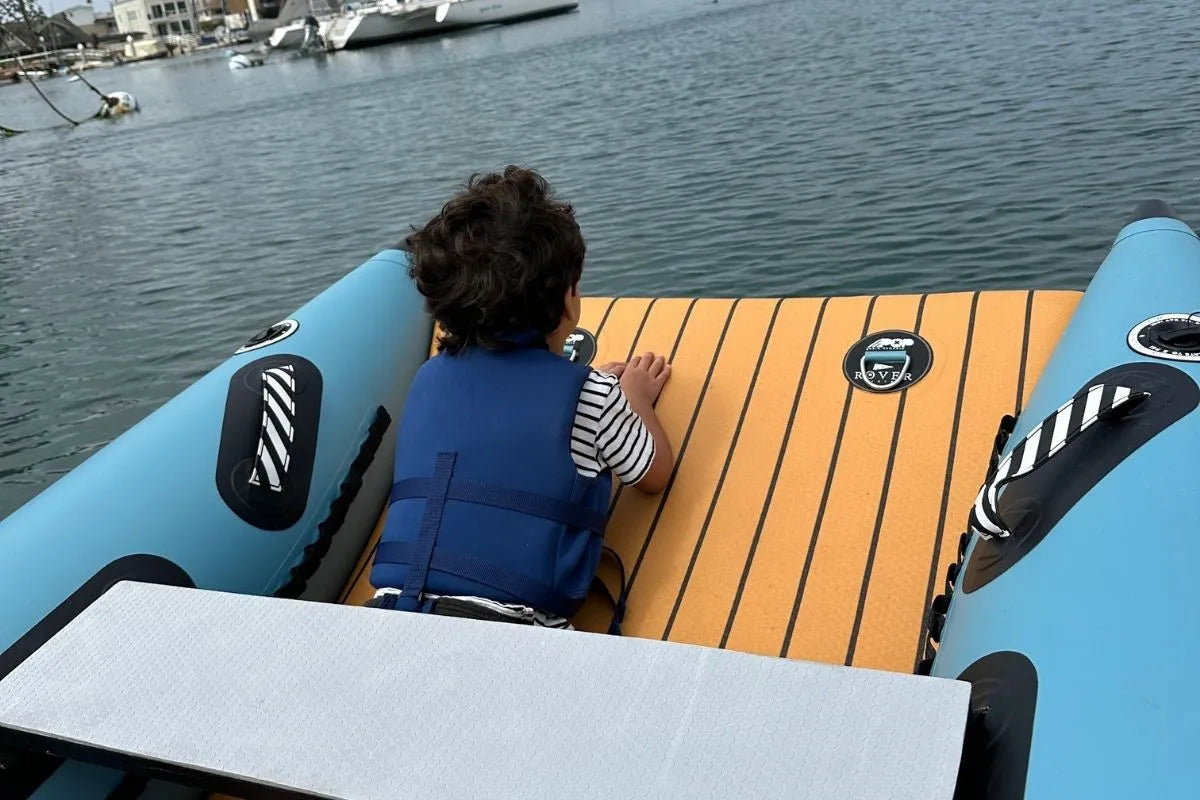
Rover Marine boats use high-pressure drop-stitch floors inflated to 10 PSI. Thousands of internal threads help the floor maintain a firm, flat shape while still allowing it to be deflated for storage.
Portability, Transportation, and Storage
Portability is one of the clearest differences between the two categories. A rigid boat keeps its full footprint. A fully inflatable boat can be deflated and packed into a smaller package.
| Ownership Factor | Fully Inflatable Boat | Rigid Boat |
|---|---|---|
| Storage footprint | Can be reduced by deflating and folding the boat. | Requires space for the complete hull. |
| Transportation | May travel in a suitable vehicle, cargo area, yacht locker, or trailer depending on size and weight. | Commonly transported on a properly rated trailer or kept at a marina. |
| Launch preparation | Requires inflation, assembly, pressure checks, and motor setup. | Does not require hull inflation but still requires launch and equipment checks. |
| Off-season storage | Can be cleaned, dried, deflated, and stored in a protected area. | Requires trailer, rack, yard, garage, marina, or dry-storage room. |
| Moving between waterways | Can be practical when the boat and equipment fit the transport plan. | Trailer logistics and launch-ramp access may be more important. |
Do Not Assume Every Inflatable Fits in Every Car
Packed size, boat weight, motor, battery, fuel, pump, seats, oars, anchor, and safety equipment all require space.
Measure the cargo opening and available storage area before buying. Do not transport a packed inflatable on a roof rack unless the rack, securing method, vehicle, and load are approved for that use.
Current Rover Marine Packed Dimensions
| Boat Size | Published Packed Dimensions | Battle Boat Weight | Battle Cat Weight |
|---|---|---|---|
| 8 Foot | 38 x 24 x 15 inches | 86 lb | 84 lb |
| 10 Foot | 45 x 28 x 18 inches | 100 lb | 98 lb |
| 12 Foot | 48 x 32 x 20 inches | 135 lb | 130 lb |

How Do Handling and Ride Characteristics Compare?
Handling depends on more than whether a hull is inflatable or rigid. Boat length, beam, hull shape, tube diameter, floor stiffness, motor, propeller, weight distribution, passenger movement, inflation pressure, wind, waves, and operator input all affect performance.
Inflatable Characteristics
- Wide tubes can provide strong initial stability.
- Inflatable sides provide buoyancy around the perimeter.
- Light weight may make the boat responsive to wind and load shifts.
- Correct inflation is essential for proper hull shape.
- Ride quality depends heavily on hull design and conditions.
Rigid-Hull Characteristics
- Permanent hull geometry does not depend on air pressure.
- Additional weight may change how the boat moves through chop.
- Tracking depends on hull shape, length, and running surface.
- Some designs provide deeper storage and built-in seating.
- Performance varies widely between hull types.
Are Rigid Boats Always Better in Rough Water?
No universal answer applies. A purpose-built rigid boat may be more appropriate for some open-water routes, higher speeds, or heavier loads. A poorly matched rigid boat can still be uncomfortable or unsafe in the wrong conditions.
Inflatable boats can perform well in many lakes, harbors, rivers, bays, and protected coastal areas. Their suitability depends on the exact boat, route, weather, load, operator, safety equipment, and access to shelter.
Boat Category Does Not Replace Weather Judgment
Neither inflatable nor rigid construction makes a boat appropriate for every wave height, wind speed, current, distance offshore, or operator. Check conditions and stay within the limits of the complete setup.
Are Inflatable Boats More Stable?
Many inflatable boats provide strong initial stability because the tubes create a broad footprint on the water. That does not mean they cannot capsize or become unstable.
Load placement, passenger movement, speed, waves, motor weight, pressure, and hull design still matter. The Battle Cat's dual-pontoon layout is intended to emphasize a wide stance, while the Battle Boat provides a more traditional inflatable-dinghy profile.
How Maintenance Differs
Both boat types require maintenance. The work is different rather than automatically easier for one category.
Fully Inflatable Boat Care
- Check pressure before use.
- Inspect valves, tubes, seams, floor, and transom.
- Avoid dragging over rough surfaces.
- Rinse after saltwater use.
- Dry before extended packed storage.
- Use compatible PVC cleaning and repair products.
Rigid Boat Care
- Inspect the hull for cracks, dents, corrosion, or impact damage.
- Maintain gel coat, paint, anodes, fittings, and hardware.
- Inspect trailers, bunks, rollers, bearings, lights, and brakes.
- Maintain drains, bilge systems, and installed equipment.
- Protect the hull during storage.
- Follow material-specific repair procedures.
Which Boat Lasts Longer?
Service life depends on construction quality, frequency of use, UV exposure, abrasion, impacts, storage, cleaning, repairs, water type, maintenance, and operating conditions.
A neglected rigid boat can develop structural, corrosion, trailer, or equipment problems. A neglected inflatable can develop abrasion, pressure, valve, seam, or storage-related problems. Neither category has a guaranteed lifespan.
Which Type Works Better for Different Activities?
Yacht Tender Use
A fully inflatable boat may work well when compact storage, removable propulsion, and the ability to deflate the tender matter.
A rigid tender may fit owners who have a suitable garage, cradle, davit, or platform and prefer to keep the hull ready for use.
Fishing
An inflatable can provide a stable, portable platform for fishing when hooks, anchors, tools, and equipment are managed carefully.
A rigid boat may offer built-in compartments, consoles, livewells, or permanently installed electronics depending on its design.
Diving
A fully inflatable boat can work for dive support when divers, tanks, weights, motor, battery or fuel, safety gear, and equipment remain within the published capacity.
A larger rigid boat may offer more permanent storage, boarding hardware, or room for specialized systems.
Family Cruising
An inflatable may appeal to families who want removable propulsion, compact storage, and several size options.
A rigid boat may appeal to families who want permanent seats, integrated shade, storage, wind protection, or a console.
What About Longer Coastal Trips?
Trip distance alone does not determine the correct boat. Consider weather, wave exposure, water temperature, fuel or battery reserve, communication, emergency equipment, shelter, operator experience, and the exact hull.
A rigid boat may be the better fit for owners who regularly need more installed equipment, weather protection, fuel capacity, or permanent storage. A portable inflatable may be the better fit when trips are shorter, conditions are appropriate, and compact storage is essential.
Can an Inflatable Be Used for an Overnight Trip?
A Rover Marine boat can transport camping or overnight equipment when the complete load remains within capacity and the route is appropriate. The boat itself is not sleeping accommodation.
Overnight planning should include secure shore accommodation, weather, navigation, anchoring, communication, lighting, battery or fuel reserve, and emergency options.
Rover Marine Fully Inflatable Options
Rover Marine offers two hull layouts in 8-foot, 10-foot, and 12-foot sizes. Both use 3.5 PSI tubes, 10 PSI drop-stitch floors, and 15-inch transoms.

Battle Boat
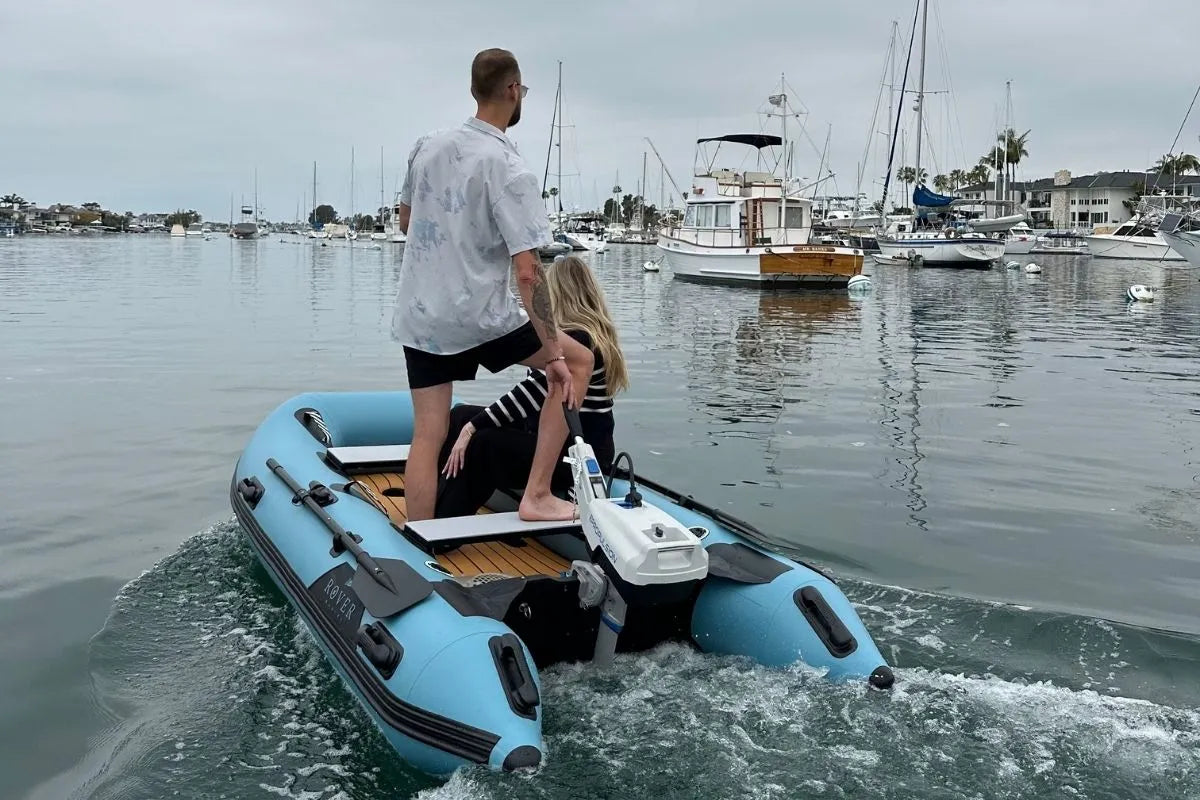
The Battle Boat uses a traditional inflatable dinghy profile. It is designed for tender trips, family cruising, fishing, diving, and general recreational use.
- Available in 8-, 10-, and 12-foot sizes.
- Traditional inflatable hull layout.
- High-pressure drop-stitch floor.
- Gas and electric outboard compatibility.
- Deflates for transportation and storage.

Battle Cat
The Battle Cat uses two parallel inflatable pontoons to create a wide catamaran-style platform for fishing, diving, family cruising, and passengers who value deck width.
- Available in 8-, 10-, and 12-foot sizes.
- Dual-pontoon inflatable hull layout.
- High-pressure drop-stitch floor.
- Gas and electric outboard compatibility.
- Deflates for transportation and storage.
Current Size and Motor Limits
| Size | Capacity | Maximum Motor | Transom |
|---|---|---|---|
| 8 Foot | 2 people / 600 lb | Up to 6 HP | 15 inches |
| 10 Foot | 4 people / 1,000 lb | Up to 10 HP | 15 inches |
| 12 Foot | 4 people / 1,200 lb | Up to 20 HP | 15 inches |
Capacity Includes the Entire Setup
Passengers, motor, battery, fuel, seats, anchor, safety equipment, cooler, fishing gear, dive gear, and personal belongings all count toward the published load limit.

Electric Outboards on Inflatable and Rigid Boats
Electric outboards can power both inflatable and rigid boats when the shaft length, motor output, battery system, motor weight, and mounting arrangement match the boat.
They are particularly useful for tender trips, fishing, harbor cruising, no-wake areas, protected water, and routes where charging access and range are predictable.
Electric Advantages
- Quieter operation than small gas outboards.
- No direct combustion exhaust at the motor.
- No onboard gasoline required.
- Simple starting and low-speed control.
- Fewer gas-engine maintenance tasks.
Electric Considerations
- Range depends on battery capacity and throttle.
- Charging access must be planned.
- Motor and battery weight count toward capacity.
- High-power operation uses energy more quickly.
- Battery care must follow the manufacturer instructions.
Current Rover Marine Electric Options
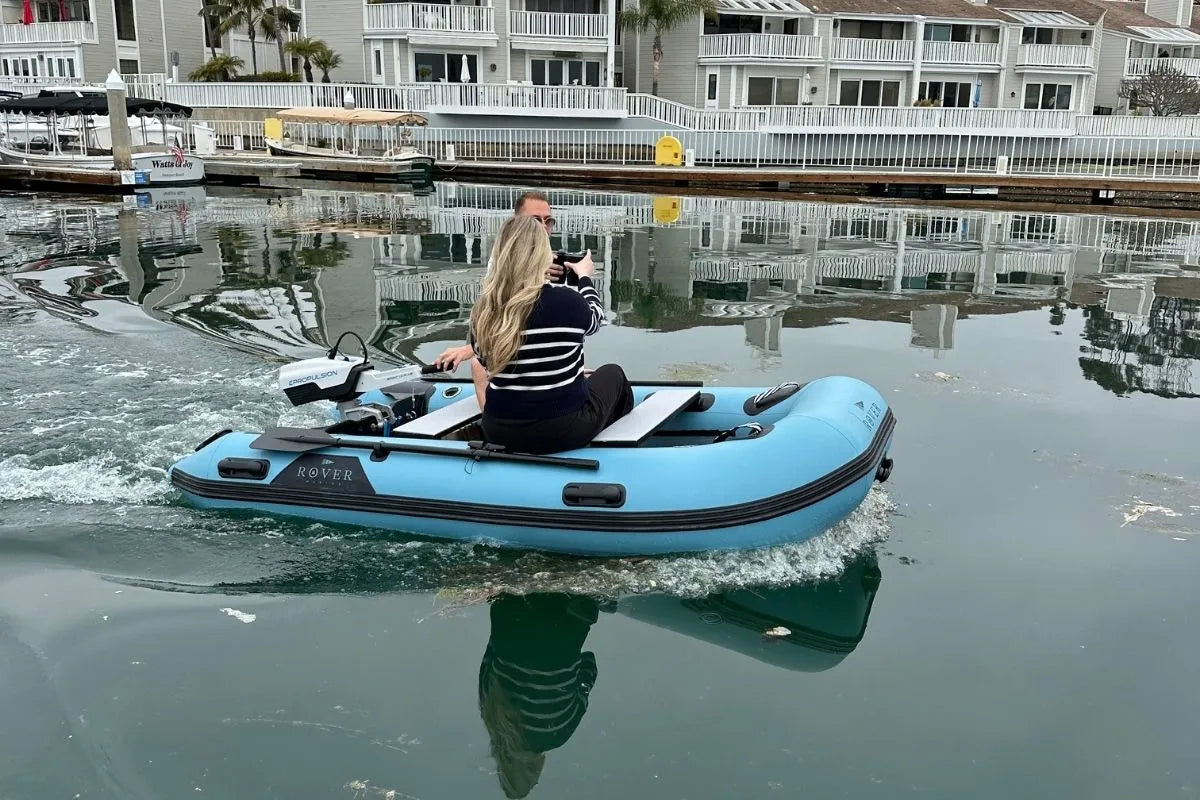
Rover Marine's current electric outboard motor collection includes short-shaft ePropulsion Spirit 1.0 Plus and Torqeedo Travel 1103 S packages.
Current Battle Boat and Battle Cat models use 15-inch transoms, making a compatible short-shaft motor the normal fit. Confirm the exact package, shaft length, battery setup, and expected range before ordering.
Can an Electric Outboard Power a Rigid Boat?
Yes, when the rigid boat's transom, weight, operating conditions, and performance requirements match the motor. A heavier rigid boat may require more power or battery capacity to achieve the same speed or distance as a lighter setup.
Which Boat Type Fits Your Ownership Plan?
A Fully Inflatable Boat May Fit You If
- You have limited storage space.
- You want the option to deflate the hull.
- You move between several waterways.
- You need a yacht tender that can be packed away.
- You are comfortable with inflation and pressure checks.
- You can protect the fabric from sharp objects and abrasion.
A Rigid Boat May Fit You If
- You have suitable trailer, marina, or permanent storage.
- You want built-in compartments or permanently installed systems.
- You do not want to inflate and deflate the hull.
- You regularly carry heavier equipment.
- You want a console, windshield, or permanent seating.
- The specific rigid hull matches your usual conditions.
Questions to Ask Before Choosing
- Where will the complete boat be stored?
- How will it be transported and launched?
- How many people and how much equipment will normally be aboard?
- What water and weather conditions are typical?
- How far will the boat usually travel?
- Do you need permanent onboard storage or installed equipment?
- Will the boat be used as a tender, fishing platform, dive boat, or cruiser?
- Do you prefer gas or electric propulsion?
- How much setup and post-trip maintenance are you willing to perform?
- What safety, registration, insurance, and local rules apply?
Choose the Exact Boat, Not Just the Category
There are capable and poorly matched boats in both categories. Compare the exact hull, size, capacity, motor, storage plan, and intended route before making a decision.
Safety Equipment for Either Boat Type
Required equipment varies by location, motor, operating area, boat size, type of use, and time of day. Common equipment may include:
- A properly fitted life jacket for every person.
- A sound-producing device.
- Navigation lights when required.
- Visual distress signals when required.
- An engine cut-off switch link when applicable.
- Registration and required documentation.
- A fire extinguisher when required.
- Communication and first-aid equipment.
- An anchor and line suitable for the operating area.
- Enough battery or fuel reserve for the return trip.
Review federal, state, and local rules before launching. Boat construction does not replace safe loading, weather awareness, operator judgment, or required equipment.
Frequently Asked Questions
Is an inflatable boat less safe than a rigid boat?
Not automatically. Safety depends on the exact design, size, load, pressure, motor, operator, weather, water conditions, maintenance, and safety equipment. Either category can be unsafe when used outside its limits.
Is a Rover Marine boat a rigid inflatable boat?
No. The Battle Boat and Battle Cat are fully inflatable boats. They do not have permanent fiberglass or aluminum lower hulls.
Are Rover Marine boats made from Hypalon?
No. Current Rover Marine boats use reinforced PVC inflatable construction with high-pressure drop-stitch floors.
Do inflatable boats fit inside any car?
No. Fit depends on the packed boat dimensions, weight, cargo opening, motor, battery or fuel, pump, seats, oars, anchor, and safety equipment. Measure the complete transportation space before ordering.
Which is better for fishing?
The better option depends on how much equipment you carry, where the boat is stored, the water conditions, and whether you need permanent electronics or compartments. Inflatable boats require careful management of hooks and sharp equipment.
Which is better for diving?
Both can support diving when the boat, load, boarding method, motor, route, and conditions are appropriate. Divers, tanks, weights, motor, battery or fuel, and safety gear all count toward capacity.
Can I use an electric outboard on either type?
Yes, when the shaft length, mounting arrangement, motor output, battery system, and total weight match the boat. Rover Marine boats use 15-inch transoms and normally pair with compatible short-shaft motors.
Are rigid boats always better in rough water?
No. Some purpose-built rigid hulls may suit certain rough-water routes better, but suitability depends on the exact hull, length, loading, weather, sea state, speed, operator, and safety equipment.
How many people can Rover Marine boats carry?
The 8-foot models are rated for two people or 600 pounds. The 10-foot models are rated for four people or 1,000 pounds. The 12-foot models are rated for four people or 1,200 pounds.
What motor can the Rover Marine boats use?
The 8-foot boats support motors up to 6 HP, the 10-foot boats support motors up to 10 HP, and the 12-foot boats support motors up to 20 HP. All current sizes use 15-inch transoms.
Which type costs less to own?
There is no universal answer. Compare purchase price, trailer or storage, marina fees, motor, fuel or electricity, batteries, insurance, repairs, maintenance, transport, and expected service life for the exact boats being considered.
What warranty applies to Rover Marine boats?
Rover Marine currently lists five years of eligible hull coverage, three years for eligible tubes and seams, and two years for covered accessory components. Review the complete warranty page for current terms and exclusions.
Compare Rover Marine Owner Experiences
Specifications explain capacity, dimensions, motor limits, packed size, and inflation pressure. Owner feedback can provide additional context about setup, transportation, storage, stability, electric propulsion, and customer support.
Visit the Rover Marine reviews page and compare those experiences with your own crew, vehicle, yacht, storage area, and typical water conditions.
Choose the Hull That Fits Your Real Boating Routine
Start with storage, transportation, passenger load, equipment, route, and typical water conditions. Then choose the hull and propulsion system that fit those needs without exceeding the boat's published limits.
Built for Water. Designed for Freedom.

Leave a comment
This site is protected by hCaptcha and the hCaptcha Privacy Policy and Terms of Service apply.