Rover Marine deck comparison
The floor is the spec that decides how the boat feels
Buyers compare tube diameter, horsepower, hull shape, and color. They rarely ask what they will be standing on. That is backwards. The floor affects standing comfort, setup time, packed size, traction, and how useful the boat feels once people and gear are aboard.

The inflatable boat deck options on the market usually come down to four categories: slat floors, air deck floors, rigid aluminum or plywood floors, and high-pressure drop-stitch floors. They are different floor systems, not just trim levels.
On Rover Marine boats, the floor inflates to 10 PSI and the tubes inflate to 3.5 PSI. That pressure gap is one of the most useful things to understand before you spend money, because a high-pressure floor is a major part of why a portable inflatable can feel usable underfoot.
All four floor styles can be right for someone. For buyers who prioritize a firm standing surface and compact storage, high-pressure drop-stitch is often the most direct fit. Other floors can make sense when minimum price, minimum weight, or maximum rigid-panel feel matters more.
The four inflatable boat deck options
This section replaces the wide table from the draft with responsive cards so it reads cleanly on desktop and mobile.
Slat floor
- RigidityLower. It can flex between slats.
- SetupFast. Often the simplest floor to roll out and inflate around.
- Packed sizeSmall, because the floor is built into the roll-up package.
- Best forSimple shuttle use, light loads, and price-sensitive buyers.
- TradeoffNot the best platform for standing, fishing, or a firm deck feel.
Air deck
- RigidityModerate. It can feel firm but springy depending on pressure and design.
- SetupFast, usually with one separate floor chamber.
- Packed sizeVery compact because the floor deflates with the boat.
- Best forOwners who prioritize low weight and compact storage.
- TradeoffMay deflect underfoot more than a high-pressure drop-stitch floor.
Aluminum or plywood
- RigidityVery high when correctly assembled.
- SetupUsually slower because panels and stringers must be fitted correctly.
- Packed sizeLargest, because the rigid panels do not roll up.
- Best forOwners who prioritize a hard-panel feel and have storage room.
- TradeoffMore parts, more weight, more bulk, and more material-specific care.
High-pressure drop-stitch
- RigidityHigh when inflated to the rated pressure.
- SetupFast, with one high-pressure floor chamber.
- Packed sizeSmall, because the floor deflates with the hull.
- Best forStanding, fishing, family use, dogs, tenders, and compact storage.
- TradeoffStill needs proper pressure, surface care, and protection from sharp abuse.
Slat floors
Slat floors use wood or plastic battens bonded into the hull fabric. You unroll the boat, inflate the tubes, and go. They are fast to set up and often less expensive to build, which is why they are common on entry-level dinghies.
The tradeoff is support. There is limited structure between slats, so the floor can flex when weight lands between them. A slat-floor dinghy can be useful for simple rowing, short shuttles, and very light-duty use, but it is not the first choice if your plan includes standing to cast, carrying heavy gear, or wanting a firm deck feel.

Air deck floors
An air deck is an inflatable floor panel that drops into the hull and inflates separately from the tubes. It is light, compact, and easy to live with if your top priorities are transport and storage.
The limit is stiffness. A conventional lower-pressure air deck can feel springy underfoot. That may be fine for seated cruising, light tender use, or short trips, but many anglers and gear-heavy users prefer a firmer high-pressure deck.
Aluminum and plywood floors
Rigid panel floors can provide a very firm surface when correctly assembled. They can make sense for buyers who value a hard-panel feel and have the room to store the floor pieces.
The tradeoffs are weight, setup time, and packed bulk. A rigid-panel floor usually means multiple panels, side stringers, and a specific assembly order. Those panels do not roll with the boat, so they may defeat the locker-storage advantage that makes an inflatable attractive in the first place.
Aluminum, plywood, and other hard-floor systems also have their own care concerns. Secure heavy gear, avoid dragging sharp equipment, and inspect for dents, corrosion, edge damage, fasteners, or water intrusion depending on the material.
High-pressure drop-stitch floors
Drop-stitch is the construction that made the floor comparison more interesting. Thousands of internal threads connect the top and bottom surfaces of the floor panel, which lets the panel inflate to higher pressure without ballooning into a round shape.
The result is a floor that feels much firmer underfoot while still deflating with the boat. Rover Marine uses drop-stitch flooring on the Battle Boat and Battle Cat, with the floor inflated to 10 PSI and the tubes inflated to 3.5 PSI.
For a deeper explanation of the construction, read What Is Drop-Stitch?.
Why the floor runs 10 PSI and the tubes run 3.5 PSI
The two numbers differ because the two structures do different jobs. The tubes are large round chambers that provide buoyancy, side support, impact forgiveness, and flotation around the hull. They need to be firm, but they also need some give at docks, beaches, and loading points.
The floor is a flatter high-pressure panel. It is designed to become the working deck, so it needs to feel firm when people stand, move, load gear, or shift weight. That is why Rover Marine floors inflate to 10 PSI while the tubes inflate to 3.5 PSI.
Do not inflate by feel alone. Use a pump with a gauge and follow the rating for the exact boat. Heat, direct sun, cold water, and storage conditions can all affect pressure.
What happens when gear hits the floor?
Boat floors get tested by anchors, coolers, tanks, tools, fishing gear, wet shoes, dogs, and the occasional bad drop. Each floor type reacts differently.
- Slat floors: the floor can flex between slats, so point loads may land on less-supported fabric.
- Air decks: the panel can deflect around impact, which can concentrate stress if the object has a sharp edge.
- Aluminum floors: they can dent or scratch, and saltwater scratches may need attention.
- Plywood floors: the panel can feel solid, but chipped edges and water intrusion can become maintenance issues.
- Drop-stitch floors: the higher pressure helps spread load, but sharp edges, abrasion, and careless gear handling can still cause damage.
Cheap insurance on any floor is simple: keep the anchor and rode in a bag, secure sharp gear, rinse grit away, and do not drag heavy equipment across the deck. For anchoring setup, read How to Anchor an Inflatable Boat.
V-TEAK traction is the surface, not the structure
Two different things get mixed together: the floor structure and the traction surface. The drop-stitch floor is the structure. The deck surface is what your feet actually touch.
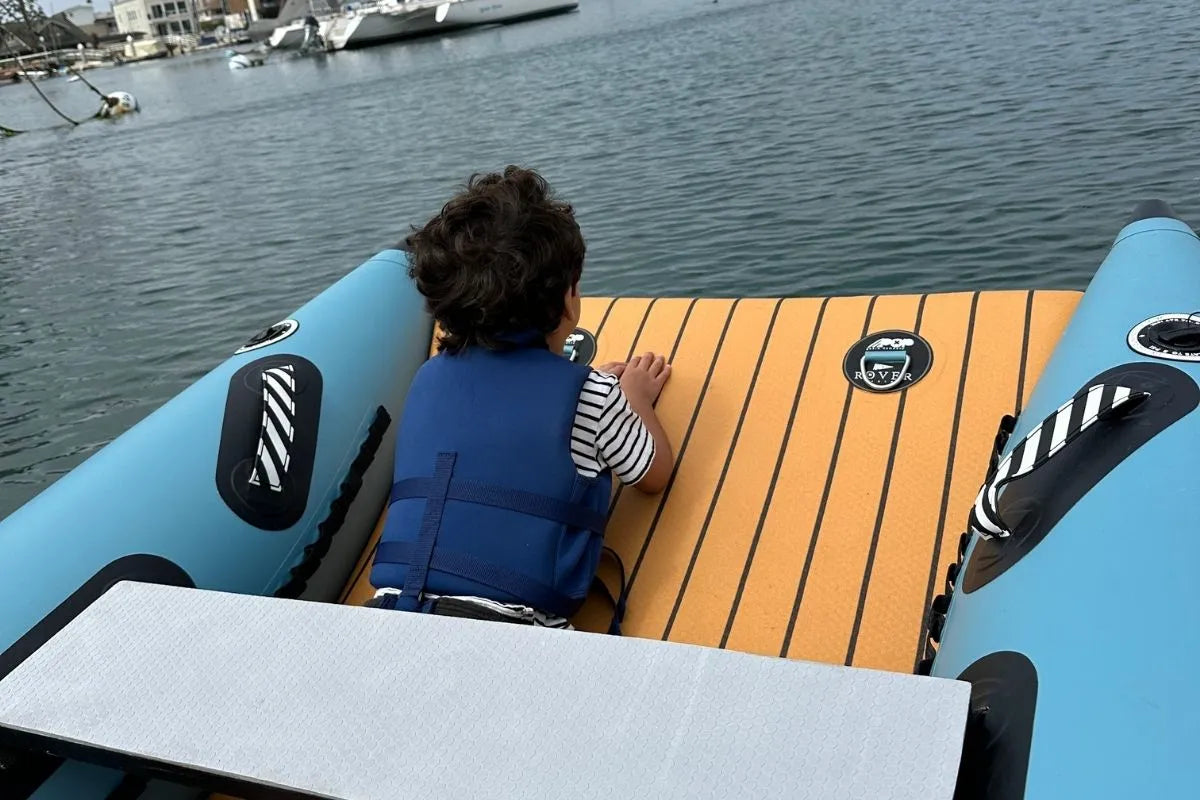
V-TEAK traction flooring is standard on Rover Marine boats. It gives the deck a wood-grain look and a textured surface for wet feet, wet shoes, family use, fishing days, and tender duty. A rigid floor with a slick surface can still feel unsafe underfoot, so structure and grip both matter.
Which floor should you buy?
Prioritize packability and a firm deck
Drop-stitch makes sense for many yacht tenders because it gives a firm working deck while still allowing the boat to deflate for locker, lazarette, or vehicle storage.
Prioritize floor stiffness and hull stability
A correctly inflated drop-stitch floor or properly assembled rigid floor is the better starting point for standing. Beam, hull shape, load, and conditions still matter.
Prioritize traction, comfort, and storage
Families benefit from a firm deck, textured surface, and easy pack-down. Read the 15-minute setup guide before planning your first launch.
Prioritize load spreading and re-boarding
Dive gear is heavy and wet. A firm deck helps, but boarding is just as important. Pair the setup with a 3-step rope ladder when swim stops or re-boarding are part of the plan.
Prioritize quiet handling and protected water
A soft inflatable hull and high-pressure floor can be useful for protected-water hunting setups. Match the boat to the load, laws, access point, and weather.
Prioritize rigid panels if storage allows
Aluminum or plywood can make sense if maximum hard-panel feel matters more than pack-down size, setup speed, or easy storage.
For a broader soft inflatable versus rigid comparison, read Rigid vs Soft Inflatable Boats.
Battle Boat vs Battle Cat floor difference
The floor system is not the main difference between the two Rover Marine hulls. Both the Battle Boat and Battle Cat use drop-stitch flooring and V-TEAK traction. The difference is the hull format.
Battle Boat
The Battle Boat uses a traditional inflatable hull layout. Choose it when you want classic dinghy handling, compact tender utility, and a familiar single-hull feel.
Battle Cat
The Battle Cat uses a dual-pontoon layout for a wider stance and a more settled feel when people, dogs, or gear shift around the deck.
Inflatable boat deck questions
What are the main inflatable boat deck options?
The main options are slat floors, air deck floors, aluminum or plywood panel floors, and high-pressure drop-stitch floors. Slat is simple and lower cost. Air deck is light and compact. Rigid panels feel very firm but add bulk and setup time. Drop-stitch creates a firm deck while still packing down.
Is an aluminum floor better than an air floor?
An aluminum floor is usually more rigid than a conventional lower-pressure air deck. It is also heavier, slower to assemble, and does not roll for storage. A high-pressure drop-stitch floor gives a firmer feel than many air decks while keeping the packability advantage.
How much pressure should an inflatable boat floor have?
On Rover Marine boats, the floor is rated to 10 PSI and the tubes are rated to 3.5 PSI. Always inflate to the rating on your exact boat and use a pump with a pressure gauge.
Can you stand up and fish from an inflatable boat deck?
You can stand on many inflatable boat floors, but how stable it feels depends on the floor type, pressure, hull shape, beam, load, water conditions, and operator balance. A 10 PSI drop-stitch floor is a better starting point for standing than a low-pressure soft floor.
Does the Battle Cat have a better floor than the Battle Boat?
No. Both boats use drop-stitch flooring at 10 PSI with V-TEAK traction. The difference is the hull. The Battle Cat uses dual pontoons for a wider stance, while the Battle Boat uses a traditional inflatable hull layout.

Leave a comment
This site is protected by hCaptcha and the hCaptcha Privacy Policy and Terms of Service apply.