Rover Marine October 2026 guide
Two hulls, one deck, and a very different ride
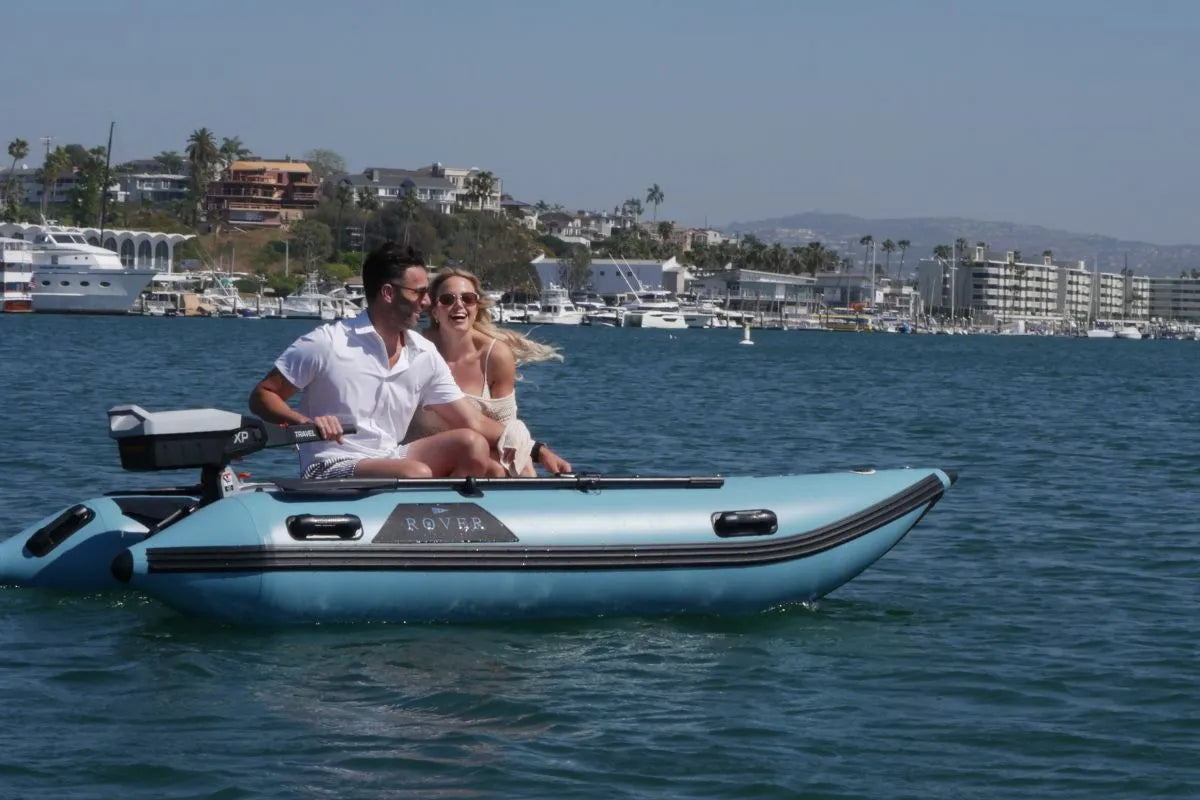
An inflatable catamaran is an inflatable boat built on two parallel pontoons joined by a rigid deck, instead of one continuous tube wrapped around a single hull. The gap between those pontoons is the whole design: it widens the boat's effective footprint on the water, which is what gives a catamaran dinghy its resistance to roll, its straight-line tracking, and its willingness to climb onto plane with modest power.

That is the definition. In practice, our 10-foot Battle Cat weighs 98 lb, carries 1000 lb, holds 3.5 psi in the tubes and 10 psi in the drop-stitch floor, and rides on five air chambers in a 4+1 layout. It starts at $1,999.
We build both kinds, and we would rather you buy the right one than the expensive one.
How a dual-pontoon hull differs from a single tube and from a RIB
Against a single-hull inflatable
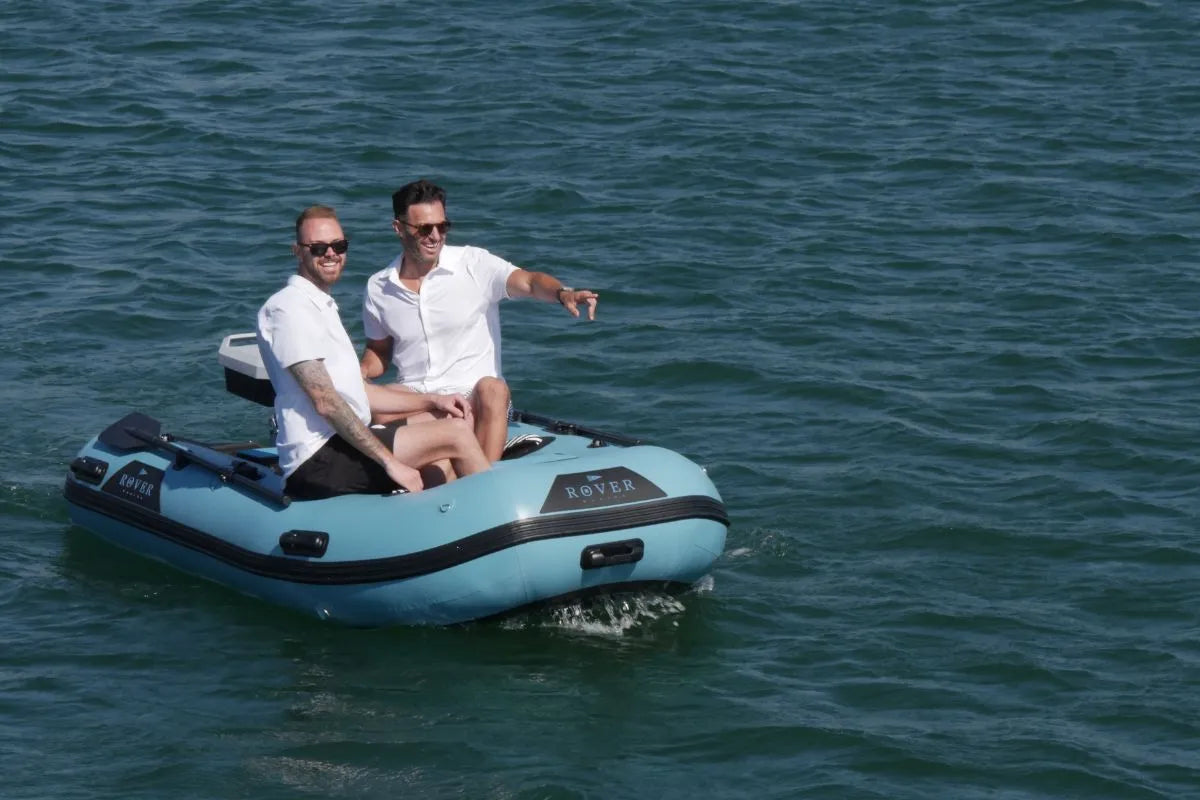
A traditional inflatable dinghy is a horseshoe. One tube runs down the port side, around the bow, and back up the starboard side, with a floor stretched between. The buoyancy sits in a continuous ring around one center of volume.
An inflatable catamaran splits that buoyancy into two separated hulls. Same air, different placement. The tubes run fore and aft as pontoons with a tunnel between them, and the deck bridges the gap. The material does not change. Both of our boats use military-grade PVC, reinforced seams, UV-resistant triple-layer tubing, and the same V-TEAK Traction deck. Only the placement changes.
Against a RIB
A rigid inflatable boat mounts inflatable tubes on a solid fiberglass or aluminum V-hull. It is the driest of the three in real chop, the heaviest by a wide margin, and it does not deflate. We do not build RIBs, so take this as description rather than pitch. A RIB is right when you have somewhere to keep it. A catamaran dinghy is right when the boat has to fold into a locker on Sunday night.
Roll stability
Inflatable catamaran:
Highest, at rest and in turns
Single-hull inflatable:
Good, calm to moderate
RIB:
Good, set by deadrise
Tracking
Inflatable catamaran:
Improved. Pontoons act as keels
Single-hull inflatable:
Standard. Wanders at low speed
RIB:
Excellent
Planing
Inflatable catamaran:
Quicker, especially on electric
Single-hull inflatable:
Good mid-range
RIB:
Best, with the horsepower
Deck room
Inflatable catamaran:
Slightly more. Wider stance
Single-hull inflatable:
Tube intrudes at the sides
RIB:
Most, but fixed layout
Packability
Inflatable catamaran:
Rolls to roughly 38 to 48 inches long by 24 to 32 wide by 15 to 20 deep depending on size
Single-hull inflatable:
Same range
RIB:
None. Davits or trailer
Weight
Inflatable catamaran:
84 / 98 / 130 lb by size
Single-hull inflatable:
86 / 100 / 135 lb
RIB:
Several times heavier
Hull damage risk
Inflatable catamaran:
Puncture, abrasion. Field repair
Single-hull inflatable:
Puncture, abrasion. Field repair
RIB:
Gouges. Shop repair
More in our inflatable catamaran vs RIB comparison.
The physics: why two separated pontoons resist roll
Righting moment and lever arm, in plain language
When a boat heels, buoyancy shifts to the low side and pushes back up. The strength of that push-back is the righting moment, and it is the product of two things: how much buoyant force moves, and how far from the centerline it moves. That distance is the lever arm.
This is why the gap matters more than tube diameter. In one wide tube, much of the volume sits near the middle where it has almost no leverage. Split it into two pontoons and push them apart, and the buoyancy is concentrated at the edges. Lean the boat and the leeward pontoon must be driven far deeper before it stops resisting, and every inch works through a longer lever.
Same principle as standing with your feet apart. You did not get heavier. Your base got wider.
Two consequences. An inflatable catamaran resists that initial heel more firmly, which is what you feel when someone boards over the side. And the stiffness carries through turns, because the outboard pontoon digs in rather than letting the boat lean out of the corner. Beam and stability are linked on any inflatable, which our guide to how beam shapes stability, speed, and handling covers.
What the tunnel does in chop
The tunnel is the open channel between the pontoons under the deck. In flat water it does very little. In chop it does two things.
It gives displaced water and trapped air somewhere to go. A single wide hull pushes a wave down and around itself, and some of that energy comes back as a slap. A dual-pontoon hull lets each pontoon cut its own path and vents the disturbance up the middle. It also splits the impact in time: two narrow hulls do not load up all at once the way one broad surface does, so the ride is a series of smaller hits rather than one flat bang. No soft hull rides like a deep-V. It is simply less punishing.
Deck width and standing stability
Because the tubes run fore and aft rather than wrapping the perimeter, less tube intrudes into the interior. You get a wider internal stance on the same beam. Our 10-foot boats measure 5 feet across, and on the cat more of that width is deck you can stand on. Standing is where owners feel it: casting, hauling a dive ladder, netting a fish. That is why we point standing anglers toward the cat, and it is the subject of our inflatable fishing catamaran guide.
Tracking and planing, especially on electric power
Two pontoons with defined chines running fore and aft act like shallow keels. They resist sideways slip, so the boat holds a heading with less correction, which matters in a crosswind or a running tide. Single-hull inflatables wander more at low speed.
Planing is the part electric owners care about. A gas outboard has torque to spare and will shove anything over the hump. Electric outboards make power differently, and a hull that needs less push to break free is worth real range. Two narrow pontoons present less wetted surface as speed builds, so the boat lifts earlier.
Every Battle Boat and Battle Cat uses a 15-inch transom, so units like the ePropulsion Spirit 1.0 Plus run in the short shaft they are built for. Power ceilings: 6 hp at 8 feet, 10 hp at 10 feet, 20 hp at 12 feet.

Where a catamaran hull is not the right answer
Three honest cases.
You want a calm-water tender and nothing more. If the job is ferrying two people to a dock on a protected lake, the extra stability is capability you will not use. The Battle Boat does that at 86 lb in the 8-foot size with a traditional single-hull layout.
You prefer the familiar single-hull layout. Both Rover Marine hull styles currently start at $1,999, so compare the live product pages and choose by use case rather than an assumed price gap.
You want the simplest possible boat. The single hull is the familiar shape, and simple has value.
Notice what is not on that list: weight. The Battle Cat is 2 lb lighter than the Battle Boat at every size. Splitting buoyancy into two pontoons redistributes material rather than adding it.
How to evaluate an inflatable catamaran if you are shopping
Ask about construction, not adjectives
Fabric and coating. Military-grade PVC is a material specification. It does not mean military-issued or defense-certified, and a builder implying otherwise is selling. Ask about UV resistance and layer count.
Seams. Ours are reinforced. Ask any builder how theirs are joined.
Chambers. The Battle Cat runs 4+1 at every size: four tube chambers plus the floor.
Floor pressure. A drop-stitch floor at 10 psi is a structural deck, not a mat. Read our drop-stitch explainer before comparing floors.
Transom. Ours is 15 inches, which means short shaft.
Certification. MIC certified with the US Coast Guard. State registration rules differ, so check yours.
Capacity and setup. Ours carry 600 / 1000 / 1200 lb by size and inflate in 10 to 15 minutes with a high-output pump. If the boat is a tender, size it to your davits and locker first, which our yacht tender size guide covers.
Read the warranty, then read the exclusions
A warranty is the cheapest honest signal you will find, because it is the builder betting money on their own hull. Ours is tiered, not flat: 5 years on the hull for manufacturing defects, structural delamination, and air leaks; 3 years on tubes and seams; 2 years on accessories. Full terms are on our warranty page.
The tiering is the informative part. A flat number tells you nothing about which component a builder trusts most. A 5-year hull term next to a 3-year tube term tells you where they think their durability sits. Few builders in this category publish tiered coverage at all.
Be equally clear about what no inflatable warranty covers. Punctures from use or handling, dock rash, boat-to-boat scuffs, abrasion, cosmetic damage from misuse, outdoor neglect, and dinghy rot are excluded. That is normal for the category. Coverage is for defects we built in, not for what the dock and the ramp hand out. Claims take up to 30 days.
Frequently asked questions
What is an inflatable catamaran?
An inflatable catamaran is an inflatable boat built on two parallel inflatable pontoons joined by a rigid deck, rather than one continuous tube around a single hull. Separating the buoyancy widens the boat's effective base, which improves roll resistance, straight-line tracking, and planing.
Is an inflatable catamaran more stable than a regular inflatable boat?
Yes, particularly at rest and in turns. Two separated pontoons place buoyancy farther from the centerline, so heeling the boat generates a stronger righting force through a longer lever arm. In practice: a firmer feel when someone boards over the side, and less lean in a turn.
How much does an inflatable catamaran weigh?
Rover Marine's Battle Cat weighs 84 lb at 8 feet, 98 lb at 10 feet, and 130 lb at 12 feet, 2 lb lighter than our single-hull Battle Boat at every size. Splitting buoyancy into two pontoons redistributes material rather than adding it.
Can you use an electric outboard on an inflatable catamaran?
Yes. Rover Marine boats use a 15-inch transom, so electric outboards such as the ePropulsion Spirit 1.0 Plus and Torqeedo Travel 1103 S fit in short-shaft form. A dual-pontoon hull suits lower-torque electric power because it needs less push to lift onto plane. Power ceilings are 6 hp at 8 feet, 10 hp at 10 feet, and 20 hp at 12 feet.
Is an inflatable catamaran worth it over a single-hull dinghy?
It is worth it if you stand up in the boat, run in chop, dive, fish, or carry an electric outboard. It may not be worth choosing over a single hull if you want a calm-water tender or the most familiar layout. Rover Marine's Battle Cat and Battle Boat both currently start at $1,999; check the live product pages before purchase.

Leave a comment
This site is protected by hCaptcha and the hCaptcha Privacy Policy and Terms of Service apply.