
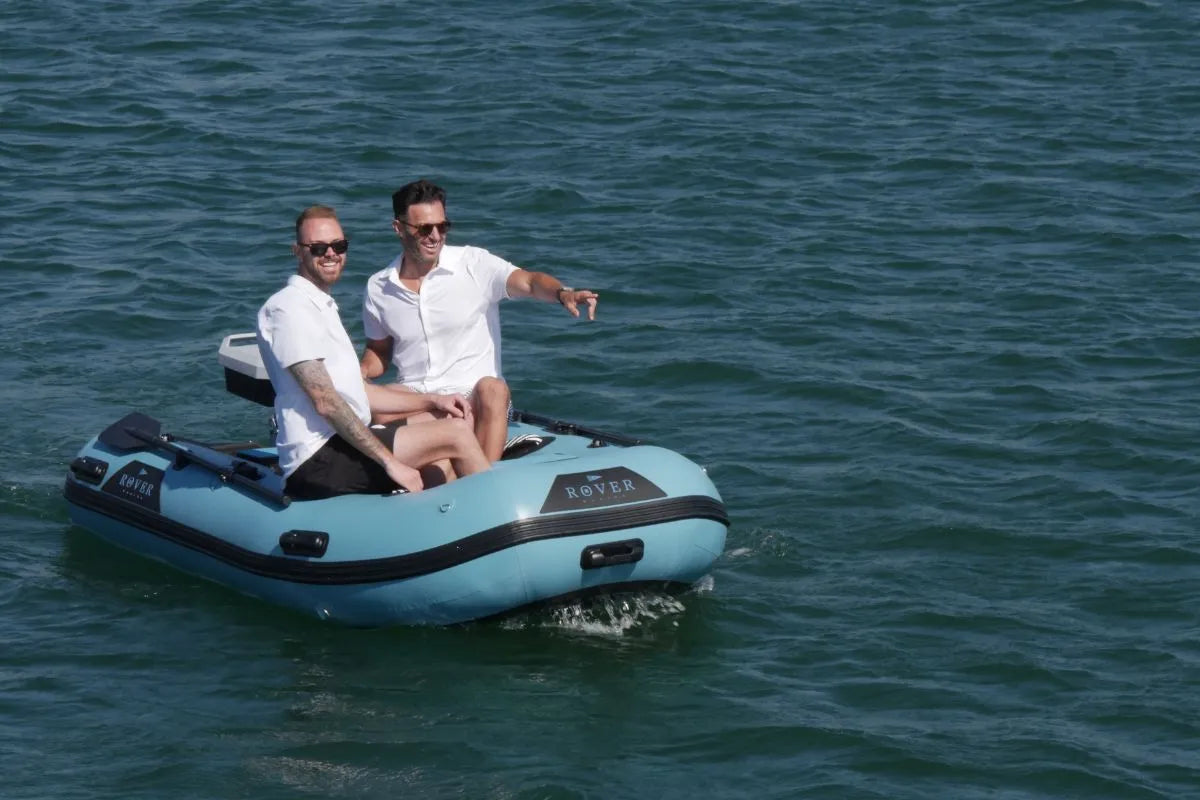
Rover Marine October 2026 guide
"Heavy duty" is a claim anyone can print
Search heavy duty inflatable boats and every listing on the first page claims the phrase. It costs nothing to write and means nothing without the construction behind it. So this page spends its whole length on the construction.

We build these boats, so we will be specific. Our tubes hold 3.5 psi and our drop-stitch floors hold 10 psi. Our 12-foot hulls carry 1200 lb across five air chambers in a 4+1 layout. We back the hull for 5 years, tubes and seams for 3, accessories for 2. Checkable numbers are the only honest version of the phrase heavy duty inflatable boats.
Toughness is seven things, listed roughly in the order each one fails.
Start with the material: fabric, coating, and seams
Fabric and coating
Tube fabric is a woven base cloth with a coating bonded to each side. The cloth carries the load. The coating carries everything else: air retention, abrasion resistance, UV resistance, and the chemistry that lets a seam bond at all.
Ours is military-grade PVC in UV-resistant triple-layer tubing. Be clear about what that phrase means, because the category abuses it. Military-grade describes a material specification. It does not mean the boat is military issue, defense certified, or built under a government contract. A brand implying otherwise is selling the word, not the spec.
The question underneath the fabric is PVC versus Hypalon, a tradeoff rather than a good-versus-bad choice. The honest version is in our PVC vs Hypalon guide.
Seams, and why the bond method matters more than the fabric
This is where cheap boats die, and almost nobody shopping knows to ask.
There are two ways to join inflatable fabric. Glued seams use an adhesive between overlapping panels. Thermally welded seams use heat and pressure to fuse the coatings into one continuous material.
Adhesive is a third substance in the joint, and heat, UV, and solvents all attack it. A glued boat usually fails at a seam, and usually after a hot summer on a dock rather than a hard day of running. A heat-welded thermal bond has no adhesive to fail, because there is no adhesive.
Our boats use reinforced seams, and seams are the first thing to inspect on any hull. Run a finger down the tube-to-floor joint. It should be smooth, with no lifted edge, no bubbling, no beads of squeeze-out. Squeeze-out means glue, and glue means a clock.
Then the structure: chambers, floor, and transom
Chamber redundancy: what 4+1 and 3+2 mean
A hull is not one air space. The chamber layout tells you what happens on your worst day.
Our 10-foot and 12-foot boats, and the Battle Cat at every size, run a 4+1 layout: four independent tube chambers plus the drop-stitch floor. The 8-foot Battle Boat runs 3+2, three tube chambers plus two floor sections.
What matters is what is left. Lose one of four tube chambers and three are still holding, plus the floor. The boat gets soft on one side and handles badly. It does not sink and it does not fold. You get home slowly, which is the point. On a single-chamber inflatable, a puncture is not an inconvenience.
Floor rigidity: 10 psi is doing structural work
A soft floor makes a soft boat. The floor ties the tubes together and stops the hull flexing along its length. It is the biggest difference between heavy duty inflatable boats and ones that only photograph like them.
Drop-stitch construction uses thousands of internal threads connecting the top and bottom surfaces, so the panel inflates flat and hard instead of ballooning. That geometry lets it hold 10 psi, nearly three times our 3.5 psi tube pressure, and behave like a rigid deck.
A curved tube at 3.5 psi has plenty of structure and stays forgiving on impact. A flat floor has to resist bending under a standing adult, so it needs the higher number. Reaching both takes 10 to 15 minutes with a high-output pump, and a real dual-action pump is the difference between hitting 10 psi and thinking you did. More in our drop-stitch explainer.
Transom and hardware attachment
The transom takes every pound of thrust the motor makes and puts it into fabric. It is the highest-stress junction on the hull.
Look for a wide bonding area where the transom meets tubes and floor, not a narrow tab. Check how D-rings, handles, and tow points attach, because those are load paths too. A well-built boat spreads load across a broad patch. A cheap one concentrates it at a point.
Ours is a 15-inch transom on every Battle Boat and Battle Cat, so outboards run short shaft, including units from our electric outboard collection. Power ceilings: 6 hp at 8 feet, 10 hp at 10 feet, 20 hp at 12 feet.
The two slow killers: abrasion and UV
Chafe points
Almost no inflatable dies of a dramatic puncture. They die of a hundred small ones nobody watched.
The chafe points are predictable. Where the hull drags on a ramp. Where a painter line saws across the bow. Where davit straps bear. Every one is preventable with a rub strake, a chafe guard, a fender, or thirty seconds when you tie up. Rinse salt off after coastal use, because dried salt is an abrasive that lives on the boat, as our saltwater cleaning guide explains.
UV is the certainty
Everything above is a risk. UV is a certainty.
Sunlight degrades coatings and seam threads for as long as the boat sits uncovered. It is slow enough that nobody notices and complete enough that it decides the boat's life. UV-resistant tubing buys time. Storage buys more. Put the boat away dry with our winter storage guide, and see the arithmetic in how long inflatable boats last.

How to check a heavy-duty inflatable boat before you buy
Fabric and coating
What it does:
Holds air, resists UV and abrasion
How to check it:
Ask the spec and layer count. "Military grade" describes material, not certification
Seam construction
What it does:
Joins panels. Most common failure
How to check it:
Ask glued or thermally welded. Inspect for lifted edges or squeeze-out
Chamber count
What it does:
Floats the boat when one is lost
How to check it:
Ask the layout, e.g. 4+1. Confirm each has its own valve
Floor rigidity
What it does:
Stiffens the hull, supports standing
How to check it:
Ask floor type and pressure. Drop-stitch at 10 psi is a structural deck
Transom and hardware
What it does:
Transmits thrust into fabric
How to check it:
Wide bonded areas, not narrow tabs. Check the hp ceiling
Abrasion resistance
What it does:
Survives ramps, pilings, davits
How to check it:
Look for rub strakes and reinforcement at wear points
UV resistance
What it does:
Decides how the boat ages
How to check it:
Ask about UV treatment, then plan covered storage
What a warranty actually tells you about a builder's confidence
Construction claims are free. A warranty is not, because it is the builder putting money behind the claim. Ours is tiered rather than flat:
Hull: 5 years. Manufacturing defects, structural delamination, and air leaks tied to manufacturing.
Tubes and seams: 3 years. Manufacturing defects or delamination affecting tubes and seams.
Accessories: 2 years. Bolt-on and clamp-on components attached to the boat.
Full terms live on our warranty page.
Why tiered coverage beats a flat number. A flat warranty says one thing about the whole boat, which says almost nothing about any part of it. A tiered warranty is the builder ranking their own components. A 5-year hull term next to a 3-year tube and seam term tells you where they believe their durability is deepest, and where the harder engineering sits. Few builders of heavy duty inflatable boats publish tiered coverage at all.
Now the exclusions, because they are real. Not covered: damage from user error, accidents, misuse, improper storage, lack of care, wildlife, or normal wear and tear. Named exclusions include punctures from use or handling, dock rash, boat-to-boat scuffs, abrasion, cosmetic damage from everyday misuse, outdoor neglect, and dinghy rot.
That is normal for the category, and it should be. A warranty covers what the factory got wrong. It does not cover what the dock, the ramp, and the sun do over five seasons. Which is why abrasion and UV are on this page: the failures that end most heavy-duty inflatable boats are ones no warranty was going to pay for.
To claim, submit the warranty form or contact us with clear photos and order information. We review it and advise next steps. Claims can take up to 30 days. Where we source a third-party product such as a motor, coverage may follow that manufacturer's policy.
The buyer's checklist: what to ask, and what a straight answer sounds like
Ask any builder these five questions. What matters is whether they can answer at all.
"What is the tube fabric and how many layers?" Straight: a spec and a layer count. Evasive: "premium marine grade."
"Are the seams glued or thermally welded?" Straight: one word, immediately. Evasive: "reinforced" repeated back at you.
"How many air chambers, and what is the layout?" Straight: a number and a structure, like 4+1. Evasive: "multiple chambers for safety."
"What is the floor type and its rated pressure?" Straight: a type and a psi figure, like drop-stitch at 10 psi. Evasive: a floor type with no number attached.
"What does the warranty cover per component, and what is excluded?" Straight: tiers and exclusions, without flinching. Evasive: one headline number and a change of subject.
Our own answers are on the Battle Boat and Battle Cat pages, with the rest in our FAQ. Both are MIC certified with the US Coast Guard, and registration rules differ by state. Battle Boat starts at $1,999, Battle Cat at $1,999. Financing is available at checkout.
Frequently asked questions
What makes an inflatable boat heavy duty?
Construction, not branding. Heavy duty inflatable boats are defined by fabric and coating, seam bond method, chamber redundancy, floor rigidity, transom attachment, abrasion resistance, and UV resistance. Rover Marine builds with military-grade PVC, UV-resistant triple-layer tubing, reinforced seams, and drop-stitch floors at 10 psi.
Does "military grade" mean an inflatable boat is military approved?
No. Military-grade describes a material specification for the PVC fabric. It does not mean the boat is military issued, defense certified, or built under a government contract. Ask any builder for layer count, coating, and UV treatment instead.
What does Rover Marine's warranty cover?
Coverage is tiered: 5 years on the hull for manufacturing defects, structural delamination, and air leaks; 3 years on tubes and seams; 2 years on accessories. Damage from user error, misuse, improper storage, and normal wear is excluded, including punctures from handling, dock rash, and abrasion.
Why is the floor pressure higher than the tube pressure?
They do different jobs. Rover Marine tubes hold 3.5 psi, where a rounded shape gives structure with impact forgiveness. The drop-stitch floor holds 10 psi because a flat panel must resist bending under standing loads.

Leave a comment
This site is protected by hCaptcha and the hCaptcha Privacy Policy and Terms of Service apply.