
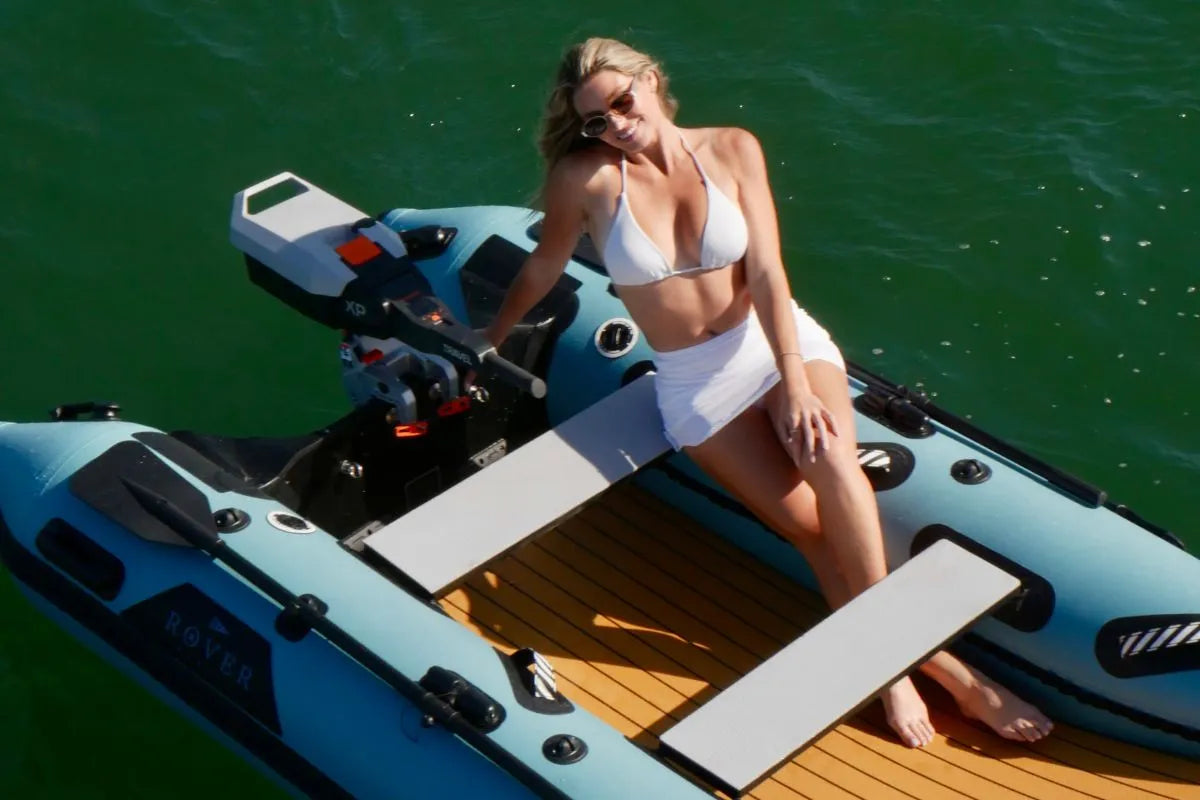
Rover Marine October 2026 guide
A cruising dinghy is the only car you own once the anchor is down
Choosing a cruising dinghy for a sailboat is a different problem from choosing a tender for a powerboat, and almost nobody writes about it that way. A sailboat under about forty feet has no transom garage, no hydraulic platform, and usually no davits. Its foredeck is already occupied by a windlass, a rode, a jib track, and a sail bag.

One number decides most of it. A dinghy you can hoist aboard alone on a halyard has to weigh under roughly a hundred pounds dry. Ours land at 84 to 86 lb at 8 feet, 98 to 100 lb at 10 feet, and 130 to 135 lb at 12 feet. Below a hundred pounds you get the boat on deck single-handed with a winch and a bridle. Above it you need a second pair of hands.
Fall is when this gets settled. Boats heading south refit in October, and the tender is the item that gets deferred until the week before departure and then bought badly. If you run a motoryacht with davits, our yacht tender size guide handles your sizing, towing, and davit loads instead. This guide is for the sailboat cruiser.
What a cruising dinghy has to do that a powerboat tender never does
A powerboat tender has a home. It sits in a garage or hangs in davits, and the questions are capacity and davit rating. A cruising dinghy on a sailboat has no home. It has to disappear when you are sailing and reappear when you are not, survive a foredeck that is a working area rather than a storage area, and be reliable in a way a powerboat tender does not. Anchored a quarter mile out with no launch service, that dinghy is the only way ashore and the only way back.
No davits under ~40 ft
What it demands:
Lifts on one halyard and one winch
Inflatable:
84-135 lb dry, hoists on a bridle
Hard dinghy:
Rigid, swings hard on the hoist
Foredeck holds ground tackle
What it demands:
Stows flat, clear of the windlass
Inflatable:
Deflates to roughly 38 to 48 inches long by 24 to 32 wide by 15 to 20 deep depending on size
Hard dinghy:
Fixed footprint, blocks jib track and windlass
Offshore passages
What it demands:
Goes below or lashes flat on deck
Inflatable:
Roll it and stow it in a locker
Hard dinghy:
Tow and risk it, or lose the deck to it
Crowded dinghy docks
What it demands:
Must not damage the boats alongside
Inflatable:
Soft tubes are a permanent fender
Hard dinghy:
Rigid gunwale is a liability to everyone
Anchoring out is the default
What it demands:
Reliability is safety, not convenience
Inflatable:
Independent air chambers, 4+1 on most sizes
Hard dinghy:
No air to lose, but no redundancy either
Long rows to shore
What it demands:
Oars have to work
Inflatable:
Rows adequately, blows around
Hard dinghy:
Rows genuinely well, carries way
Year-round salt
What it demands:
Rinses clean, resists UV
Inflatable:
UV-resistant triple-layer tubing, military-grade PVC
Hard dinghy:
Gelcoat chalks, needs refinishing
Foredeck stowage and the halyard hoist
Why the tender lives forward, and why it has to fold
The only flat space on most cruising sailboats that is not a cockpit is the foredeck between mast and bow. That is also where the rode runs and the windlass sits. A hard dinghy stowed upside down forward covers all of it. You lose the windlass in the exact conditions where you want it, and you cannot get a foot on the jib track to shift a lead.
A deflatable cruising dinghy solves this by not being a boat when it is stowed. Rolled, ours pack to roughly 38 to 48 inches long by 24 to 32 wide by 15 to 20 deep depending on size, which lashes against the cabin trunk or drops through a hatch. On a 32-footer that is the difference between a working foredeck and a cluttered one.
Hoisting aboard on a halyard
Without davits the standard technique is a halyard and a winch. Clip a spinnaker or spare genoa halyard to a three-point bridle, lead the halyard to a cabin-top winch, and grind the boat up and over the lifelines. Two details matter. Use a bridle rather than a single lifting point, or the hull folds and dumps whatever is still aboard. And drain the dinghy first, because water runs 8.3 lb per gallon and a few inches in the bilge turns a manageable hoist into a bad one.
Why weight matters more here than anywhere else
On a powerboat with davits, thirty extra pounds is a rating question. On a sailboat it is a physical question about whether you can do this alone at dusk in a rolly anchorage.
An 8-foot Battle Cat is 84 lb and a Battle Boat is 86 lb. At 10 feet, 98 and 100 lb. Those hoist single-handed. The 12-foot boats are 130 and 135 lb, a two-person lift on most decks and better suited to a larger cruiser. Battle Cat is 2 lb lighter at every size because splitting buoyancy into two pontoons redistributes material rather than adding it.
The passage decision: stow it, do not tow it
Towing a cruising dinghy offshore in a following sea is how tenders are lost. The boat surfs down a wave, overruns the painter, yaws, and either flips or snatches the line hard enough to part it. It happens at night, and you find out at dawn.
Deflate and stow for anything longer than a day hop in protected water. Ours deflate in a few minutes and inflate in 10 to 15 with a high-output pump, tubes to 3.5 psi and the drop-stitch floor to 10 psi. That is short enough that stowing for passage is not a chore you will talk yourself out of.
Life at anchor, and why reliability is a safety question
Cruisers anchor out. That is the point of the boat. It also means the tender hauls groceries, jerry cans, crew, and occasionally somebody who needs a dock in a hurry. A cruising dinghy failure at anchor is not an inconvenience. It is a stranding.
Air chambers are the argument. Our 10 and 12-foot boats run a 4+1 chamber layout, and the 8-foot Battle Boat runs 3+2. A puncture in one chamber makes the boat soft and slow. It does not sink it. A hard dinghy has no air to lose, which is fair, but no redundancy if you hole it.
Then there is the dinghy dock. In a busy anchorage you will raft three deep against strangers' boats. Soft tubes are a permanent fender. A rigid gunwale is a liability to every hull it touches.

Power on a boat that makes its own electricity
A small gas outboard is the default. Simple, hauls a load upwind, indifferent to your battery bank. Our ceilings are 6 hp at 8 feet, 10 hp at 10 feet, and 20 hp at 12 feet. The costs are a gas can on deck, a motor to service, and weight on the pushpit rail.
Rowing is the fallback every cruiser should be able to manage. An inflatable rows adequately, not well. Short waterline, high freeboard, and real windage mean that in 15 knots you will be working for it. Carry oars regardless of what hangs on the transom.
Electric suits a cruising dinghy well, with one caveat worth hearing plainly. Our 15-inch transom takes short-shaft electric outboards, including the ePropulsion Spirit 1.0 Plus and other units in our electric outboard collection. No fuel aboard, near silence at anchor, nothing to winterize. The caveat is range and charging. Usable range is a beach run and back, not a tour of the bay, and you are recharging from a house bank that solar and the alternator already fight over. Anchor close in and electric is excellent. Land a mile away against a current and you want gas.
The honest case for a hard dinghy
We build inflatables. We also think a hard dinghy is right for some cruisers, and pretending otherwise would be insulting.
A hard dinghy rows properly. It tracks, it carries way between strokes, and it will take you a mile upwind with no engine at all. If you anchor far out, do not want to own an outboard, and value that self-sufficiency, the argument is real and no inflatable answers it. Hard dinghies also shrug off oyster shell and coral rubble that will abrade a tube.
What you accept in exchange: it never gets smaller, it owns your foredeck permanently, and it is a problem at a crowded dinghy dock. Choose it deliberately, not by default.
Salt, rinse discipline, and what the warranty actually covers
Salt kills tenders slowly, through neglect rather than failure. Rinse with fresh water when you can, get salt out of the seams and from under the floor, and never stow the boat wet and rolled for weeks. Our guides on cleaning saltwater stains and storing an inflatable for winter cover the routine, and the storage piece applies to any long layup, not only November.
On coverage, the honest version. Rover Marine's warranty runs 5 years on the hull for manufacturing defects, structural delamination, and air leaks tied to manufacturing, 3 years on tubes and seams for manufacturing defects or delamination, and 2 years on bolt-on and clamp-on accessory components. Motors and third-party products may follow their own manufacturer's policy where we source them. Claims go through the warranty form with photos and order information and can take up to 30 days to resolve.
What it excludes matters just as much to a cruiser. Punctures from use or handling, dock rash, boat-to-boat scuffs, abrasion, cosmetic damage from everyday misuse, outdoor neglect, and dinghy rot are named exclusions, along with damage from accidents, misuse, and improper storage. That is normal for the category, and we would rather say it than let you discover it. The warranty protects you against a boat that was built wrong. Rinse discipline protects you against everything else.
For the broader tender decision, our yacht tender buying guide goes deeper on sizing and outfitting.
Frequently asked questions
What size cruising dinghy is best for a sailboat?
For most cruising sailboats between 30 and 40 feet, an 8 or 10-foot tender is the right range. An 8-foot dinghy carries 2 people or 600 lb at 84 to 86 lb dry. A 10-foot carries 4 people or 1000 lb at 98 to 100 lb. Both hoist on a halyard and deflate to roughly 38 to 48 inches long by 24 to 32 wide by 15 to 20 deep depending on size.
Should you tow a dinghy offshore or stow it?
Stow it. Towing a tender offshore in a following sea is the most common way cruisers lose dinghies, because the boat surfs, overruns the painter, and yaws or flips. Deflate and stow below, or lash the boat flat on deck, for any overnight or open-water passage. Tow only for short hops in protected water.
How do you get a dinghy on deck without davits?
Clip a spinnaker or spare genoa halyard to a three-point lifting bridle on the dinghy, lead the halyard to a cabin-top winch, and grind the boat up and over the lifelines. Drain it first. Use a bridle rather than a single lifting point so the hull cannot fold under load.
Is an inflatable or a hard dinghy better for cruising?
An inflatable is better if the tender must disappear for passages, stow on a crowded foredeck, and raft safely at a dinghy dock. A hard dinghy is better if you row everywhere, carry no outboard, and have permanent deck space. Rowing performance is the hard dinghy's genuine advantage over any inflatable.
Does Rover Marine's warranty cover a punctured tube?
No. The warranty covers manufacturing defects, with 5 years on the hull, 3 years on tubes and seams, and 2 years on accessory components. Punctures from use or handling, dock rash, abrasion, and boat-to-boat scuffs are named exclusions, as is damage from misuse or improper storage. Full terms are on the warranty page.

Leave a comment
This site is protected by hCaptcha and the hCaptcha Privacy Policy and Terms of Service apply.