
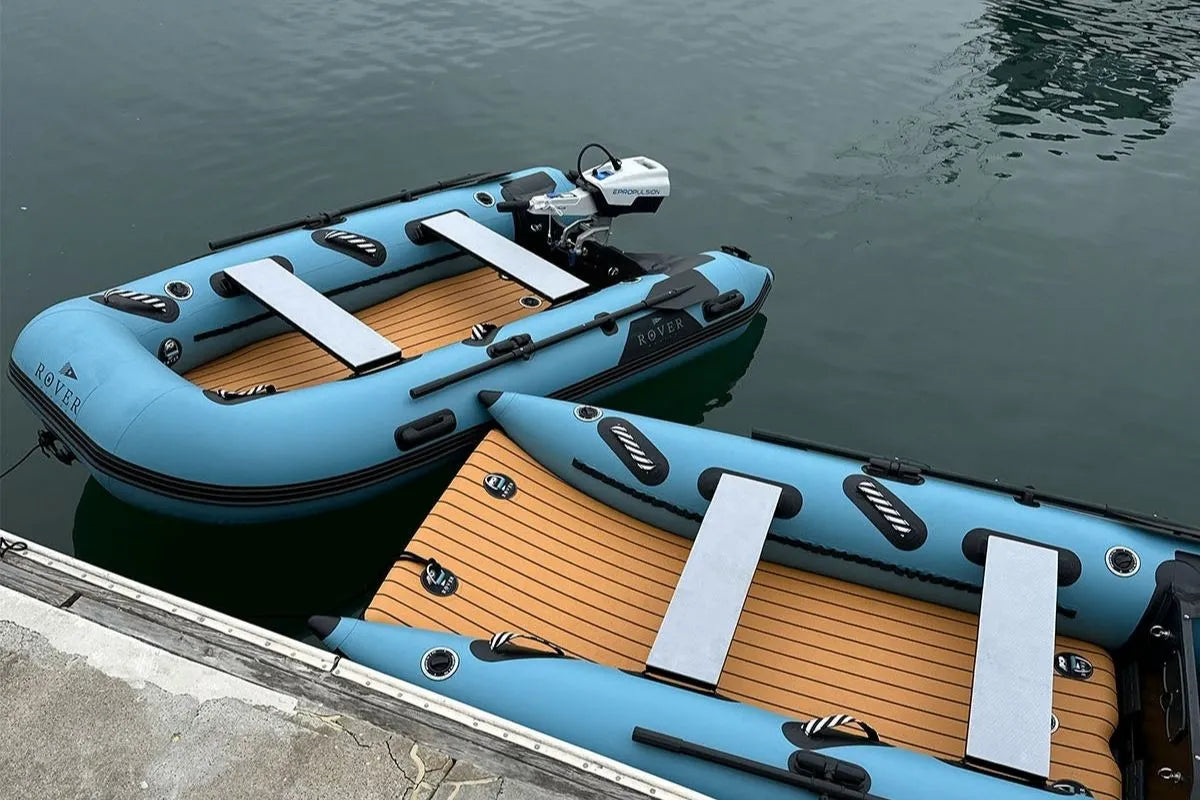
Rover Marine October 2026 guide
The paperwork is the last thing standing between you and the water
Four things stall a boat purchase over two thousand dollars: registration, insurance, financing, and delivery. Three of them get explained everywhere. Inflatable boat insurance is the one nobody covers, so buyers guess, assume their homeowners policy has it handled, and find out otherwise at the worst possible moment.

Here is the thing worth understanding before anything else. A boat like our 10-foot Battle Cat weighs 98 lb, carries 1000 lb or four people, takes up to 10 hp on a 15-inch transom, and has current pricing shown on the live product page. To you that is a tender. To an insurer it is a powered vessel operating in public waterways with other people aboard, and those are two different categories with two different sets of consequences.
We build these boats. We are not insurance agents, we do not sell policies, and nothing here is a recommendation about what coverage to buy. What follows is the shape of the decision and the questions to ask, so that when you call your own carrier you are having an informed conversation. Confirm every specific with that carrier and with your state boating agency.
Does an inflatable boat need its own insurance policy?
Insurance requirements depend on the state, the financing agreement, and where the boat is kept. Verify the legal requirement with your state boating agency and any contractual requirement with your lender, marina, yacht club, or storage facility.
Practically, two things override the legal question.
The first is a financing agreement. A lender may require proof of coverage as a condition of financing. If you finance the purchase, ask the provider exactly what coverage and documentation the agreement requires.
The second is where you keep it. A marina, yacht club, or dry-stack facility may require proof of liability coverage in its slip or storage agreement. That requirement comes from the facility contract, not from the state. If your inflatable lives in a locker at home and launches off a beach, inflatable boat insurance may never be asked about. If it lives at a marina, it will be.
The homeowners policy assumption, and where it runs out
This is the single most common assumption we hear about inflatable boat insurance, and it is worth taking apart carefully, because it is partly right.
Many homeowners and renters policies do extend some coverage to small watercraft. That is real. What varies enormously between policies and carriers is where the edges sit. Three places the assumption usually breaks down.
Value limits. A policy that extends to a small boat often does so up to a stated limit. Whether a two-thousand-dollar-plus boat plus a motor plus rigging sits inside that limit is a policy-specific question with a policy-specific answer.
Whether the motor counts. Some policies treat a boat and its motor differently, and horsepower thresholds are common in the language. Our boats accept up to 6 hp at 8 feet, 10 hp at 10 feet, and 20 hp at 12 feet. Where your motor lands relative to that language is something only your policy can tell you.
Whether liability travels. This is the one that matters most. Homeowners policies may provide limited watercraft liability, but the scope varies. Whether coverage follows a boat away from the property is a different question from whether the stored boat is treated as personal property.
So do not assume in either direction. Pull the actual policy document and read the watercraft section, or call your carrier and ask them to walk you through it. Ask specifically about the motor, about liability away from the property, and about the dollar limit. That is the entire instruction in this section, and it is the most useful thing on this page.
What a marine policy typically covers
Inflatable boat insurance, when written as a marine policy, is built from categories. Knowing them is what lets you have a real conversation with an agent instead of nodding along.
Hull / physical damage
What it protects:
The boat itself against covered loss such as theft, fire, storm, collision
Why it matters on a small boat:
Replaceable, and the smallest financial exposure on this list
Motor
What it protects:
The outboard, sometimes as a separate scheduled item
Why it matters on a small boat:
Often the most valuable single component on an inflatable, and the easiest thing to lose to theft
Liability
What it protects:
Injury or property damage you cause to others
Why it matters on a small boat:
The coverage that actually matters, because there is no ceiling on what an injury claim can become
Medical payments
What it protects:
Injuries to you and your passengers
Why it matters on a small boat:
Tenders carry guests, and guests are the people most likely to slip while boarding
Wreck removal
What it protects:
The cost of recovering or removing a sunk or disabled vessel
Why it matters on a small boat:
An obligation that can land on the owner regardless of the boat's value
Towing and assistance
What it protects:
On-water towing when the motor quits
Why it matters on a small boat:
A dead outboard a mile offshore is a real scenario with a real invoice
Trailer
What it protects:
The trailer itself, on the road and at rest
Why it matters on a small boat:
Only relevant if you trailer, which many inflatable owners never do
Liability is the coverage that actually matters
Hull and motor coverage is about property. Liability is about people, and the asymmetry is stark. If your boat is destroyed, you have lost a boat. If someone is injured in an incident involving your boat, the exposure is not bounded by the value of the boat, and no amount of care makes that exposure zero.
That is the honest reason a two-thousand-dollar inflatable is worth a conversation about coverage. Not because the hull is precious. Because the hull is not the risk.
How insurers tend to think about small boats
A few patterns are worth knowing so the questions do not surprise you. Insurers generally care about the value of the hull, the horsepower and value of the motor, how and where the boat is used, who operates it, and where it is kept. Small, low-horsepower boats sit at the simple end of that spectrum. Expect questions in those categories, and expect that answering them accurately matters more than answering them favorably.
What changes when the boat deflates
This is where inflatable owners have a genuinely different profile, and it is worth raising with your carrier rather than leaving unstated.
A boat on a mooring or in a wet slip is exposed continuously to weather, theft, and other vessels. An inflatable that deflates to roughly 38 to 48 inches long by 24 to 32 wide by 15 to 20 deep depending on size and lives in a garage or a boat locker is not. It is exposed only while in use, and stored in a way that changes both the theft picture and the storm picture. Whether that matters to a given carrier is their call, not ours, but it is a fact about your boat worth stating when you ask about inflatable boat insurance. Our guide to storing an inflatable boat for winter covers doing that layup properly.
Registration: the short version
Registration is a separate obligation from insurance, and the two get tangled constantly. The short version:
Most states require you to register a boat that has a motor. Rules for unpowered boats vary widely.
Requirements, processes, and fees differ by state. There is no national rule to fall back on.
Rover Marine hulls are built with documentation for registration where required, so the hull identification your state asks for is on the boat.
The DMV or state agency paperwork is handled separately by you, as the owner, after purchase.
We wrote the state-by-state detail up already. For the specifics where you boat, read do you have to register an inflatable boat, then confirm with your state agency, because these rules change.

A warranty is not insurance, and the difference trips people up
We get this conflated more than almost anything else, so here it is plainly. A warranty covers the boat being built wrong. Inflatable boat insurance covers things that happen to the boat and to other people.
Rover Marine's warranty runs 5 years on the hull for manufacturing defects, structural delamination, and air leaks tied to manufacturing, 3 years on tubes and seams for manufacturing defects or delamination, and 2 years on bolt-on and clamp-on accessory components. Motors and third-party products may follow the original manufacturer's own policy where we source them. Claims go through the warranty form with photos and order information, and can take up to 30 days to resolve.
What the warranty explicitly does not cover is the entire category insurance exists for. Punctures from use or handling, dock rash, boat-to-boat scuffs, abrasion, cosmetic damage from everyday misuse, outdoor neglect, and dinghy rot are named exclusions, as is damage from accidents, misuse, improper storage, wildlife, or normal wear.
Read that list again, because it answers the question people are really asking. If you drag the boat over an oyster bar, that is not a warranty claim. If a dock cleat gouges a tube, that is not a warranty claim. Those are exactly the events an insurance conversation is about. The two do not overlap, and neither substitutes for the other.
What to have ready before you call an insurer
Have this in front of you and the call takes ten minutes instead of three.
Hull identification number and the make and model of the boat
Length and year - 8, 10, or 12 feet for our boats, and the model year
Hull value - the purchase price, from $1,999 for a Battle Boat and from $1,999 for a Battle Cat
Motor make, model, and horsepower, and whether it is gas or electric, since our 15-inch transom takes short-shaft units from our electric outboard collection
Where it is stored - deflated in a garage, on a trailer, in a boat locker, on a mooring
How you use it - tender, fishing, day trips, and roughly how often
Where you use it - inland lakes, coastal, or both, and whether you cross state lines
Who operates it, and whether anyone has completed a state boating safety course
Your existing homeowners or renters policy, so you can ask the watercraft question directly
Safety equipment changes outcomes, and our inflatable boat safety checklist covers what belongs aboard. If you are still deciding on the boat itself, how long inflatable boats last and our FAQ page cover the ownership questions that come before the paperwork.
Frequently asked questions
Do you need insurance for an inflatable boat?
Requirements depend on state law and on contracts such as financing, marina, yacht-club, or storage agreements. Confirm the legal requirement with your state boating agency and any contractual requirement with the other party. Ask an insurance professional how liability, the boat, and the motor would be covered.
Is an inflatable boat covered by homeowners insurance?
Sometimes, partly. Many homeowners and renters policies extend limited coverage to small watercraft, but the value limit, whether the motor is included, and whether liability follows the boat away from your property all vary by policy. Read the watercraft section of your actual policy or call your carrier and ask those three questions specifically.
What does inflatable boat insurance typically cover?
Marine policies are usually built from categories: hull or physical damage, the motor, liability for injury or damage you cause to others, medical payments for passengers, wreck removal, on-water towing, and the trailer if you have one. Which categories apply to your boat and how they are structured is set by your carrier and policy.
Does a boat warranty cover accidental damage?
No. Rover Marine's warranty covers manufacturing defects, with 5 years on the hull, 3 years on tubes and seams, and 2 years on accessory components. Punctures from use or handling, dock rash, abrasion, and damage from accidents, misuse, or improper storage are named exclusions. Warranties cover build defects. Insurance covers accidents and liability.
Do you have to register an inflatable boat?
Most states require registration for a boat with a motor, and rules for unpowered boats vary widely by state. Rover Marine hulls are built with documentation for registration where required, so the hull identification your state requires is on the boat. The DMV paperwork is handled separately by the owner after purchase.

Leave a comment
This site is protected by hCaptcha and the hCaptcha Privacy Policy and Terms of Service apply.