If you have spent any time shopping for a dinghy, tender, or small fishing platform, you have run into two very different designs that get talked about in the same breath: the rigid inflatable boat, usually called a RIB or RHIB, and the inflatable catamaran. They both use inflatable tubes. They both exist to give small-boat owners more stability and buoyancy than a plain hard skiff. And they both get lumped under the broad "inflatable" label at the boat show.
That is where the similarity ends.
A true RIB rides on a fixed fiberglass, aluminum, or composite hull with inflatable tubes bonded around the sides. An inflatable catamaran rides on two parallel air-filled hulls connected by a deck or high-pressure floor. The ride feel, storage requirements, cargo layout, and how each one behaves in chop are genuinely different. This is not a marketing split. It is a different way of building a small boat.
This guide compares them head-to-head for 2026, using real specs, real use cases, and real price tags. If you are deciding between a soft inflatable, a molded RIB, and a cat-style inflatable, start with Rover Marine's rigid vs soft inflatable boat breakdown, then come back here when you are ready to choose between hull formats.
Quick answer: A true molded RIB is the stronger choice for speed, fixed-hull handling, and rougher open-water tender runs if you have the storage, davits, or trailer to support it. An inflatable catamaran is the better choice when stability, deck space, easy boarding, fishing, diving, and portable storage matter more. For Rover Marine buyers, the Battle Boat is the packable traditional inflatable hull option. The Battle Cat is the inflatable catamaran option.
What "Inflatable Catamaran" and "RIB" Actually Mean
The term RIB means rigid inflatable boat. In common boating use, a RIB has a solid hull, usually fiberglass or aluminum, with inflatable tubes around the perimeter. The Discover Boating inflatable boat guide describes inflatable boat components including tubes, fabric, transom, floor, and bottom, and notes that the bottom may be fabric, fiberglass, or aluminum.
Federal boating language is broader. Under 33 CFR 173.3, an inflatable boat is a vessel that uses air-filled flexible fabric for buoyancy. That definition covers a broad category. It does not mean every inflatable is a RIB.
An inflatable catamaran, sometimes called an inflatable cat boat, is structurally different from a RIB. Instead of one solid hull, it has two long inflatable pontoons bridged by a deck or high-pressure floor. The hulls run in parallel, much like a sailing catamaran. There is no molded V-hull underneath. Initial stability comes from the wide stance of the two tubes, not from a keel.
In plain English: a RIB is a fixed-hull boat with inflatable sides. An inflatable catamaran is two long inflatable hulls with a usable deck between them.
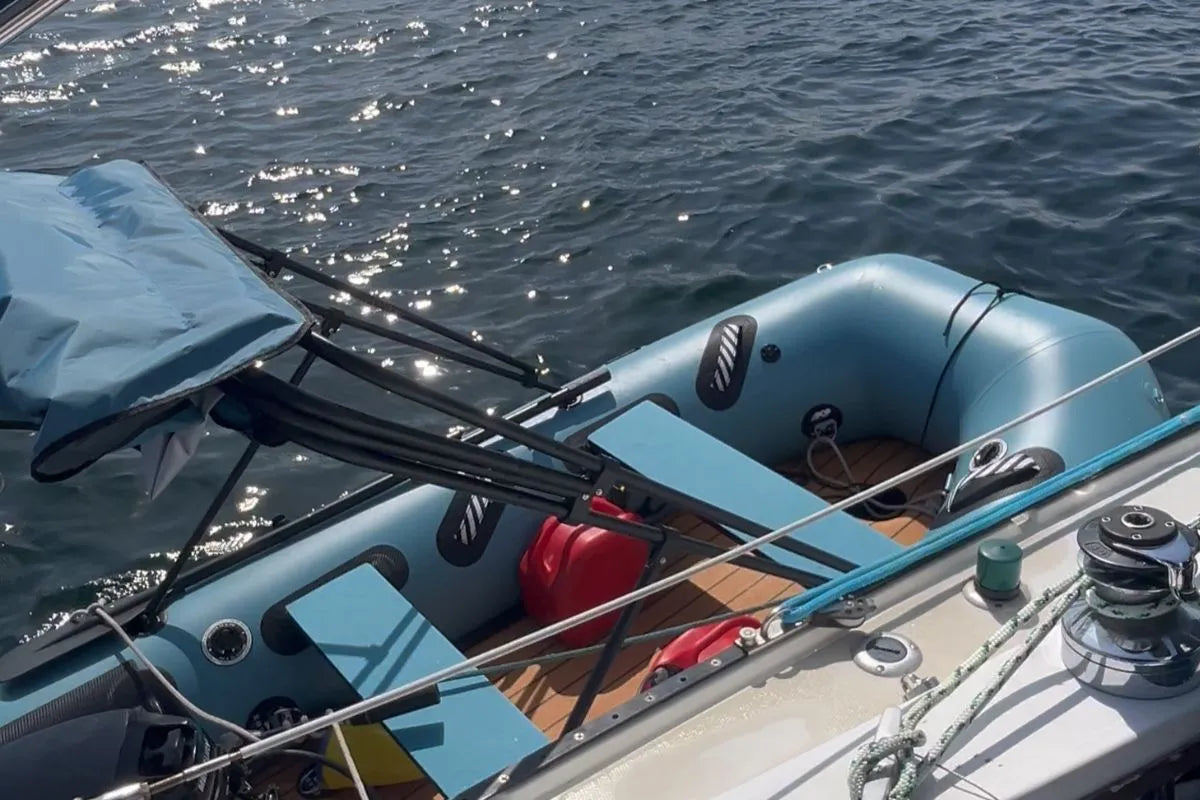
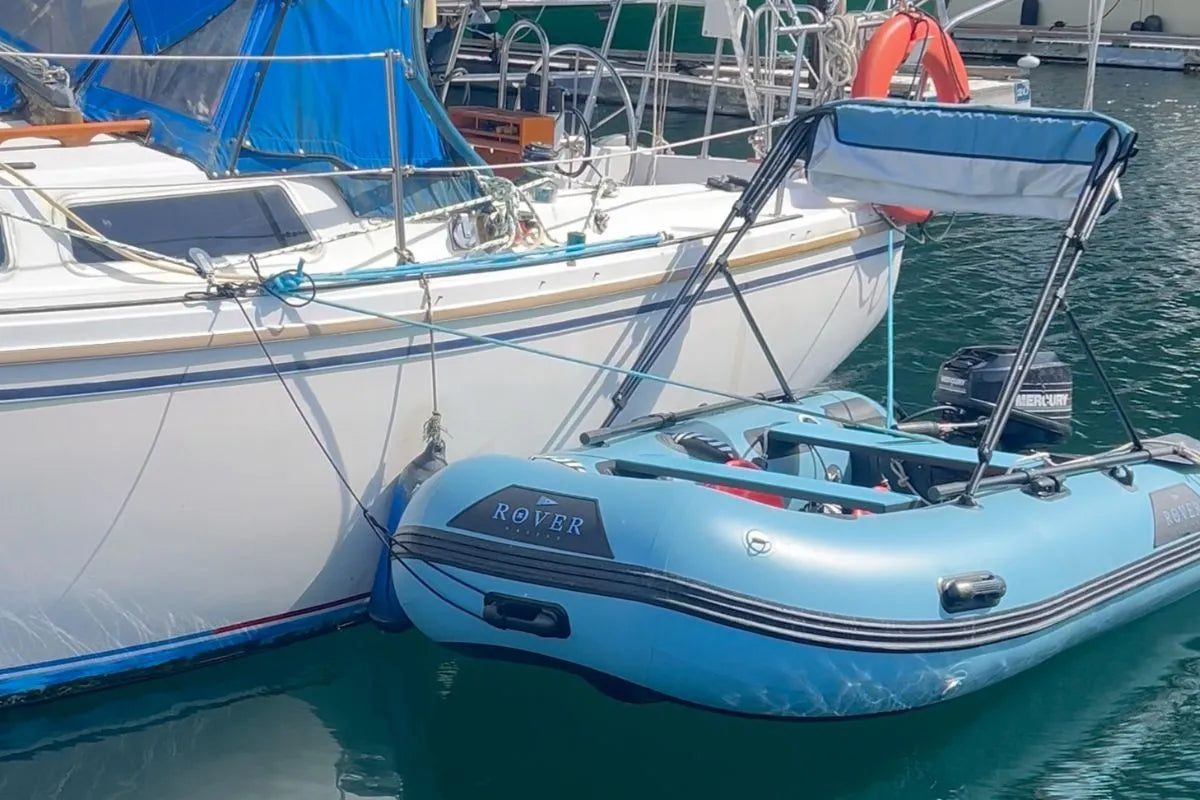
This matters because not every inflatable dinghy that feels firm underfoot is a true RIB. The Rover Marine Battle Boat is a traditional inflatable hull with a high-pressure floor. The Battle Cat is an inflatable catamaran with dual pontoons and a reinforced high-pressure floor. Both pack down. A molded RIB generally does not.

Side-by-Side Spec Comparison
The Battle Boat is Rover Marine's traditional inflatable dinghy with a high-pressure drop-stitch floor, built for packable tender duty, lake use, beach launching, and no-trailer boating. The Battle Cat is the inflatable catamaran, built around dual pontoons for wider stance, better lateral stability, and more confidence when people are moving around on deck.
Both are portable Rover Marine inflatables. Both inflate fast. Both work with electric or gas outboards within their size-specific ratings. They behave very differently on the water.
| Spec | Battle Boat Traditional Inflatable | Battle Cat Inflatable Catamaran |
|---|---|---|
| Hull type | Traditional inflatable hull with high-pressure floor | Catamaran-style dual pontoons with reinforced high-pressure floor |
| Sizes | 8 ft / 10 ft / 12 ft | 8 ft / 10 ft / 12 ft |
| 8 ft deflated size | 38 in x 24 in x 15 in | 38 in x 24 in x 15 in |
| 8 ft assembled weight | 86 lb | 84 lb |
| Starting price | From $1,999 | From $2,299 |
| Max passengers, 8 ft / 10 ft / 12 ft | 2 / 4 / 4 | 2 / 4 / 4 |
| Recommended power, 8 ft / 10 ft / 12 ft | Up to 6 hp / 10 hp / 20 hp | Up to 6 hp / 10 hp / 20 hp |
| Tube and floor pressure | Tube 3.5 psi / Floor 10 psi | Tube 3.5 psi / Floor 10 psi |
| Initial stability at rest | Good | Excellent |
| Setup time | About 10 to 15 minutes with a high-output pump | About 10 to 15 minutes with a high-output pump |
| Best for | Packable tender duty, leisure runs, light fishing, SUV transport | Fishing, diving, family-stable tender work, choppier active use cases |
The 8 ft Battle Cat costs $300 more than the 8 ft Battle Boat at current starting prices. You are paying for a different on-water experience. The Battle Boat gives you a familiar single-hull inflatable layout with easy handling and balanced floor space. The Battle Cat gives you a wider stance, better lateral stability, and a platform that feels more settled when people stand, board, fish, or load gear.

Stability: Why Twin-Hull Inflatables Feel Different Underway
Stability is the single biggest reason buyers pick an inflatable catamaran over a narrow single-hull inflatable or a fixed-hull RIB. When you step onto a Battle Cat tied to the dock, the wide dual-pontoon footprint resists side-to-side movement. You do not need to tiptoe around the centreline the same way you might in a narrower tender.
That is why inflatable cats make sense for fly fishermen, scuba divers loading gear, families boarding from a swim platform, and photographers who need a steadier platform. A cat-style boat gives you initial stability, meaning resistance to heel when the boat is at rest or moving slowly.
A true RIB or a single-hull inflatable behaves differently. It may roll a little when someone steps aboard, then settle into the tubes. Once underway, a rigid V-hull RIB can use its molded hull shape to cut through chop, track cleanly, and lean into turns. That is why RIBs are common as rescue craft, commercial tenders, and faster support boats.
A cat does not roll as much. It tends to pitch more as the two hulls meet wave faces. In flat water, protected coves, marinas, lakes, and calm fishing zones, that wide stance feels planted. In short, steep chop, a true molded RIB may feel more settled at speed, while the inflatable catamaran still wins when people are standing, boarding, or shifting gear.
Quick rule of thumb: if your water is mostly flat, lakes, protected coves, marinas, dive sites, and sheltered bays, the cat feels more stable. If you are crossing exposed water at speed and have fixed-hull storage, a true RIB is the rougher-water tool.
Speed and Planing Characteristics at 3, 6, and 10 hp
Both Rover Marine platforms are rated for outboard power, but power ratings are not speed guarantees. Load, trim, shaft length, prop choice, current, wind, tube pressure, and water state all change the result. Do not buy the motor first and force the boat to match it.
Use this as practical guidance, not a speed promise.
| Outboard Class | True Molded RIB | Battle Boat | Battle Cat |
|---|---|---|---|
| 3 hp or 3 HP-equivalent electric | Good for quiet tender speed and short transfers, not a speed setup. | Good for short tender runs, lake use, harbour cruising, and calm-water errands. | Good for stable, quiet, low-speed control with fishing, family, or gear aboard. |
| 6 hp gas | Light loads may plane depending on hull and setup. | Within the 8 ft Battle Boat rating. Load and trim matter. | Within the 8 ft Battle Cat rating. Stability matters more than chasing top speed. |
| 10 hp gas | This is where many small true RIBs start to show their fixed-hull speed advantage. | Fits the 10 ft and 12 ft Battle Boat ratings. The 8 ft model is rated up to 6 hp. | Fits the 10 ft and 12 ft Battle Cat ratings. The 8 ft model is rated up to 6 hp. |
| 20 hp gas | Common on larger RIBs where the hull, transom, and storage plan are built for it. | Only the 12 ft Battle Boat lists up to 20 hp. | Only the 12 ft Battle Cat lists up to 20 hp. |
If you are running a 3 HP-equivalent electric like the ePropulsion Spirit 1.0 Plus Short Shaft or the Torqeedo Travel 1103 S Short Shaft Extended Range Package, both Rover designs live in the practical tender-speed range. The difference is feel. The Battle Boat gives you a familiar single-hull inflatable ride. The Battle Cat gives you the flatter, wider, more stable platform.
Want more detail on power matching? Read Rover Marine's best outboard motors for inflatable dinghies.

Weight, Packability, and Setup Time
This is where Rover Marine inflatables separate themselves from true molded RIBs. A molded RIB can be a great boat, but it is not trunk-portable in the same way. You need a trailer, davits, chocks, a dock, or a fixed storage plan. That works for some owners. It is a problem for others.
The 8 ft Battle Boat packs to 38 in x 24 in x 15 in and weighs 86 lb assembled. The 8 ft Battle Cat packs to 38 in x 24 in x 15 in and weighs 84 lb assembled. Both are built for truck beds, SUVs, RV storage, yacht lockers, garage shelves, and no-trailer water access.
Setup with a high-output pump is straightforward: unroll, inflate to spec, check pressure, mount the motor, load safety gear, and launch. With Rover Marine boats, the floor inflates to 10 PSI and the tubes inflate to 3.5 PSI. Do not shortcut pressure. Underinflated boats feel sloppy, waste power, and put extra stress on seams and the transom.
If you are choosing between sizes before choosing a hull type, Rover Marine's inflatable dinghy size comparison guide walks through the length-to-use-case math.
Price: 5-Year Total Cost of Ownership
List price is only part of the story. A boat that needs a trailer, storage yard, davit upgrade, or dock space can get expensive fast. A packable inflatable keeps the ownership math cleaner because storage is usually handled at home, in the vehicle, or aboard the yacht.
This example uses the 8 ft Battle Boat and 8 ft Battle Cat paired with the ePropulsion Spirit 1.0 Plus. Accessory costs are rough owner-budget estimates, not Rover Marine product claims. Source anchors, PFDs, and safety equipment from a proper marine supplier if Rover Marine does not currently sell that item.
| Cost Item | Battle Boat | Battle Cat |
|---|---|---|
| Boat purchase, 8 ft starting price | $1,999 | $2,299 |
| Electric outboard, ePropulsion Spirit 1.0 Plus | $2,999 | $2,999 |
| Pump, PFDs, anchor, line, and basic safety gear | Budget about $250 or more | Budget about $250 or more |
| Annual garage, closet, or yacht-locker storage | $0 if you already have space | $0 if you already have space |
| Patch kit, glue, cleaner, and basic care supplies over 5 years | Budget about $60 to $100 | Budget about $60 to $100 |
| Estimated 5-year budget before resale | About $5,300+ | About $5,600+ |
There is no clean Kelley Blue Book for inflatable dinghies, and used prices depend heavily on condition, UV exposure, storage, seams, valves, and whether the motor package is included. Treat resale as a bonus. Buy the layout that fits your water first.
Tube Material, UV, and Long-Term Durability
Hull type matters, but tube care matters more. UV exposure, heat, salt, pressure management, storage habits, and seam care will decide how long any inflatable lasts.
BoatUS notes that small inflatable dinghies are often made with PVC because it is lightweight and cost-effective, while larger and heavy-duty craft often use Hypalon/CSM for stronger UV resistance and longer harsh-climate service life.
Rover Marine inflatables use military-grade PVC with reinforced seams and drop-stitch flooring. That makes sense for owners who want portability, value, easy storage, and rugged day-to-day use. If you store any PVC inflatable in Florida, the Gulf, the Bahamas, Southern California, or another high-UV zone, cover it, rinse salt, dry it, and keep it out of the sun when you can.
Material does not replace maintenance. Do not leave a boat half-covered, half-baked in the sun, and full of sand, then blame the fabric. Rinse it. Dry it. Check pressure. Store it properly.
Best Use Case Matrix
Here is how the two design families actually get used by US boaters:
| Use Case | Best Fit | Why |
|---|---|---|
| Yacht tender, exposed chop, fixed storage available | True molded RIB | Fixed V-hull handling is strong when speed and chop are the priority. |
| Yacht tender, no trailer, no fixed RIB storage | Battle Boat or Battle Cat | Both pack down and work for yacht lockers, SUVs, RVs, and garage storage. |
| Freshwater bass or panfish | Battle Cat | Stable casting platform and less side-to-side roll. |
| Scuba, freediving, or swim platform boarding | Battle Cat | Wider stance helps when loading gear or climbing back aboard. |
| Kayak or paddleboard alternative | Battle Boat | Simple handling, compact storage, and easy general-purpose use. |
| Inshore saltwater fishing | Battle Cat | Deck space and stability help standing anglers and gear-heavy setups. |
| Day cruising with 3 to 4 passengers | Either, in 10 ft or 12 ft sizes | Both 10 ft and 12 ft Rover models list 4-person capacity. |
| Photography or film work | Battle Cat | Steadier platform at rest and slow speed. |
| Higher-power speed-first boating | True molded RIB, or 12 ft Rover model within rating | Fixed hulls generally use horsepower more aggressively. Rover 12 ft models list up to 20 hp. |
When the RIB Wins / When the Cat Wins
A true molded RIB wins when:
- You are crossing exposed water regularly.
- You want the strongest fixed-hull handling in chop.
- You have davits, chocks, a trailer, or dock storage.
- You want to run higher horsepower and use that power for speed.
- You do not need the boat to pack into a bag or vehicle cargo area.
The Battle Boat wins when:
- You want a rugged, packable traditional inflatable hull.
- You need no-trailer transport in an SUV, truck, RV, or yacht locker.
- You are usually launching solo or with one helper.
- You want the lower starting price in the Rover Marine lineup.
- You want a straightforward tender, lake boat, cottage boat, or light fishing platform.
The Battle Cat wins when:
- Stability at rest is your number-one priority.
- You fish, dive, shoot photos, or load gear from the boat.
- Your water is mostly flat or protected, including lakes, bays, rivers, coves, and marinas.
- You want maximum usable deck confidence for the footprint.
- You carry coolers, camera gear, dive gear, kids, or a dog that benefits from a flatter, wider platform.
There is no universally better design. There is a better design for your water, your storage, your motor, and your mission.
FAQ
What does "RIB boat" mean?
RIB stands for rigid inflatable boat. It is a boat with a rigid hull, usually fiberglass, aluminum, or composite, and inflatable tubes around the sides. The rigid hull handles the water. The tubes add buoyancy, impact protection, and stability.
Is an inflatable catamaran safer than a RIB?
Neither is automatically safer. They are safer in different conditions. A cat is more stable at rest and at low speed, which helps with boarding, fishing, diving, and moving around with gear. A true RIB can be the better tool for speed, chop, and exposed-water tender runs. Match the design to your water.
Can I use an inflatable catamaran as a sailboat tender?
Yes. An inflatable catamaran can work well as a sailboat or yacht tender, especially if you value stability when stepping on and off the boat. Many cruisers still prefer true RIBs for fast exposed anchorage runs because the molded hull handles chop well. If storage and portability matter more than fixed-hull speed, the Battle Cat makes a strong tender case.
Which holds up better long-term?
Hull layout is only part of durability. Tube material, UV exposure, storage, cleaning, pressure management, and seam care matter more over time. Both Rover Marine platforms use military-grade PVC with reinforced seams and drop-stitch flooring. Keep the boat covered, rinsed, dry, and stored out of hard sun whenever possible.
Do I need a trailer for either Rover Marine boat?
No. The Battle Boat and Battle Cat both pack down for transport and storage. That is one of the biggest reasons US boaters buy portable inflatables instead of hardshell skiffs or molded RIBs. A true molded RIB generally does need fixed storage, a trailer, davits, or chocks.
The Bottom Line
If your mission is coastal chop, speed, and rougher exposed tender work, and you have the storage system for it, a true molded RIB is still hard to beat.
If your mission is portable boating, yacht tender use, lake runs, cottage access, no-trailer storage, and quick weekend launching, the Battle Boat makes more sense than a fixed-hull RIB for a lot of owners. The 8 ft Battle Boat starts at $1,999 and gives you a tough traditional inflatable hull with real packability.
If your mission is fishing, diving, photography, family cruising, swim-platform boarding, or flat-water day use where stability matters more than top speed, go with the cat. The 8 ft Battle Cat starts at $2,299 and gives you a wide, stable platform you can use without thinking about every footstep.
Either way, pair the boat with a quiet, low-maintenance electric outboard from the Rover Marine electric outboards collection and you have a portable setup you can throw in the vehicle, launch without a trailer, and use for real water access.
Still deciding between electric and gas power? Read comparing outboard vs electric engines for dinghies next.
Questions about fit, motor pairing, or storage? Call 844-207-6837 or reach the team through the Rover Marine contact page.

Leave a comment
This site is protected by hCaptcha and the hCaptcha Privacy Policy and Terms of Service apply.