
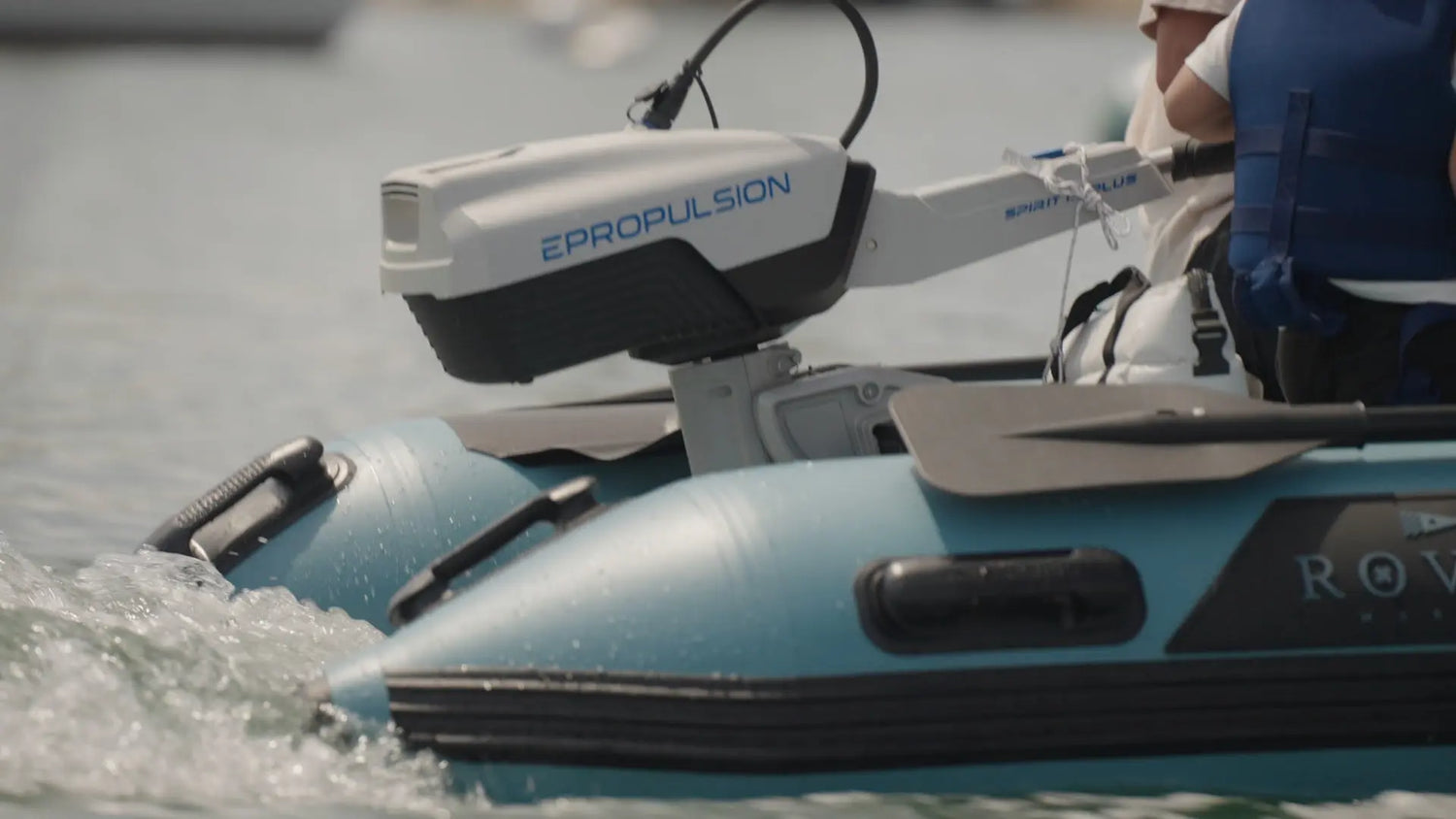
The useful comparison is not “outboard versus electric,” because an electric motor can also be an outboard. The real decision is gas outboard versus electric outboard. Both can power a correctly rated inflatable dinghy, but they organize energy, weight, maintenance, noise, refueling, and route reserve differently.
This guide compares those systems without promising a universal range, lower lifetime cost, or gas-equivalent performance.
Should a dinghy use gas or electric?
How gas and electric systems differ
| Factor | Electric outboard | Gas outboard |
|---|---|---|
| Energy | Battery charged from a compatible electrical source | Fuel carried in an approved system |
| Starting | Electronic controls and battery state | Manual or electric start, depending on motor |
| Routine service | Battery, connectors, propeller, software, corrosion, inspections | Fuel, cooling, lubrication, ignition, lower unit, propeller, corrosion |
| Noise and exhaust | Quieter and no direct combustion exhaust at the motor | Combustion noise, vibration, and exhaust |
| Replenishment | Charging time and access | Rapid refueling where fuel is available |
| Endurance | Highly sensitive to throttle and battery capacity | Highly sensitive to throttle, tank size, load, and conditions |
Range and runtime require a route model
Electric power demand can rise sharply with throttle. A favorable low-speed runtime cannot be converted into a full-throttle promise. Use the exact battery, loaded boat, expected throttle, wind, waves, current, temperature, pressure, and battery health, then keep a return reserve.
Gas also needs a reserve. Tank capacity alone is not range. Consumption changes with load, motor, propeller, trim, sea state, and throttle. Secure fuel, manage ventilation, inspect lines, and prevent spills.
Installed weight and storage can decide the answer

Compare motor, battery or fuel, tank, lines, controls, charger carried aboard, lifting equipment, and storage protection. A removable battery can split the lift into pieces, but the complete weight still counts toward capacity.
Gas storage needs ventilation and responsible fuel handling. Electric storage needs battery temperatures, charge state, terminals, charger, and fire-safety instructions from the manufacturer. Neither system should be stored casually.
Cost and maintenance over several seasons
Sticker price is only one line. Electric cost includes the complete battery and charger package, charging access, possible extra capacity, service, and eventual battery replacement. Gas cost includes tank, line, fuel, oil where applicable, scheduled service, winterization where applicable, and storage.
Do not claim electric always costs less. Frequency, fuel price, electricity, service access, battery life, and duty cycle decide. Compare a realistic three-season budget and the owner time required for each routine.
Current Rover Marine compatibility
| Size | Inflated dimensions | Capacity | Maximum motor | Battle Boat / Cat weight |
|---|---|---|---|---|
| 8 ft | 8 x 4 x 15 in | 2 people / 600 lb | Up to 6 HP | 86 / 84 lb |
| 10 ft | 10 x 5 x 18 in | 4 people / 1,000 lb | Up to 10 HP | 100 / 98 lb |
| 12 ft | 12 x 5.5 x 20 in | 4 people / 1,200 lb | Up to 20 HP | 135 / 130 lb |
ePropulsion short shaft
Review the Spirit 1.0 Plus listing for the current 1 kW, 3 HP equivalent class package and exact inclusions.
Torqeedo short shaft
Compare the Travel 1103 S Essential and Extended Range packages for battery configuration and contents.

All current Rover sizes list 15-inch transoms. Stay within 6, 10, or 20 HP and follow the motor maker’s installation. Equivalent horsepower does not guarantee identical gas performance.
What Rover owners say about electric setups
That is the right way to use social proof: confirm that owners are using the configuration for relevant activities, then do the technical route and weight planning yourself.
Use properly fitted life jackets and confirm the current requirements for the exact craft, motor, operating area, and activity. The U.S. Coast Guard provides current life jacket guidance.
Five-year ownership questions for gas and electric
Estimate acquisition, energy, routine service, winterization or battery care, storage equipment, replacement parts, and expected component replacement. Do not rely on a single fuel-price or electricity-price snapshot. The useful comparison is whether the owner can support the system where and how it is used.
For electric, document usable battery capacity, charger input, charge time under the exact power source, storage state of charge, temperature limits, waterproofing instructions, and replacement-battery availability. For gas, document approved fuel, tank and line storage, ventilation, seasonal care, oil and cooling requirements, spill prevention, and nearby service.
Route risk changes the answer
A short protected tender route with dependable charging can favor electric even if rapid refueling is unavailable. Repeated duty with limited shore power may favor gas. Noise restrictions, gasoline-storage rules, lifting limits, and service access can reverse either choice.
Use the same loaded route to test both candidates. Record throttle, conditions, elapsed time, energy or fuel consumed, and reserve. Do not compare an electric motor at efficient displacement speed with a gas motor at a different duty point and call the result definitive.
Frequently asked questions
Is an electric motor an outboard?
Yes. Outboard describes the mounting arrangement. The power source can be electric or gas.
Is electric better for short tender trips?
It can be when charging, route, load, and desired quiet operation fit. It is not automatic.
Is gas better for long trips?
Rapid refueling can help sustained duty, but the exact hull, motor, tank, route, and conditions decide.
Which has less maintenance?
Electric typically has fewer combustion-service tasks, but still needs battery, electrical, propeller, corrosion, and inspection care.
Which is lighter?
Compare complete systems. Motor-only weight can hide the battery, tank, fuel, charger, or cables.
Which is quieter?
Electric is generally quieter than a comparable small gas outboard, but not literally silent.
Which is cleaner?
Electric produces no direct combustion exhaust at the motor. Lifecycle impact depends on battery and electricity factors.
Can I use either on Rover Marine boats?
A compatible motor may be used if shaft, mounting, weight, and power remain within current limits.
What shaft should I choose?
Short shaft is the normal match for the 15-inch transom.
How do I plan electric reserve?
Use the exact package and loaded route, then turn back before the reserve becomes necessary.
How do reviews help?
They identify ownership themes and support experiences, not guaranteed range or fit.
Where can I compare current electric packages?
Use Rover Marine’s live electric motor collection and product pages.
Choose the energy system that fits the route
Compare complete weight, replenishment, service, storage, and return reserve before choosing gas or electric.

Leave a comment
This site is protected by hCaptcha and the hCaptcha Privacy Policy and Terms of Service apply.