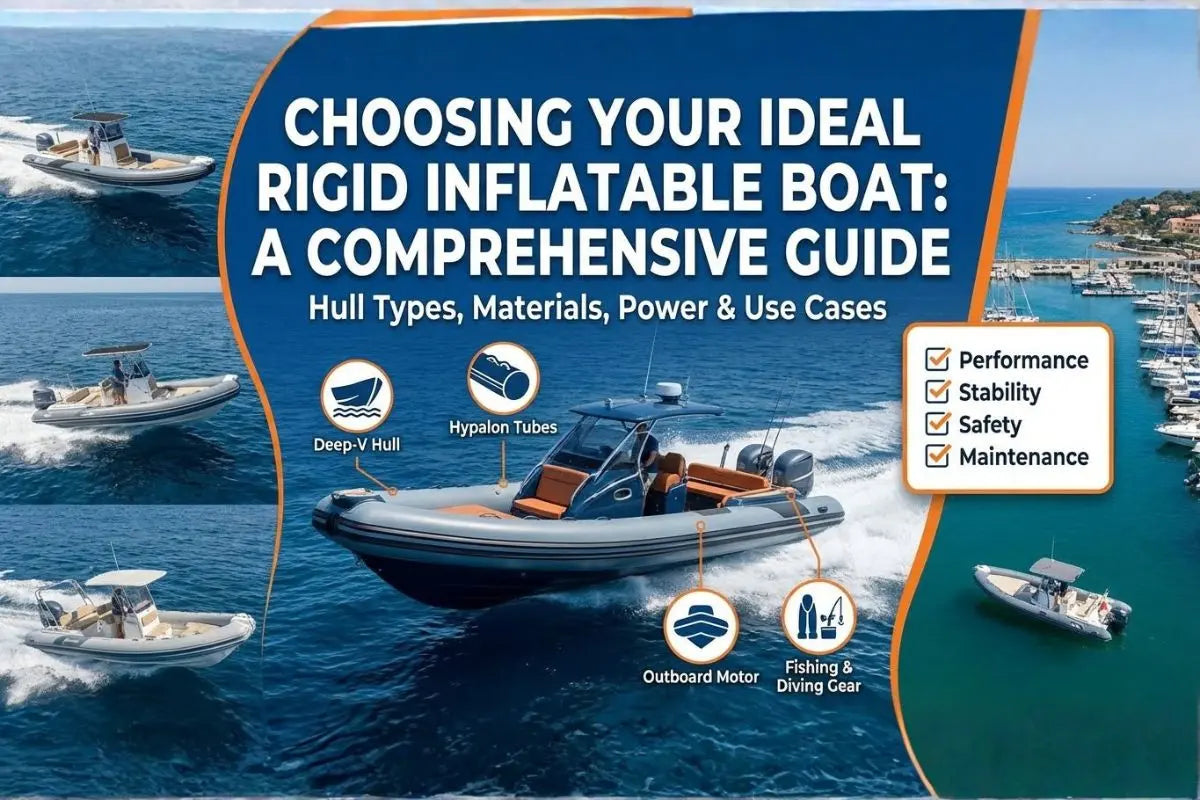
Rigid inflatable boats, commonly called RIBs, combine a solid hull with inflatable side tubes. Their rigid hulls distinguish them from fully inflatable boats that use inflatable floors, keels, or pontoons instead of a permanent aluminum or fiberglass lower hull.
Neither category is automatically better for every owner. A true RIB may make sense when higher-speed handling, a permanent hull, and rougher-water capability are priorities. A fully inflatable boat may make more sense when compact storage, easier transportation, tender duty, and the ability to deflate the complete boat are more important.
This guide explains the main RIB hull types, materials, uses, power options, maintenance needs, and how Rover Marine's Battle Boat and Battle Cat fit as fully inflatable alternatives.

What Is a Rigid Inflatable Boat?
A rigid inflatable boat combines a solid lower hull with inflatable tubes positioned around the sides. The lower hull is commonly made from aluminum or fiberglass, while the tubes may use PVC or CSM-based fabric.
The rigid hull controls much of the boat's water entry, tracking, and planing behavior. The inflatable tubes add buoyancy, provide a softer contact surface, and can contribute to stability as the boat heels or carries changing loads.
True Rigid Inflatable Boat
- Permanent aluminum or fiberglass lower hull.
- Inflatable side tubes or collars.
- Usually transported on a trailer, davit, or deck cradle.
- Cannot be fully folded into a compact storage package.
- Often designed for higher sustained speeds.
Fully Inflatable Boat
- No permanent rigid aluminum or fiberglass lower hull.
- Uses inflatable tubes, pontoons, keel, or floor structures.
- Can be deflated for more compact storage.
- Often easier to move without a dedicated trailer.
- Available in traditional and catamaran-style layouts.
A Fully Inflatable Catamaran Is Not Automatically a RIB
Catamaran describes a twin-hull layout. RIB describes a boat with a rigid lower hull and inflatable tubes. A catamaran can be rigid, partially inflatable, or fully inflatable.
Rover Marine's Battle Cat is a fully inflatable catamaran. It should not be described as a rigid inflatable boat because it does not use a permanent aluminum or fiberglass lower hull.
What Are the Main RIB Hull Types?
RIBs can use several rigid hull geometries. The exact behavior depends on deadrise, beam, chines, weight distribution, tube placement, motor setup, and total load, not simply the name of the hull category.
Deep-V RIB
A deep-V hull uses a sharper angle through the bottom to enter waves more gradually. It may provide a more comfortable ride at speed in chop than a flatter hull.
The trade-off can include more draft, greater power demand, and less initial stability while sitting still.
Modified-V RIB
A modified-V balances wave entry with at-rest stability and lower-speed efficiency. It is common in mixed-use recreational and tender designs.
Actual performance varies because manufacturers use different deadrise, chine, and beam configurations.
Rigid Catamaran RIB
A rigid catamaran RIB uses two permanent lower hulls with inflatable tubes or collars. Its separated hulls can create a wide stance and usable deck area.
Ride quality depends on tunnel shape, hull spacing, load, and sea conditions.
Flatter-Hull RIB
A flatter rigid hull may offer shallow draft and stronger initial stability in calm water.
It may produce a firmer ride than a deeper V when crossing short, steep chop at speed.
| Rigid Hull Type | Common Strength | Potential Trade-Off | Common Use |
|---|---|---|---|
| Deep-V | Wave entry and ride quality while moving through chop. | May require more power and feel less steady at rest. | Coastal transit, larger tenders, recreational use. |
| Modified-V | Balance of handling, stability, and efficiency. | May not equal a deep-V in rough water or a flat hull at rest. | Day boating, tender service, fishing, mixed use. |
| Rigid Catamaran | Wide stance and strong initial stability. | Tunnel and twin-hull ride can vary in short, steep chop. | Diving, fishing, work platforms, specialized tenders. |
| Flatter Hull | Shallow draft and at-rest stability in calm water. | Can produce a firmer ride as chop and speed increase. | Protected water, utility work, shallow access. |
How Does Hull Shape Affect Stability?
Initial stability describes how steady a boat feels during small movements at rest. Secondary stability describes how the boat responds as it heels farther.
A wide or twin-hull platform may feel steady when passengers stand or move around. A narrower deep-V may lean more at rest but provide a softer wave entry while moving. Tube position and inflation also influence when the inflatable collars contact the water.
How Does Hull Shape Affect Ride Quality?
Ride quality depends on more than the hull category. Speed, weight, deadrise, length, beam, trim, propeller, wave direction, and operator technique all matter.
Buyers should avoid assuming every deep-V is smooth in all chop or every catamaran is always more stable. Compare the exact model and intended operating conditions.
How Do RIB Hull and Tube Materials Compare?
A RIB combines two major material systems: the rigid lower hull and the inflatable tubes. Each system has different maintenance, repair, weight, and storage considerations.
| Material | Common Advantages | Common Considerations |
|---|---|---|
| Aluminum rigid hull | Strong for its weight, impact resistant, and weldable by qualified repairers. | Requires corrosion control, electrical isolation, and coating inspection. |
| Fiberglass rigid hull | Can be molded into complex shapes with a smooth finished surface. | Gelcoat and laminate can be damaged by impact or poor repair. |
| Reinforced PVC tubes | Practical balance of weight, cost, repairability, and production consistency. | Requires proper UV care, cleaning, pressure management, and storage. |
| CSM-based tubes | Often selected for demanding UV, heat, chemical, or commercial exposure. | Usually costs more and requires compatible repair materials and methods. |
Aluminum vs. Fiberglass RIB Hulls
Aluminum can be a practical choice for utility use, rocky shorelines, workboats, and owners who prioritize impact resistance. It still requires careful corrosion management, especially where dissimilar metals, wiring, saltwater, and damaged coatings meet.
Fiberglass can provide a refined finish and allows designers to mold chines, strakes, storage areas, and other shapes into the hull. Repairs should be completed by someone familiar with laminates, core materials, gelcoat, and structural bonding.
PVC vs. CSM Tube Fabric
Fabric performance depends on the complete specification, including the base cloth, coatings, seams, adhesives or welding method, reinforcement, pressure, storage, climate, and maintenance.
It is not accurate to assign one universal lifespan to every PVC or CSM boat. A carefully stored PVC boat may outlast a poorly maintained boat made from a more expensive material.
Is Drop-Stitch Flooring Part of a RIB?
Some tenders and inflatable boats use drop-stitch floors, but the presence of a drop-stitch deck does not make a boat a RIB. A true RIB is defined by its permanent rigid lower hull.
Drop-stitch construction uses internal threads to hold the upper and lower surfaces at a fixed distance when inflated. It creates a firm, packable deck that is common in fully inflatable boats such as Rover Marine's Battle Series.
Which Boat Type Fits Different Activities?
The best platform depends on the trip. Buyers should begin with crew size, payload, water conditions, storage, transportation, and distance before choosing a hull category.
Fishing
Anglers may value deck room, at-rest stability, low-speed control, rod storage, electronics, and enough range to return safely.
A rigid modified-V or deep-V may suit longer coastal travel. A fully inflatable catamaran may suit anglers who prioritize portability and a wide standing platform on more protected water.
Diving
Dive boats need room for tanks, weights, fins, safety equipment, and reboarding. Every piece of equipment must be included in the total load.
Rigid catamarans, wide modified-V RIBs, and fully inflatable catamarans can all work, depending on distance and conditions.
Yacht Tender Use
Tender buyers should consider lifting points, davit capacity, storage footprint, motor weight, boarding, expected passenger load, and distance from the yacht to shore.
A RIB can remain ready for frequent use. A fully inflatable boat can be packed into a smaller storage area when it is not needed.
Family Cruising
Families may prioritize predictable handling, seating, shade, straightforward controls, quiet operation, and simple storage.
The correct choice depends on whether the family values higher-speed travel or easier transportation and compact storage.
What About Watersports and Towing?
Towing a tube, skier, or other rider requires a boat, motor, tow attachment, steering system, and operating environment approved for that use.
Buyers should not assume that reaching a certain horsepower rating makes every RIB or inflatable boat suitable for watersports. Confirm the intended towing use with the manufacturer before adding tow hardware or carrying out repeated towing activities.
How Rover Marine Differs From a Traditional RIB
Rover Marine's Battle Boat and Battle Cat are fully inflatable boats. They do not use permanent aluminum or fiberglass lower hulls and should not be described as RIBs.
Their advantage is that the complete boat can be deflated for transportation and storage. Both use triple-layer reinforced 1100D PVC, heat-welded seams, 3.5 PSI tubes, and 10 PSI drop-stitch floors.

Battle Boat
The Battle Boat uses a traditional inflatable tender layout with an inflatable hull structure and high-pressure drop-stitch floor.
- Fully deflates for transportation and storage.
- Available in 8-foot, 10-foot, and 12-foot sizes.
- Supports properly matched gas or electric outboards.
- Designed for tender use, fishing, diving, and cruising.

Battle Cat
The Battle Cat uses two parallel inflatable pontoons to create a wide catamaran-style platform.
- Fully deflates for transportation and storage.
- Available in 8-foot, 10-foot, and 12-foot sizes.
- Wide stance for fishing, diving, and passenger movement.
- Supports properly matched gas or electric outboards.
Current Rover Marine Specifications
| Boat Size | Capacity | Maximum Motor | Transom | Pressure |
|---|---|---|---|---|
| 8 Foot | 2 people / 600 lb | Up to 6 HP | 15 inches | 3.5 PSI tubes / 10 PSI floor |
| 10 Foot | 4 people / 1,000 lb | Up to 10 HP | 15 inches | 3.5 PSI tubes / 10 PSI floor |
| 12 Foot | 4 people / 1,200 lb | Up to 20 HP | 15 inches | 3.5 PSI tubes / 10 PSI floor |
Boat Weight by Model
| Model | 8 Foot | 10 Foot | 12 Foot |
|---|---|---|---|
| Battle Boat | 86 lb | 100 lb | 135 lb |
| Battle Cat | 84 lb | 98 lb | 130 lb |
RIB vs. Fully Inflatable Boat
| Decision Factor | Traditional RIB | Fully Inflatable Boat |
|---|---|---|
| Lower hull | Permanent aluminum or fiberglass hull. | Inflatable floor, keel, pontoons, or hull structure. |
| Storage | Retains the rigid hull footprint. | Can be deflated into a smaller package. |
| Transportation | Often uses a trailer, davit, cradle, or deck storage. | May travel in a vehicle, yacht locker, or storage area. |
| Ride at speed | Rigid hull can support specialized wave-entry designs. | Performance depends on inflatable hull shape, pressure, and load. |
| Impact and abrasion | Rigid hull handles some impacts but can dent, crack, or lose coating. | Fabric can puncture or abrade and should not be dragged. |
| Ownership fit | Owners prioritizing permanent readiness and rigid-hull handling. | Owners prioritizing portability and compact storage. |
Gas and Electric Power Options
Both RIBs and fully inflatable boats can use gas or electric outboards when the boat manufacturer approves the motor weight, power, shaft length, and installation.
Electric Outboards
- Quieter than comparable combustion motors.
- Zero exhaust emissions at the motor.
- No gasoline, carburetor, or engine-oil changes.
- Range depends on battery capacity and conditions.
- Charging access must be planned.
Gas Outboards
- Fast refueling where safe fuel access is available.
- More power options for higher-speed applications.
- Potentially longer practical range with additional fuel.
- Requires fuel storage and engine servicing.
- Produces direct exhaust and more motor noise.
Electric Motors Available From Rover Marine
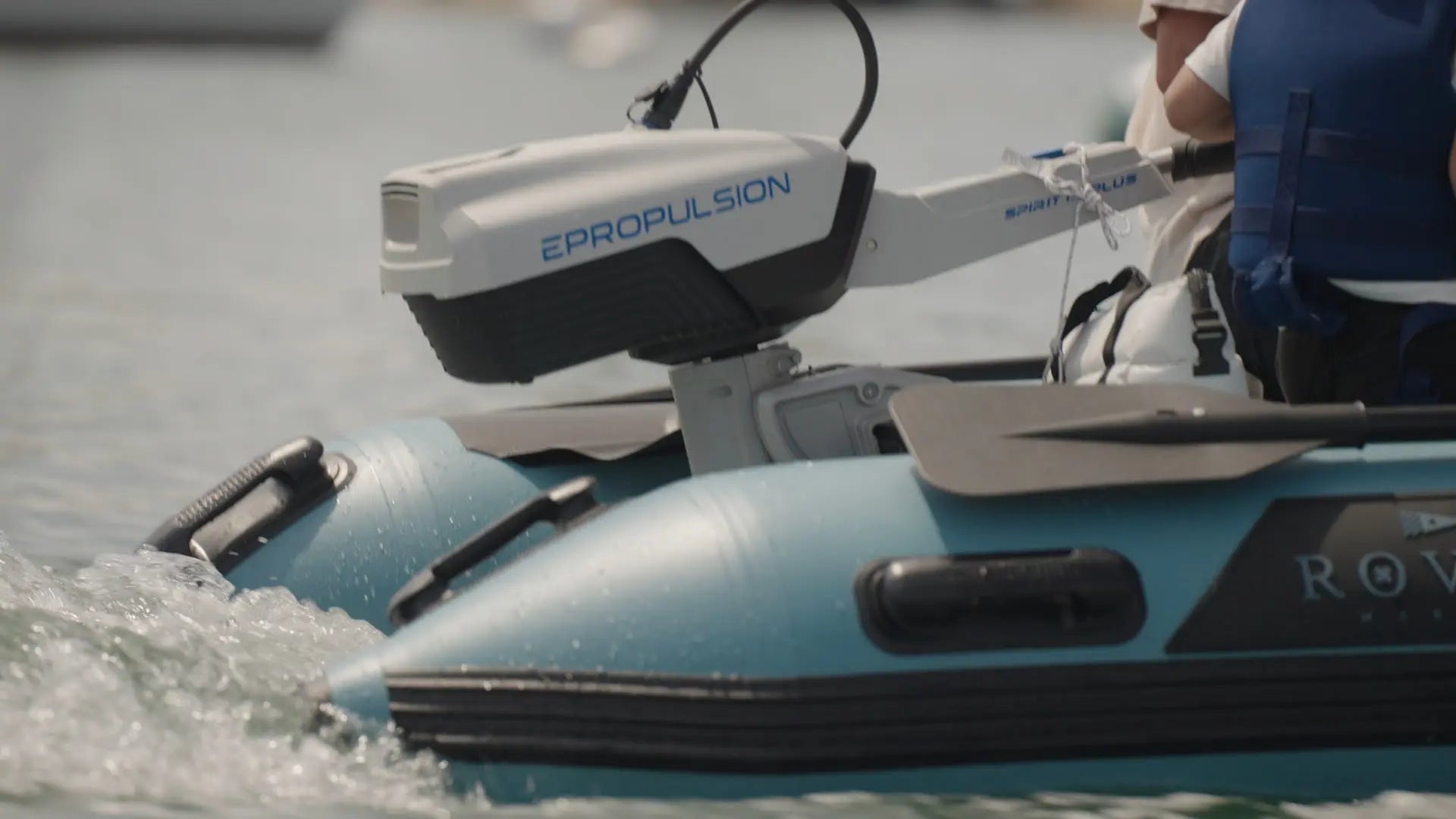
Rover Marine's current electric motor collection includes short-shaft options from ePropulsion and Torqeedo for boats with 15-inch transoms.
| Electric Motor | Configuration | Common Use | Planning Requirement |
|---|---|---|---|
| ePropulsion Spirit 1.0 Plus Short Shaft | Portable electric motor with removable battery platform. | Tender runs, fishing, harbor cruising, and calm-water trips. | Confirm battery capacity, range, and complete package weight. |
| Torqeedo Travel 1103 S Short Shaft | Portable Travel platform with removable battery and tiller display. | Tender use, fishing, marina travel, and protected water. | Confirm the selected battery package provides sufficient reserve. |
Compare current short-shaft and long-shaft listings in the Rover Marine electric outboard motor collection .
Electric Motor Equivalency Requires Context
Electric motor manufacturers may compare propulsion with a gasoline horsepower class. That does not mean the electric system will provide the same speed, acceleration, planing ability, or range as every gas outboard carrying that horsepower number.
Compare actual power, battery capacity, propulsive performance, motor weight, expected load, and operating conditions.
What Should Buyers Compare Before Choosing?
- True RIB or fully inflatable construction.
- Passenger and total load capacity.
- Boat, motor, battery, and fuel weight.
- Hull geometry and normal water conditions.
- Maximum motor rating and transom height.
- Trailer, davit, vehicle, or storage requirements.
- Fishing, diving, tender, or family-use priorities.
- Warranty, parts, service, and repair support.
Size and Capacity
Choose a boat based on the loaded trip rather than the empty showroom weight. Passengers, motors, batteries, fuel, anchors, coolers, fishing equipment, dive gear, and safety equipment all count toward capacity.
Transportation and Storage
A true RIB keeps its rigid hull footprint and will normally require a trailer, davit, cradle, tender garage, or deck space. A fully inflatable boat may be stored in a smaller area after deflation.
Water Conditions
Protected lakes, harbors, coastal bays, rivers, and exposed offshore water place different demands on a boat. Match the hull and motor to the environment rather than relying on a broad claim that one hull is always more capable.
Total Ownership Cost
Include the motor, battery or fuel system, trailer, storage, registration, insurance, safety equipment, maintenance, repairs, replacement components, and seasonal storage when comparing cost.
How to Maintain RIBs and Fully Inflatable Boats
Maintenance should follow the exact boat, material, and motor manufacturer's instructions. General care begins with cleaning, inspection, correct pressure, and proper storage.
Traditional RIB Care
- Rinse tubes and rigid hull after saltwater use.
- Inspect hull coatings, gelcoat, tubes, seams, and valves.
- Check transom, steering, hardware, and lifting points.
- Maintain aluminum corrosion protection where applicable.
- Repair structural hull damage professionally.
- Follow the tube-fabric manufacturer's care instructions.
Fully Inflatable Boat Care
- Rinse with fresh water after saltwater use.
- Maintain the published tube and floor pressure.
- Inspect seams, valves, handles, transom, and floor.
- Avoid dragging the boat over abrasive surfaces.
- Dry thoroughly before extended packed storage.
- Store away from sharp objects, chemicals, and excessive heat.
Repairing Tubes and Inflatable Floors
Small punctures may be repairable with material-specific patches and adhesives. The fabric, preparation, curing time, temperature, and adhesive must all match the manufacturer's instructions.
Seam separation, major tears, transom damage, large floor damage, or repeated pressure loss should be evaluated by the boat manufacturer or an experienced inflatable-boat repair professional.
Motor Maintenance
Electric and gas outboards have different maintenance requirements. Follow the exact manual rather than using a generic monthly or annual schedule.
- Inspect the propeller before and after use.
- Rinse appropriate components after saltwater use.
- Check mounting hardware and the engine cutoff system.
- Maintain electrical connectors and batteries as instructed.
- Inspect gas fuel systems and cooling systems as instructed.
- Complete manufacturer-required seasonal service.
Current Rover Marine Warranty Coverage
The previous article contained outdated blanket three-year warranty language. Rover Marine now publishes tiered factory coverage for eligible boats and covered components.
Coverage applies to qualifying manufacturing defects and remains subject to the complete terms, exclusions, documentation requirements, and claim review process.
Motors, batteries, electronics, and other third-party equipment generally follow the warranties provided by their manufacturers.
Read the Complete Rover Marine WarrantyFrequently Asked Questions
Is the Rover Marine Battle Boat a RIB?
No. The Battle Boat is a fully inflatable boat with a high-pressure drop-stitch floor. It does not use a permanent aluminum or fiberglass lower hull, so it is not a rigid inflatable boat.
Is the Battle Cat a rigid inflatable catamaran?
No. The Battle Cat is a fully inflatable dual-pontoon catamaran. It uses inflatable pontoons and a high-pressure floor rather than permanent rigid catamaran hulls.
What is the main advantage of a traditional RIB?
A traditional RIB combines a permanent rigid lower hull with inflatable tubes. Depending on the exact design, this can support specialized wave-entry geometry, higher sustained speeds, and permanent onboard systems.
What is the main advantage of a fully inflatable boat?
A fully inflatable boat can be deflated into a smaller storage footprint. This can make transportation and storage easier for owners who do not want a permanent trailer, davit, or marina slip.
How long does a RIB last?
There is no universal lifespan. Service life depends on hull and tube materials, construction, UV exposure, saltwater care, pressure, climate, storage, use frequency, repairs, and maintenance.
Which is more stable, a deep-V RIB or a catamaran?
A catamaran often provides stronger initial stability because its buoyancy is spread across two hulls. A deep-V may provide a softer wave entry while moving through chop. Exact behavior depends on the specific design, load, speed, and conditions.
What motor can the 12-foot Battle Boat and Battle Cat use?
Both 12-foot models support motors up to 20 HP. Each is rated for four people or 1,200 pounds and uses a 15-inch transom.
Can Rover Marine boats use electric outboards?
Yes. Rover Marine offers compatible short-shaft options from ePropulsion and Torqeedo. Confirm the shaft length, complete package weight, battery capacity, and expected range before ordering.
What warranty does Rover Marine provide?
Current eligible coverage consists of five years for the hull, three years for tubes and seams, and two years for eligible covered accessories. Complete terms are available on the Rover Marine warranty page .
Read Rover Marine Owner Experiences
Product specifications establish the capacity, weight, motor, and pressure limits. Owner feedback can provide additional insight into transportation, setup, stability, storage, electric motor use, and customer support.
Visit the Rover Marine reviews page and compare those experiences with your crew size, storage limitations, intended water, and motor preference.
Choose Between Permanent Hull Performance and Full Portability
Choose a traditional RIB when a permanent rigid hull, higher-speed handling, and fixed onboard systems are priorities. Choose a fully inflatable Battle Boat or Battle Cat when compact transportation and storage matter more.
Built for Water. Designed for Freedom.


Leave a comment
This site is protected by hCaptcha and the hCaptcha Privacy Policy and Terms of Service apply.