
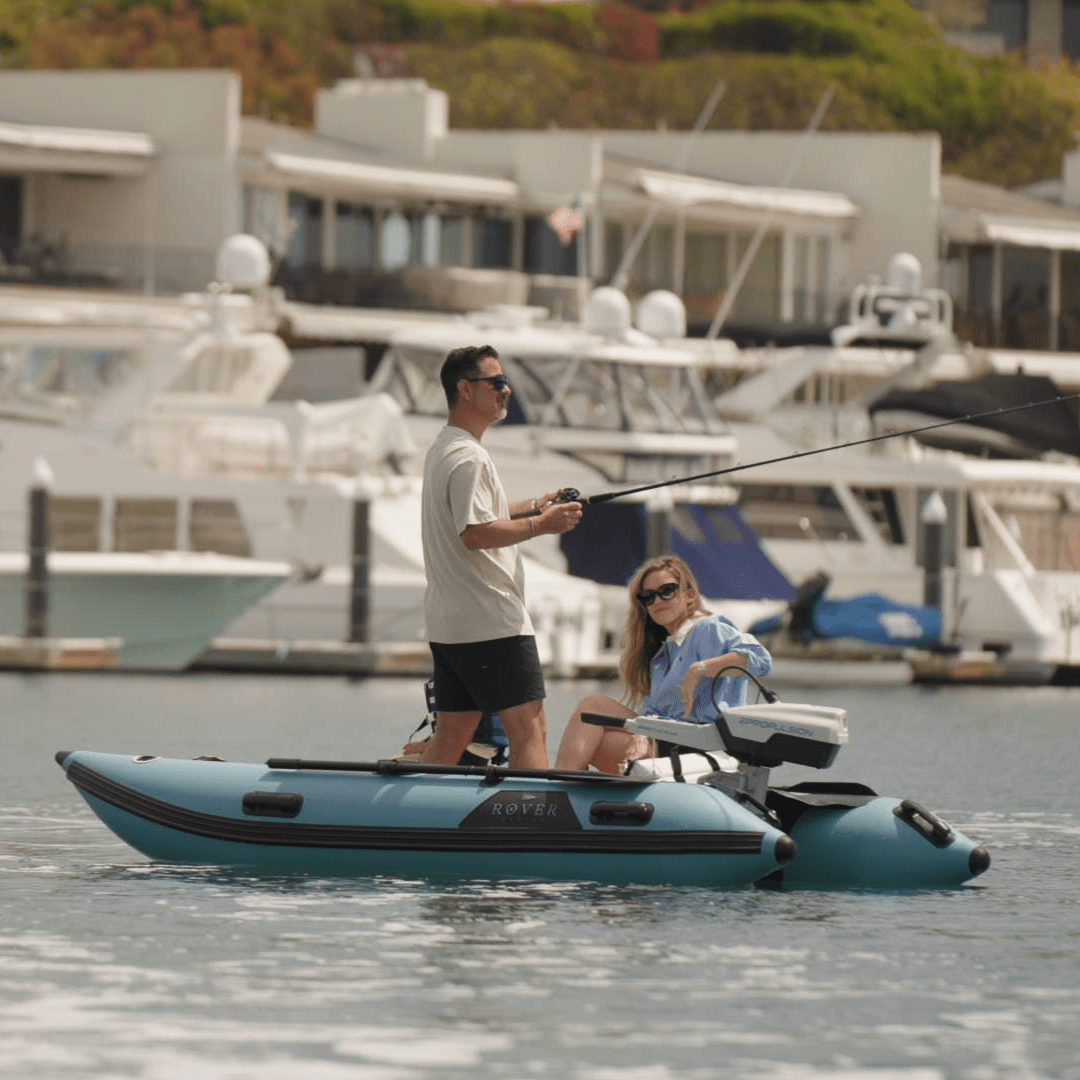
Ten years ago, a fishing dinghy usually meant an aluminum jon boat on a trailer. Today, more US anglers are showing up with a packed inflatable in the vehicle, an electric outboard, and enough gear for a full day on the water.
The reason is simple: modern inflatable dinghies are tougher, quieter, and easier to store than the boats many anglers grew up using. You do not need a slip. You do not need a trailer. You do not need to build your whole weekend around a crowded ramp.
This guide is a no-fluff blueprint for building a fishing dinghy that works on US lakes, bays, and skinny coastal water in 2026. We will cover hull choice, outboard strategy, rigging essentials, five destinations worth the drive, and exactly what to pack. By the end, you will have a setup you can actually use, not a fantasy build that only works in a catalog.
If you are still sorting out propulsion first, start with Rover Marine's top engine types for inflatable dinghies guide.
Quick answer: The best fishing dinghy setup for most US anglers is a stable inflatable hull, a quiet electric outboard, properly balanced gear, and basic safety equipment that matches the water. Choose the Battle Cat if standing stability is the priority. Choose the Battle Boat if compact storage, simple handling, and solo fishing matter more.
Why Inflatables Work as Fishing Platforms
New anglers and experienced boaters are both running into the same problem: traditional boat ownership is heavy. Truck, trailer, storage, insurance, ramp traffic, maintenance, and parking all stack up before you even make a cast.
Inflatables solve a lot of that. They are storage-friendly, vehicle-friendly, and easier to launch from places that do not work for a rigid hull. A packed inflatable can live in a garage, RV, truck bed, yacht locker, or cottage storage room. When the conditions line up, you inflate, rig, launch, and fish.
For anglers, the real advantages are access and stealth. A shallow-draft inflatable can reach backwater, weed edges, protected coves, flats, and small launches that larger boats skip. Pair one with an electric outboard and you can work water quietly without fuel smell, engine noise, or the constant small-engine routine.
This is not a pool toy. Treat it like a real boat. Rig it cleanly, load it evenly, carry safety gear, and respect the weather.

Lake vs Coastal: How the Water Changes Your Setup
The fish do not care what kind of boat you are in, but the water does. Lake fishing and coastal fishing ask different things of a dinghy.
| Factor | Lake | Coastal |
|---|---|---|
| Typical chop | Calm to light chop, often 0 to 1 ft | Wind chop, tide, boat wake, and changing current |
| Salt exposure | None unless brackish | Constant rinse-and-dry discipline required |
| Wind fetch | Variable, depending on lake size | Always part of the plan |
| Draft priorities | Weed edges, coves, timber, shallow banks | Skinny flats, mangroves, oyster bars, tide windows |
| Run distances | Often short, spot-to-spot runs | Can stretch longer with wind, tide, and return planning |
| Outboard choice | Small electric is often ideal | Electric works well for short flats runs, but range planning matters |
For lakes, a compact traditional inflatable hull like the Battle Boat is often the better answer when you are running solo, covering moderate flat water, and storing tight. For bays and coastal flats, a wide catamaran layout like the Battle Cat gives you the stability to stand and sight-cast, plus more confidence when wind chop starts working across the beam.

Hull Choice: Catamaran Casting Deck vs Traditional Inflatable Hull
This is the fork in the road.
The Battle Cat is the catamaran option. Wide beam, dual pontoons, and a reinforced high-pressure floor make it the better fishing platform when standing stability matters. You can stand up to throw a frog into lily pads, work a fly line on a flat, or fight a slot red without the boat rocking every time you shift your weight.
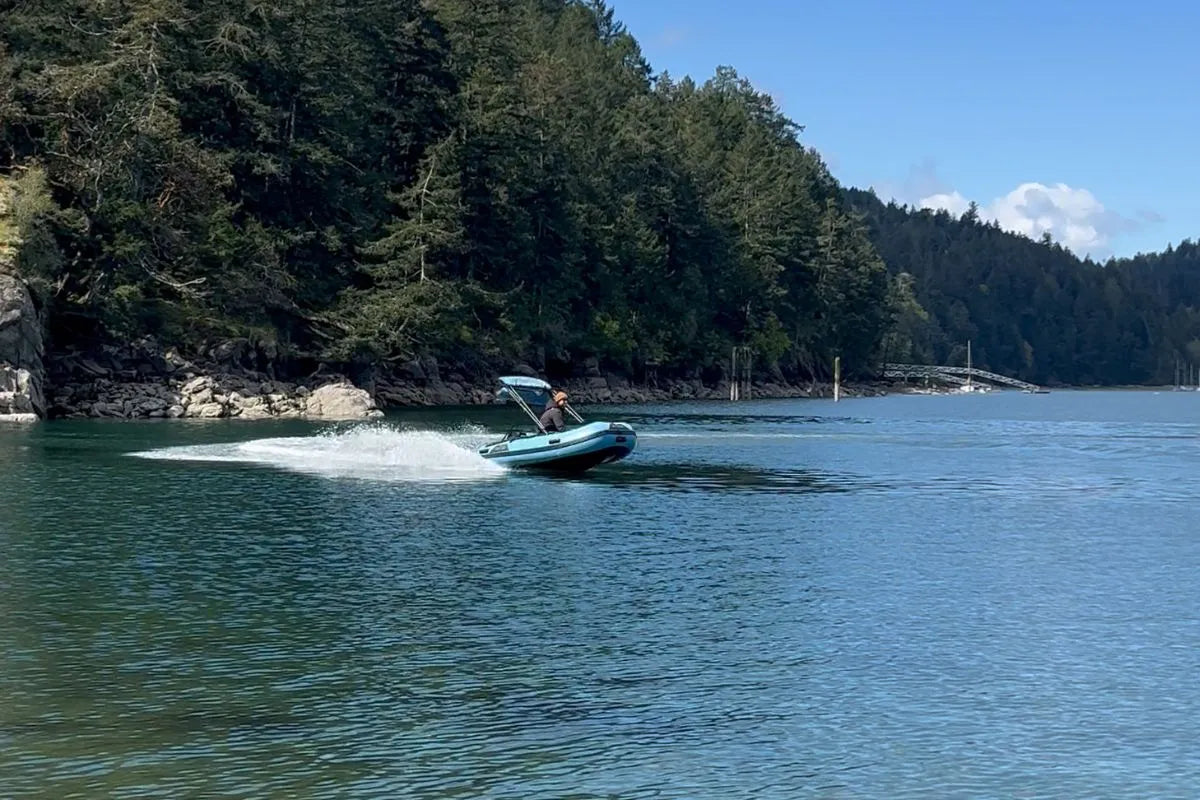
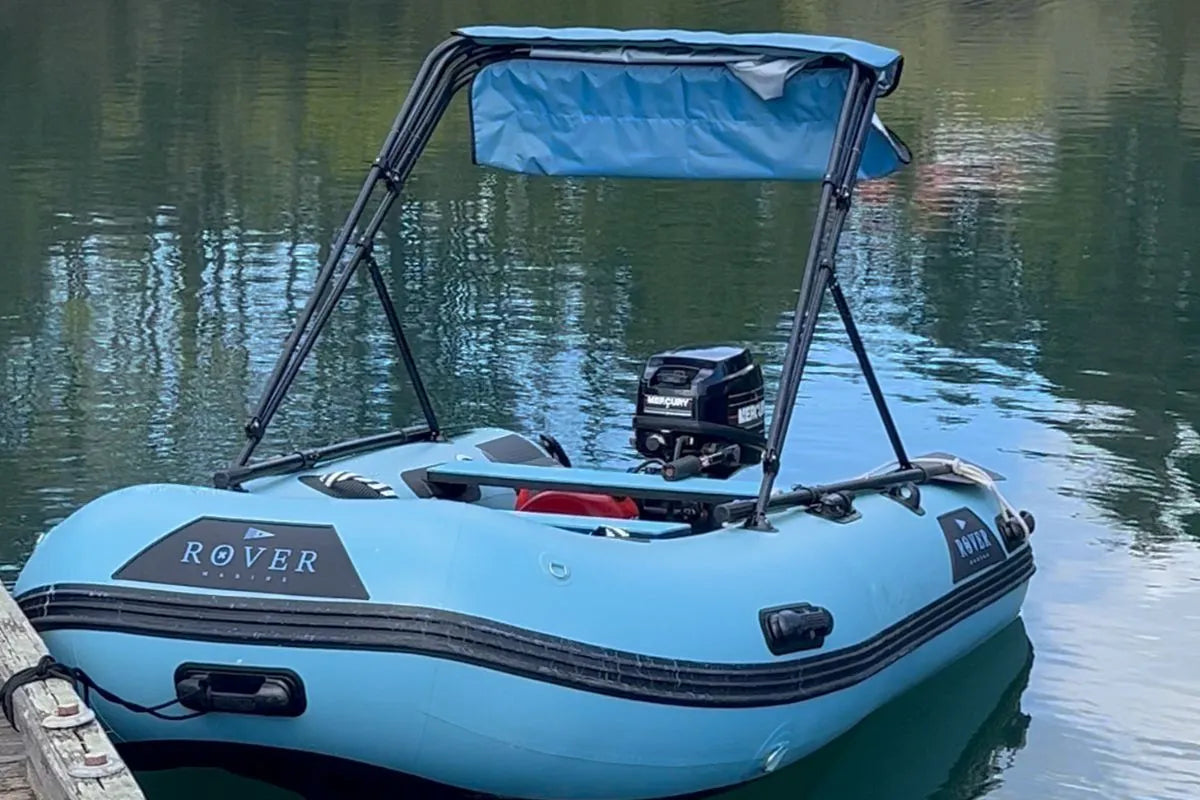
The Battle Boat is the traditional inflatable hull option. It is the pick when you want simple handling, compact storage, and an easy all-around dinghy that can fish, cruise, tender, and explore. The 8 ft Battle Boat packs down to 38 in x 24 in x 15 in, weighs 86 lb assembled, and starts at $1,999.
The 8 ft Battle Cat starts at $2,299, weighs 84 lb assembled, and uses the same 38 in x 24 in x 15 in packed size. The difference is not just the spec sheet. The Battle Cat feels wider and more planted when you stand, shift gear, or fish with another person aboard.
For a deeper dive on hull choice specifically for anglers, read Rover Marine's guide to choosing the perfect fishing dinghy.
Electric Outboards: The Quiet Advantage
Gas outboards still have a place. They win when you need long range, fast refueling, or sustained higher-speed runs. But for inflatable fishing, electric power has a hard practical advantage: it is quiet, clean, and simple.
If you fish shallow coves, docks, weed lines, back bays, or flats, noise matters. Electric outboards let you creep into water without fuel smell, engine rattle, or shouting over the motor. They also make sense for lakes and reservoirs where gas engines may be restricted. Always check local rules before you launch.
Two electric options cover most Rover Marine fishing dinghy builds:
| Outboard | Best For | Notes |
|---|---|---|
| ePropulsion Spirit 1.0 Plus Short Shaft | All-around lake fishing, tender runs, quiet bass water | 1kW / 3HP equivalent, 1276Wh battery, $2,999 on Rover Marine |
| Torqeedo Travel 1103 S Essential Package | Premium tender and dinghy use with Torqeedo controls | 3HP equivalent, quiet operation, $3,299 on Rover Marine |
| Torqeedo Travel 1103 S Extended Range Package | Longer planned outings and premium range-focused builds | 3HP equivalent package, $3,599 on Rover Marine |
Both ePropulsion and Torqeedo are quiet enough for slow approaches, marina runs, and protected fishing water. For full motor comparisons, see Rover Marine's best outboard motors for inflatable dinghies guide, or browse the full electric outboard motors collection.
One practical note: electric outboards reward conservative planning. Charge before every trip, understand your return distance, watch wind and current, and consider a spare battery if your motor supports it and your fishing day demands it.
Rigging Essentials: Rod Holders, Anchor, Livewell, and Fish Finder
A bare inflatable is transportation. Rigged right, it becomes a fishing boat.
Rod holders. Use clamp-on or track-mounted options when possible. Get at least two: one for a ready rod and one for trolling or storage. Avoid drilling, gluing, or adding permanent mounts unless the boat manufacturer specifically supports the installation.
Anchor system. A small folding grapnel or lightweight marine anchor with proper rode works for many lake and protected bay situations. Add a quick-release plan so you can leave the anchor fast if weather, current, or boat traffic changes.
Livewell alternative. Most inflatable dinghies are not built around a hard plumbed livewell. A soft-sided insulated fish bag or cooler with a battery-powered aerator is the cleaner workaround for many anglers.
Fish finder. Use a portable unit with a suction-cup, clamp, or transom-mount transducer. Keep wiring clean and removable. The less you permanently modify the boat, the better.
Storage. Dry bags are not optional. Water always finds tackle, keys, phones, batteries, and jackets on a small boat.

Rover Marine does not need to sell every piece of fishing hardware for this setup to work. Source anchors, PFDs, rod holders, fish finders, navigation lights, and safety gear from a reputable local marina or marine supplier, then rig them cleanly and safely.
Top 5 US Fishing Destinations for Inflatable Boats
These five destinations play to an inflatable's strengths: shallow access, quiet movement, protected pockets, and flexible launch options. Always check local regulations before you go. For saltwater and federal waters, review NOAA Fisheries recreational fishing resources. For state licenses, start with Take Me Fishing's state license lookup.
1. Lake Okeechobee, Florida
Huge shallow water, legendary bass culture, and endless backwater. A shallow-draft inflatable can work edges and protected pockets without needing a full-size bass boat.
2. Mosquito Lagoon, Florida
Skinny-water sight-casting for redfish and seatrout. A quiet electric outboard and a stable platform are both useful here.
3. Devils Lake, North Dakota
A walleye and perch destination with broad water and plenty of structure. Calm mornings reward a compact, efficient setup.
4. Thousand Islands, New York
Smallmouth, pike, current, structure, and fast-changing weather on the St. Lawrence. Watch conditions closely and do not overload a small boat.
5. Florida Keys Backcountry
Bonefish, permit, snook, tarpon, mangroves, grass flats, and water so shallow many boats cannot get there. This is exactly where a quiet, portable inflatable makes sense.
These are not the only options. They are examples of water where portability and shallow access matter. The same logic applies to local reservoirs, cottage lakes, tidal creeks, and protected bays across the country.
Packing for a Day on the Water
A tight pack list saves your morning. Here is what we would prioritize.
| Category | Item |
|---|---|
| Safety | USCG-approved PFD per person, whistle, VHF radio or phone in waterproof case. Federal rules require at least one wearable PFD for each person on board. |
| Propulsion | Fully charged battery, charger at the truck or dock, spare battery if your setup supports it. |
| Hull | Repair kit, pump, pressure gauge, spare valve parts if available. |
| Fishing | Two rods rigged, compact tackle box, pliers, measuring tape, landing net. |
| Environment | Sunscreen, polarized sunglasses, hat, rain shell, bug protection where needed. |
| Food and water | Water, high-calorie snacks, and a cooler that does not overload the boat. |
| Navigation | Chart app with offline maps, compass, tide/current info if coastal. |
| Cleanup | Trash bag, towel, fish bag or insulated soft cooler. |
Load the boat balanced. On the Battle Boat, keep heavy gear low and near center. On the Battle Cat, spread weight across the beam so both pontoons stay loaded evenly.
For federal PFD language, review 33 CFR 175.15. State rules can add more requirements, especially for children, night operation, registration, and inland waters.
Build Your Battle Cat Fishing Rig
One takeaway from this guide: an 8 ft Battle Cat paired with an ePropulsion Spirit 1.0 Plus is a strong compact fishing rig for anglers who want stability first. The boat starts at $2,299 and the motor is listed at $2,999, putting the boat-and-motor package at $5,298 before safety gear, rigging, tax, or shipping.
If you prefer a Torqeedo setup, the Torqeedo Travel 1103 S Essential Package is listed at $3,299 and the Extended Range Package is listed at $3,599.
If compact storage and solo use matter more than standing stability, build around the Battle Boat. The 8 ft model starts at $1,999, packs down cleanly, and makes sense for anglers who fish lighter, launch faster, and move often.
Stability Build
Boat: Battle Cat
Motor: ePropulsion Spirit 1.0 Plus or Torqeedo Travel 1103 S
Best for: Standing casts, flats, bass, photography, two-person fishing, and gear-heavy days.
Compact Build
Boat: Battle Boat
Motor: ePropulsion Spirit 1.0 Plus or other short-shaft motor within rating
Best for: Solo fishing, tender use, cottage storage, lake runs, and tight transport.
FAQ
Are inflatable boats good for fishing?
Yes. Modern inflatables with reinforced tubes and high-pressure floors are strong fishing platforms for lakes, bays, rivers, flats, and protected coastal water. They beat rigid boats on portability and storage, but they still need proper loading, safety gear, and weather judgment.
Will hooks or fish teeth puncture an inflatable?
A quality inflatable is tougher than most people think, but hooks can still puncture fabric if you treat the boat carelessly. Keep treble hooks contained, use hook keepers, do not leave loose lures on the floor, and handle fish with pliers or a net. Rover Marine inflatables use military-grade PVC with reinforced seams and drop-stitch flooring, but no inflatable is hook-proof.
Can I fish saltwater with an inflatable dinghy?
Yes, with rinsing discipline. Rinse the hull, outboard, hardware, floor, and fishing gear with fresh water after every salt run. Dry the boat before storage when possible. Salt is manageable. Neglect is what causes problems.
Do I need a license to run an electric outboard?
Fishing licenses, boat registration, and boating education rules vary by state. Many motorized boats require registration even when the motor is electric. Check your state fish and wildlife agency, boating agency, or the Take Me Fishing license lookup before launching.
What size inflatable is best for two anglers?
For two anglers, a 10 ft or 12 ft inflatable usually gives better room than an 8 ft model. If both anglers stand or carry heavy gear, the Battle Cat layout makes sense. If one angler sits and one stands, or the priority is compact transport, the Battle Boat can work well when loaded properly.
Ready to Build Your Fishing Rig?
Pick your hull, pick your outboard, rig it cleanly, and fish it for years. Do not overcomplicate it.
Start with the Battle Cat if stability is the job. Start with the Battle Boat if compact storage and all-around use matter more. Match either one with an electric outboard from the Rover Marine electric outboard motors collection.
Questions about which setup fits your home water? Call 844-207-6837 or reach the team through the Rover Marine contact page. Our team runs these boats, and we will help you build the right rig the first time.

Leave a comment
This site is protected by hCaptcha and the hCaptcha Privacy Policy and Terms of Service apply.