
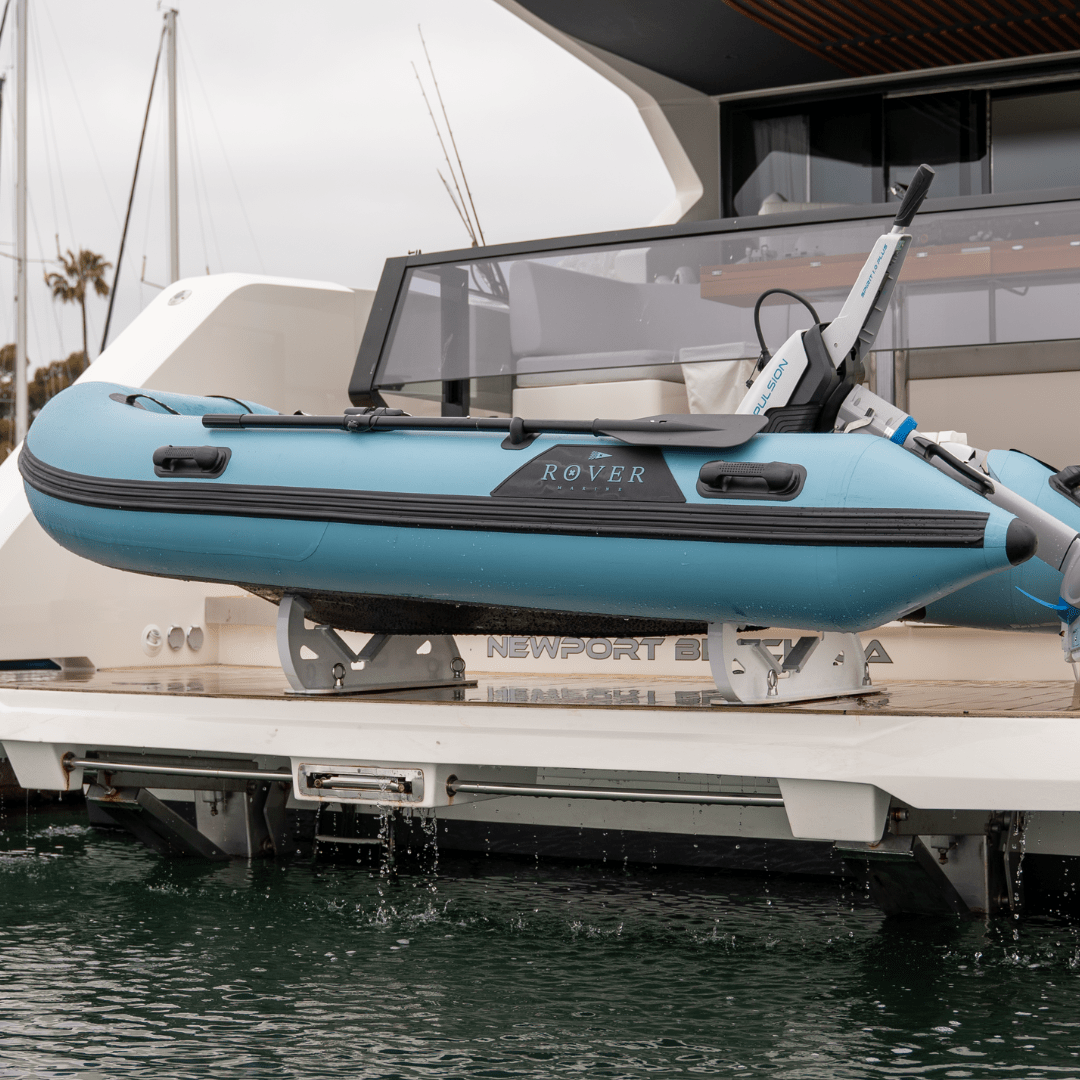
The tender is the second most important boat in your fleet. It moves you from mooring to dock, runs groceries, carries dive gear, and bails you out when the main engine needs a shop day. A packable V-hull inflatable like the Rover Marine Battle Boat or a wide, stable inflatable catamaran like the Battle Cat makes that job easier because storage, towing, and launching are part of the design.
Getting the tender-to-yacht question right, how you move it, lift it, and stow it, is one of the quiet upgrades that separates a comfortable passage from a miserable one.
This guide walks through the three practical methods cruisers use in 2026, the US rules that apply when you tow a dinghy, and the gear choices that make any of the three work better. It is written for yacht owners who already know their boat but want a straight-shooting checklist on the dinghy side.
Quick answer: Tow your dinghy only for short, protected-water hops. Use davits when you need fast daily access and your yacht has the structure for it. For passages, bad weather, or long-term storage, deflate, bag, and lash the inflatable securely on deck or below. The safer answer is usually the one that keeps the tender out of the water before conditions get ugly.

The Three Ways Yachties Carry a Dinghy
There are three approaches in common use, and every cruiser eventually picks one primary method plus a backup:
- Towed astern on a painter, sometimes with a bridle.
- Davit-lifted off the stern or on a gantry.
- Deck-stowed, usually deflated, lashed to the foredeck, coachroof, or stored below when space allows.
Each has its moment. Short hops in protected water? Tow it. Overnight passage in open water? Lift it or stow it. Bluewater with any chance of heavy weather? Stow it deflated, on deck or below, lashed down hard.
The mistake is treating one method as universal. Towing is convenient until it is not. Davits are clean until the sea gets on your stern. Deck stow is slower, but it is the most conservative heavy-weather answer.

Towing: Painter Length, Bridle Setup, and Speed Limits
Towing is the easy answer, and it is fine most of the time in coastal and protected water. Get it wrong, though, and you can damage the tender, load the painter dangerously, or lose the dinghy altogether.
Painter length
The rule yachties repeat is simple: the dinghy should ride one or two wave lengths behind the mother ship so it sits in the same phase of the wave. On flat water, 20 to 30 feet is often workable. In a following sea, you may need 40 to 60 feet so the tender is not surfing into your transom on every crest.
Do not set painter length once and forget it. Adjust for wind direction, wake, current, chop, and boat speed. The right length in a flat marina fairway may be wrong an hour later in open water.
Bridle setup
A Y-bridle attached to two strong bow points spreads load and helps keep the tow straight. Do not overload a single light-duty bow ring or clip to whatever hardware is closest. Use proper line, inspect chafe points, and keep a spare painter aboard the mother ship.
Floating line can help reduce prop-wrap risk, but it does not eliminate it. Keep line out of the prop wash and never reverse blindly with the dinghy astern.
Speed limits
Most inflatable tenders tow best at displacement speeds. Push too fast and the dinghy may porpoise, yaw, surf, or fill with spray. Before you go fast, lift it or stow it.
The faster the yacht goes, the less margin you have. Speed turns a simple tow into a load case. Treat the tender like gear under tension, not like a beach toy trailing behind you.
Motor off, fuel closed
If you tow with an outboard mounted, tilt it clear of the water, confirm the clamp is secure, and follow the motor manual. For gas outboards, close the fuel vent if applicable and secure the fuel system. For electric outboards, remove or secure the battery per the manufacturer’s instructions if conditions justify it.
If the tow will be long or lumpy, removing the motor is usually smarter. A small outboard is expensive, heavy, and miserable to recover if the tender flips.
Davit Systems: Weight Capacity and Hoisting Tips
Davits are the cleanest solution on yachts with the structure and stern layout to support them. Two arms off the stern, a pair of tackles or electric winches, and the tender rides dry and out of the water when you are not using it.
Before you buy, install, or trust a davit system, check two numbers: the safe working load of the davit system and the wet, loaded weight of your tender. Do not use dry boat weight alone. Add the motor, battery or fuel, anchor, oars, water trapped in the boat, and any gear that gets forgotten on board.
The ABYC H-40 standard covers fittings and equipment attached to or carried on boats for anchoring, mooring, docking, lifting, towing, and trailering. If your installer talks about lifting a tender but cannot explain safe working load, backing plates, load paths, and dynamic load, slow the job down and get better advice.
Hoisting tips that matter
- Drain the boat before lifting so you are not hauling extra water.
- Use a proper lifting harness with equalized legs.
- Keep hands and feet clear of loaded tackle, blocks, and pinch points.
- Snug the tender against the davit arms or cradle so it cannot swing hard in a beam sea.
- Install a safety line independent of the tackle in case a block, shackle, or line fails.
- Remove loose gear before lifting. A dinghy full of gear becomes a swinging storage bin.
A packable inflatable like the Battle Boat is friendly to davit planning because the weights are straightforward: the 8 ft model weighs 86 lb assembled, the 10 ft model weighs 100 lb, and the 12 ft model weighs 135 lb. The Battle Cat is slightly lighter by size, with the 8 ft model at 84 lb, the 10 ft at 98 lb, and the 12 ft at 130 lb.
Add an electric outboard and you still need to do the math. The ePropulsion Spirit 1.0 Plus Short Shaft is listed at 42.6 lb total weight on Rover Marine. The Torqeedo Travel 1103 S Short Shaft Extended Range Package is listed at 44.4 lb. That is manageable for many cruising davit systems, but only if the davits, mounts, and yacht structure are rated for the total wet load with margin.

Deck Stow: Deflating and Securing for Passage
For any passage where the weather could turn, or any yacht without davits, deck stow is the conservative answer. This is where a packable inflatable earns its keep.
The 8 ft Battle Boat packs to 38 in x 24 in x 15 in. The 8 ft Battle Cat packs to the same listed deflated size. That fits many yacht storage plans better than a rigid dinghy of similar working capacity, but measure the actual space before buying. Not the space you think you have. The one you can physically access with wet gear and tired hands.
Stow procedure
- Rinse the hull with fresh water, especially after saltwater use.
- Let the boat dry when time and conditions allow.
- Open valves and deflate according to the manufacturer’s pattern.
- Roll or fold cleanly without forcing sharp creases into hardware or seams.
- Bag the boat and add a desiccant pack if storing long-term in a damp space.
- Lash the bag at two strong tie-down points minimum, four in rough weather.
- Store the outboard vertically and secured according to its manual.
Do not let the tender become loose deck cargo. A bagged inflatable sliding across a coachroof in a roll is still dangerous. Lash it like it matters, because it does.
If you need a broader storage refresher, check Rover Marine’s Journal for inflatable boat storage, transport, and maintenance guides.
Transom Mounts for Smaller Yachts
Boats under about 34 feet often do not have room for full davits. A transom mount, folding platform, stern cradle, or chock system can be the next-best answer when the yacht layout supports it.
The dinghy usually lives upside down, on edge, or cradled against the stern, secured by two or more straps to proper hard points. The mount has to carry the dinghy’s dry weight plus dynamic load from waves, roll, and acceleration. Do not rely on light rail-mount brackets if the load belongs on real structure.
A few transom-mount realities are worth knowing before you commit:
- Visibility. A dinghy on the transom can block part of your stern view. Plan helm sightlines, camera coverage, or crew lookout accordingly.
- Swim platform access. If the tender lives on the transom, you may need to launch it every time someone wants easy water access.
- Outboard handling. Many crews remove the outboard before mounting the dinghy. A dedicated outboard bracket on a rail or pushpit can make that safer.
- Following seas. Anything mounted aft needs to be evaluated for boarding seas, stern squat, and green water over the platform.
Transom storage can work well, but only when the yacht, mount, dinghy, and sea state agree. If one part of that setup feels improvised, fix it before the passage.
Night Running and Heavy-Weather Recovery
Two scenarios will spoil a passage if you are not prepared.
Night running with the tender astern
The painter is hard to see at night. The tender is harder to track in chop. Add reflective tape where it does not interfere with required navigation lights, and make sure the towing setup does not obscure the mother ship’s stern light. If you add lighting to the tender, make sure it is legal, visible, and not confusing to other traffic.
Watch the tow. A tender that suddenly appears closer may be surfing forward, shortening the painter, or starting to yaw. Do not wait until it hits the transom.
Heavy-weather recovery
If it is blowing and you decide to lift, shorten tow, or recover the tender, do it on the leeward side of the mother ship when possible. Slow the boat to bare steerageway, reduce load on the painter, and keep crew out of the bite of the line.
Never let crew stand between a loaded painter and a fixed object. A parted line under tension is a whip. A dinghy full of water is not a dinghy anymore. It is a moving load.
If recovery becomes unsafe, crew safety comes first. In a true last-resort situation, some skippers may choose to cut the tender loose with flotation and a tracking device rather than put crew in danger. That is not a casual tactic. It is a last-resort seamanship call, and it may create a navigation hazard that needs to be reported and recovered when conditions allow.
USCG Rules for Dinghies Under Tow
The US Coast Guard Navigation Rules apply on US waters, and towing a dinghy changes how you should think about lights, lookout, risk of collision, and maneuvering room.
- Rule 24 covers towing and pushing lights. The USCG Navigation Rules should be your reference before towing at night or in reduced visibility. Do not assume a short dinghy tow has no lighting implications.
- Rule 5 requires a proper lookout. If the tender is astern, swinging, obscuring lights, or pulling wide in your wake, that is your problem to manage.
- Rule 7 requires you to assess risk of collision. A long painter can put your tender closer to another vessel, dock, buoy, swimmer, or obstruction than the yacht itself appears to be.
Registration and hull identification rules are state-specific. The BoatUS Foundation registration guide states that mechanically powered vessels generally need proper numbering and registration, with state details and exemptions varying. If your dinghy has an electric or gas motor, check your state boating agency before assuming it is exempt.
This is especially important for yacht tenders. Some owners think of the tender as gear. Many authorities treat a powered dinghy as a separate vessel.
The Packable Inflatable Advantage
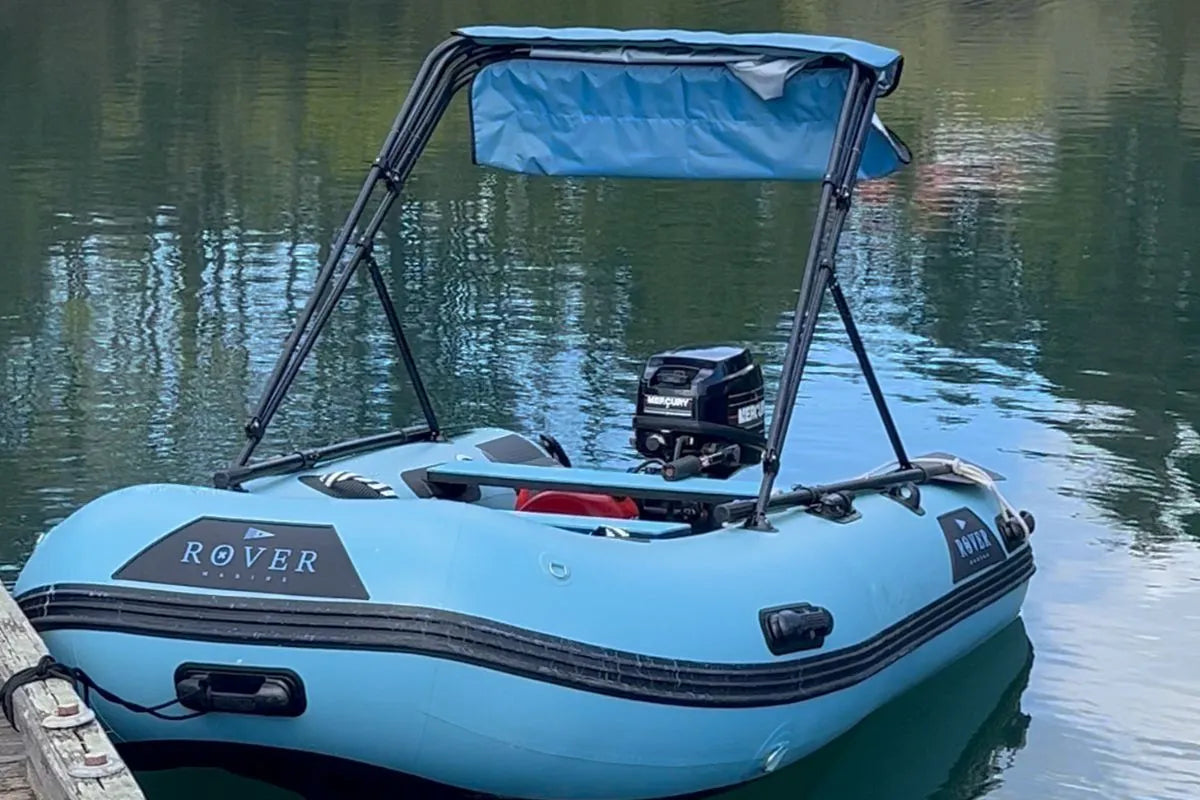
The whole tow, stow, and store conversation gets easier when your tender is designed to pack small and stay manageable. A V-hull Battle Boat fits many yacht tender jobs where a rigid dinghy would create storage problems. A Battle Cat gives you inflatable catamaran stability for boarding, guest transfers, fishing, and gear-heavy tender duty.
Pair either with a clean, quiet electric outboard, such as the ePropulsion Spirit 1.0 Plus, the Torqeedo Travel 1103 S Essential Package, or the Torqeedo Travel 1103 S Extended Range Package, and you simplify the tender routine. No gasoline smell belowdecks. No fuel vent checklist before every tow. No carburetor drama after a few quiet weeks at anchor.
A few specifics worth calling out for yacht owners
38 in packed length matters. The 8 ft Battle Boat and 8 ft Battle Cat both list a 38 in x 24 in x 15 in deflated size. Measure your cockpit locker, lazarette, deck space, or storage bay before you buy. Compact does not mean magic. It means measurable.
Electric outboards simplify storage. An electric outboard still needs to be secured properly, but you eliminate gasoline smell, fuel stabilization, and vent management. Batteries should be stored and charged according to the manufacturer’s instructions.
Weight savings matter at the davit. Every pound saved on tender dry weight is a pound you do not carry at your davit arms. Over a season of cruising, lifting, launching, and recovering, that adds up.
Travel and seasonal storage are easier. A packable inflatable can be moved, shipped, stored, or transported in ways that a rigid tender cannot. Check carrier limits before flying with oversized gear, but the broader point stands: a deflated inflatable gives you options a rigid hull does not.
FAQ
How long should my dinghy painter be?
Long enough that the tender rides cleanly in your wake without surfing into the transom or dragging awkwardly behind the yacht. In flat protected water, 20 to 30 feet is often workable. In a following sea, 40 to 60 feet may be needed. Carry a spare painter and adjust length for conditions.
Can I tow an inflatable at 20 knots?
Not as a normal practice. Most inflatables tow best at displacement speeds. If you are pushing beyond hull speed, the smarter move is usually to lift the tender, stow it, or slow down. High-speed towing increases load, spray, yaw, and failure risk.
Do I need davits on a 36-foot sailboat?
You do not need them, but they make weekly cruising easier if the yacht structure, stern layout, and safe working load support the setup. A transom mount plus a deck-stow backup can also work. The key is having a heavy-weather plan before you need it.
What is the best way to store a dinghy for passage?
Deflated, bagged, and lashed securely on deck or stored below when space allows. Use multiple tie-down points, protect the bag from chafe, and secure the outboard separately according to its manual. Davits are convenient at anchor, but deck stow is usually more conservative offshore.
Does the Coast Guard require lights on a towed dinghy?
The Navigation Rules include towing-light requirements and proper-lighting rules, and the right setup depends on vessel type, tow length, visibility, and operating condition. Your mother ship must show proper lights, maintain a lookout, and avoid creating confusion or obstruction. Review USCG Navigation Rules before towing at night or in restricted visibility.
Ready to Upgrade Your Tender Setup?
If your current dinghy is a storage headache or a weight problem at the davits, it may be time to rethink the tender itself.
Browse the full lineup in all Rover Marine products, or start with the two hulls most cruisers pick for yacht service: the V-hull Battle Boat from $1,999 and the twin-pontoon Battle Cat from $2,299.
Match either with a clean electric outboard from the Rover Marine electric outboard motors collection and you have a tender that tows cleanly in protected water, stows smaller than anything rigid, and runs quiet when you drop it in the water.
Questions about fit, davit weight, outboard pairing, or which tender makes sense for your yacht? Call 844-207-6837 or reach the team through the Rover Marine contact page. We run these boats too.

Leave a comment
This site is protected by hCaptcha and the hCaptcha Privacy Policy and Terms of Service apply.