
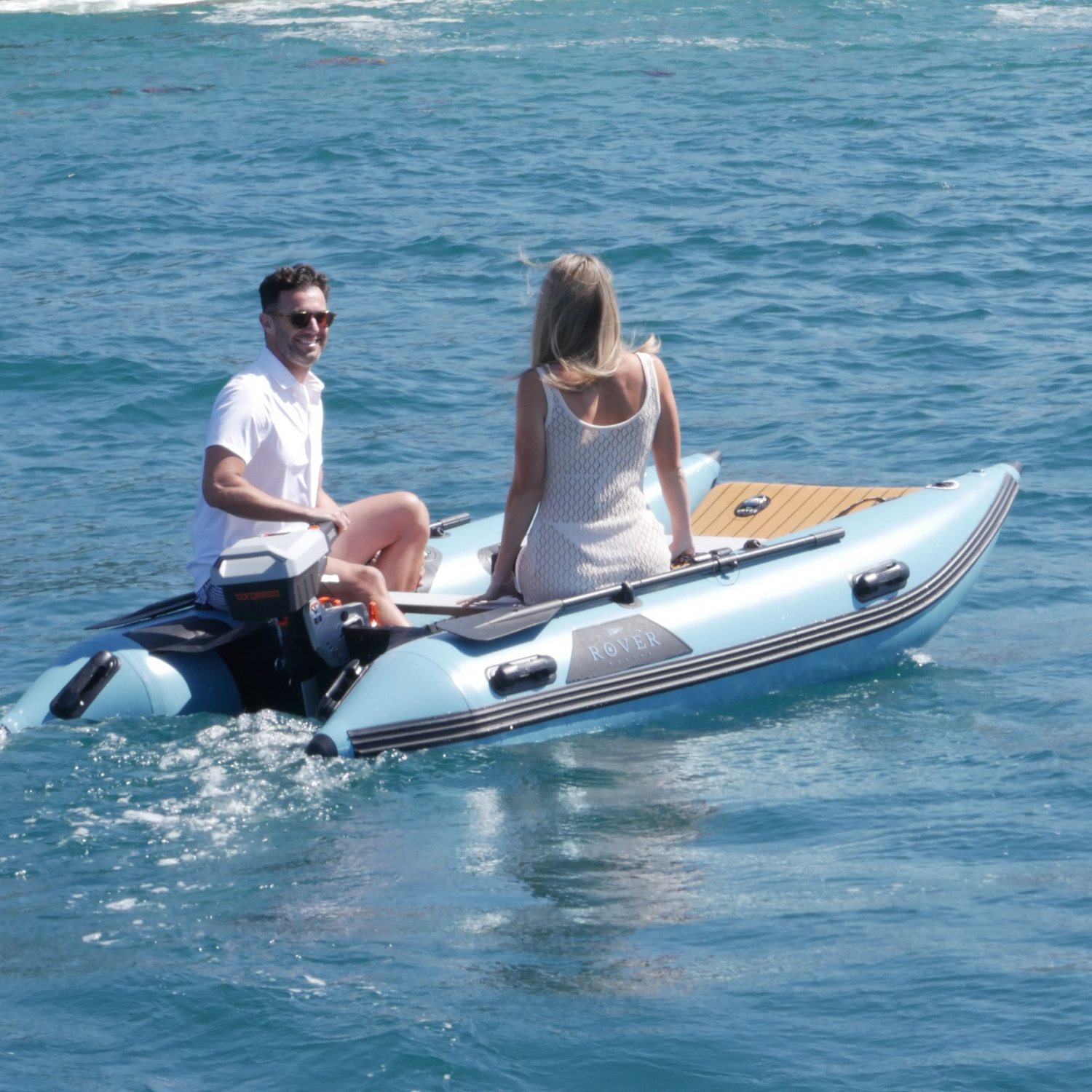
The best inflatable boat for fishing is the one that matches your water, your load, your storage space, and the way you actually fish.
Modern inflatable boats have become a serious option for anglers who want a stable fishing platform without a trailer, slip, driveway, or heavy aluminum hull. They pack into a vehicle, launch from more places, and give you access to lakes, ponds, backwaters, rivers, and protected coastal water that bigger boats often skip.
This guide compares hull type, size, fishing setup, outboard pairing, and the Rover Marine models that make the most sense for anglers in 2026.
Why Inflatables Work for Fishing
A fishing boat does not need to be complicated to be useful. For many anglers, the biggest problem is not catching fish. It is getting on the water without dealing with a trailer, crowded ramp, storage rules, or a heavy hull.
A quality inflatable solves that problem. It can be stored in a garage, closet, dock box, RV, yacht locker, or SUV. It can launch from ramps, beaches, cottage docks, shallow banks, and smaller access points.
Trailer less Access
Pack the boat, motor, pump, tackle, and rods into a vehicle and reach water that would be annoying or impossible with a trailer.
Stable Fishing Platform
High-pressure inflatable floors give anglers a firm deck for standing, casting, landing fish, and organizing gear.
Quiet Operation
Pairing an inflatable with an electric outboard gives you quiet movement for docks, coves, ponds, and early-morning fishing.
Easy Storage
No driveway space, marina slip, or winter storage contract required. Deflate, dry, pack, and store it clean.
V-Hull vs Catamaran: Which Fishes Better?
The main decision is hull style. Rover Marine’s Battle Boat is the V-hull inflatable dinghy. The Battle Cat is the inflatable catamaran with a wider twin-pontoon stance.
| Factor | Battle Boat V-Hull | Battle Cat Catamaran |
|---|---|---|
| Standing stability | Good | Excellent |
| Casting platform feel | Traditional dinghy feel | Wide, planted deck feel |
| Fly fishing | Works best with careful footing | Better choice for standing casts |
| Distance cruising | Stronger fit | Good, but more stability-focused |
| Kids or pets aboard | Good | Better due to wider stance |
| Gear-heavy fishing | Good | Better platform for coolers, tackle, rods, and dry bags |
For most anglers who stand and cast, the Battle Cat is the stronger fishing platform. For anglers who want a more classic inflatable dinghy layout with better all-around cruising feel, the Battle Boat makes more sense.
Choosing the Right Size: 8 ft, 10 ft, or 12 ft
Length is about crew, gear, and water size. Bigger is not always better, but many anglers are happier one size up if they fish with a partner.
8 ft: Solo and Small Water
Best for one angler, ponds, small lakes, backwaters, cottage use, and trunk-portable setups. Easy to store, easy to launch, and simple to manage alone.
10 ft: The Sweet Spot
Best for one angler with serious gear or two anglers who pack clean. Strong fit for bass, crappie, panfish, walleye, and light inshore use in protected water.
12 ft: More Room and More Load
Best for two anglers, bigger lakes, more gear, longer days, cooler storage, fish finder setup, and anglers who want the most deck room.
Rule of Thumb
If you fish alone, 8 ft can work. If you fish with a partner, start at 10 ft. If you carry coolers, tackle, electronics, and extra gear, consider 12 ft.
Best Rover Marine Fishing Setups
Battle Cat 10 ft
Best overall fishing inflatable
The Battle Cat 10 ft is the strongest all-around fishing setup for anglers who want stability, deck space, and confidence underfoot. It is a great fit for bass, crappie, panfish, walleye, fly fishing, and light protected-water coastal fishing.
Battle Boat 12 ft
Best for distance and bigger water
The Battle Boat 12 ft is the better Rover choice for anglers who want a larger V-hull inflatable for longer runs, bigger lakes, and a more traditional dinghy feel.
Battle Cat 8 ft
Best pond and backwater boat
The Battle Cat 8 ft is a compact, stable platform for ponds, no-wake lakes, creeks, backwaters, and short solo sessions where portability matters.
Battle Boat 8 ft
Best solo trunk-portable setup
The Battle Boat 8 ft starts at $1,999 and gives solo anglers the lowest-cost entry into Rover Marine’s inflatable lineup.
Battle Boat and Battle Cat Fishing Specs
| Spec | Battle Boat | Battle Cat |
|---|---|---|
| Starting price | $1,999 | $2,299 |
| Available sizes | 8 ft, 10 ft, 12 ft | 8 ft, 10 ft, 12 ft |
| 8 ft capacity | 2 people / 600 lb | 2 people / 600 lb |
| 10 ft capacity | 4 people / 1000 lb | 4 people / 1000 lb |
| 12 ft capacity | 4 people / 1200 lb | 4 people / 1200 lb |
| Tube pressure | 3.5 PSI | 3.5 PSI |
| Floor pressure | 10 PSI | 10 PSI |
| Power rating | 8 ft up to 6 HP, 10 ft up to 10 HP, 12 ft up to 20 HP | 8 ft up to 6 HP, 10 ft up to 10 HP, 12 ft up to 20 HP |
Electric vs Gas vs Trolling Motor
The motor should match the water. A pond rig does not need the same power plan as a big-water fishing setup.
Electric Outboards
Electric outboards are the cleanest fit for most inflatable fishing setups. They are quiet, low-maintenance, simple to store, and strong enough for many tender, lake, pond, and protected-water fishing trips.
Rover Marine’s electric outboard collection includes the ePropulsion Spirit 1.0 Plus at $2,999 and the Torqeedo Travel 1103 S Extended Range Package at $3,599.
Gas Outboards
Gas can make sense for larger 12 ft setups, longer runs, and boaters who need more range away from charging. The tradeoff is noise, fuel, smell, maintenance, and winterization.
Trolling Motors
A small trolling motor can work well for ponds, no-wake lakes, and short-distance fishing. Registration requirements vary by state and motor type, so check local rules before launch.
Fishing Rigging: What to Add
The best inflatable fishing setups are simple. Add the gear you actually use and keep the deck clean.
- Clamp-on rod holders: useful for trolling, bait fishing, transport, and keeping rods organized without drilling.
- Anchor kit: match the anchor to your bottom type. Read the inflatable boat anchors guide.
- Cooler or livewell: a removable cooler can double as seating, storage, or a simple aerated livewell setup.
- Fish finder: a compact portable unit with a transom mount or suction mount keeps the setup flexible.
- Dry bags: keep phone, wallet, keys, extra layers, and battery gear dry.
- Landing net: use a rubberized net to protect fish and avoid hook tangles.
- Tool control: keep pliers, knives, hooks, and tackle boxes secured away from tubes.
Where Each Rover Hull Shines
| Fishing Use Case | Best Battle Boat | Best Battle Cat |
|---|---|---|
| Bass on small lakes | Battle Boat 10 ft | Battle Cat 10 ft |
| Bass on larger reservoirs | Battle Boat 12 ft | Battle Cat 12 ft |
| Crappie and panfish | Battle Boat 8 ft | Battle Cat 8 ft |
| Fly fishing | Battle Boat 10 ft | Battle Cat 10 ft |
| Protected inshore fishing | Battle Boat 10 ft or 12 ft | Battle Cat 10 ft or 12 ft |
| Pond hopping | Battle Boat 8 ft | Battle Cat 8 ft |
| Solo trunk-portable rig | Battle Boat 8 ft | Battle Cat 8 ft |
| Maximum standing stability | Battle Boat 10 ft or 12 ft | Battle Cat 10 ft or 12 ft |
The Battle Cat wins when the fishing platform is the priority. The Battle Boat wins when you want the more traditional V-hull dinghy experience.
Inflatable Fishing Boat vs Jon Boat
A jon boat still has advantages. It can be simple, durable, and familiar. But it usually needs a trailer or truck bed, takes more storage space, and can be harder to launch from small access points.
An inflatable fishing boat is the better fit when you care about portability, storage, quiet electric pairing, and access to more launch points. It is also easier to store through winter and easier to move without help.
Choose an Inflatable If...
- You do not want a trailer.
- You need compact storage.
- You fish multiple small lakes or ponds.
- You want a quiet electric setup.
- You launch from beaches, banks, cottages, or docks.
Choose Aluminum If...
- You regularly hit rough docks, rocks, or heavy structure.
- You want a permanent hard-mounted deck layout.
- You keep the boat on a trailer.
- You fish heavy commercial-style loads.
- You do not need compact storage.
FAQ
Can I stand and cast from an inflatable boat?
Yes, with the right hull and conditions. The Battle Cat is the better Rover Marine choice for standing stability. Always keep weight centered, avoid sudden movements, and use caution in wind, wake, or current.
Will a fish hook puncture the tube?
Quality reinforced PVC is highly resistant to incidental hook contact, but anglers should still use normal caution around hooks, knives, gaffs, pliers, and sharp tackle.
Is an inflatable boat safe for saltwater fishing?
Yes, for appropriate protected inshore use. Rinse thoroughly after saltwater trips, dry before storage, and avoid offshore conditions that belong to a different boat category.
How fast can I set up and start fishing?
Setup time depends on the boat size, pump, motor, and rigging. A clean, simple setup gets faster after a few trips. Keep accessories removable and organized to save time at the launch.
Do I need to register an inflatable fishing boat?
Registration requirements vary by state, propulsion type, motor size, and local rules. Check your state boating agency before launching with any powered setup.
Which Rover Marine inflatable is best for fishing?
For most anglers, the Battle Cat 10 ft is the strongest overall fishing choice because of its stable catamaran layout. For solo portability, look at the Battle Boat 8 ft or Battle Cat 8 ft. For bigger water and more gear, look at 12 ft models.
Pick Your Fishing Setup
Match the hull to your water first. Then choose the size, motor, and rigging that make the day easier instead of more complicated.
- Shop the Battle Cat from $2,299
- Shop the Battle Boat from $1,999
- Browse electric outboards
- Read the electric outboard comparison
- Read the inflatable boat anchors guide
- Browse all Rover Marine products
Questions about the best inflatable fishing boat for your lake, bay, pond, or cottage setup? Reach out through the Rover Marine contact page.

Leave a comment
This site is protected by hCaptcha and the hCaptcha Privacy Policy and Terms of Service apply.