
Rover Marine October 2026 guide
The tender is the boat you actually use
The mothership gets the survey, the bottom job and the winter cover. The tender gets used more, and it takes every landing on rock, ramp and concrete the big boat never sees.

Which is why the aluminum boat vs inflatable boat question is worth settling in October rather than April. Off-season is when this decision is cheap. Measure your davits, put a tape on the locker, and note that an inflatable packs to roughly 38 to 48 inches long by 24 to 32 wide by 15 to 20 deep depending on size while an 8-foot aluminum hull is 8 feet long in January and 8 feet long in July. That one fact decides it for a lot of boats.
We build inflatable boats. We do not build aluminum dinghies, and we are not going to pretend they are bad. Some setups make a hard dinghy the right answer, and skipping that part would cost us the argument. Choosing a primary boat for lakes and rivers rather than a tender to carry aboard? Our inflatable vs jon boat vs aluminum skiff guide is for that reader. This page stays on tender duty.
Aluminum boat vs inflatable boat: two bets about buoyancy
An aluminum dinghy is a rigid hard-bottom tender built from welded or riveted aluminum plate, where buoyancy comes from the volume of the hull itself. An inflatable tender carries its buoyancy in sealed air chambers along the gunwales, over a rigid drop-stitch floor, and collapses to a fraction of its size when the air comes out.
Everything downstream follows from where the buoyancy lives. Aluminum puts it in a shell that is heavy, rigid and abrasion-proof. An inflatable puts it at the edges, high and wide, in a material that is soft, light and packable.
One term worth clearing up: an "aluminum hull inflatable dinghy" is a third thing again, a rigid hull with tubes bonded to it. That is a RIB, covered in our inflatable catamaran vs RIB comparison. We build neither RIBs nor aluminum hulls.
Where the aluminum dinghy is genuinely better
It rows properly and tows straight
This is the hard dinghy's best argument and it is not close. A rigid hull with a narrow entry and real lateral resistance turns oar strokes into forward motion and holds a course between them. A soft hull sits high and wide with almost no grip on the water, so it rows adequately in flat conditions and poorly into any breeze. If your mooring is a quarter mile out and you would rather not own a motor, buy the aluminum dinghy.
The same rigidity tracks under tow. A hard dinghy follows in your wake and settles at a steady distance on the painter. Inflatables tow fine when trimmed correctly, but they are lighter, they sit higher, and a following sea moves them around.
Abrasion and UV do not threaten it
Drag an aluminum hull up a cobble beach and you get a scratch. Do the same repeatedly with fabric and you eventually get wear. Concrete ramps, barnacled pilings, oyster shell and gravel are where aluminum simply does not care.
Sun is the same story. Our tubing is UV-resistant triple-layer material and holds up well, but a fabric boat left uncovered in year-round high-UV service is on a clock a metal hull is not on. Our September piece on how long inflatable boats last is blunt about that.
No pump, no setup, almost no maintenance
An aluminum dinghy is ready when you untie it. An inflatable stored deflated needs 10 to 15 minutes with a high-output pump to reach 3.5 psi in the tubes and 10 psi in the drop-stitch floor. That is a real cost, and only owners who keep the boat inflated on davits avoid it. Bare or painted aluminum then asks for very little in service: rinse it, keep dissimilar metals off it, watch for galvanic corrosion at fasteners and the outboard bracket, touch up paint.
Where the inflatable tender wins, and why
Load capacity for its length
Buoyancy at the edges is efficient. Our 10-foot boats carry 4 people or 1000 lb on a 5-foot beam and the 12-foot carries 1200 lb, because the tubes displace exactly where load wants to go. A hard dinghy of the same length finds that displacement in hull volume, which means a deeper hull or a lower waterline as you load it. Foot for foot, tubes take more people and gear before freeboard gets uncomfortable.
Initial stability at the moment tenders actually flip
Tenders do not capsize under way. They capsize when someone steps in from a swim platform, off-center, one foot in the boat and one on the mothership. That is a hard load applied right at the gunwale. Fat tubes out at the edge generate large righting force the instant the hull heels, so the boat firms up under the foot instead of rolling away from it. A narrow aluminum dinghy has far less initial stability at the rail, which is why it feels tender at exactly the wrong moment. On the Battle Cat the dual pontoons carry that buoyancy further outboard again.
The tube is a permanent fender
Your topsides are gelcoat or paint you paid for. An aluminum dinghy alongside in a chop is a metal edge working against that finish, and no fender rigging stops it being metal. A soft tube is a fender that is always deployed, on every side. Cruisers who care about their finish often decide the whole argument here.
It fits in the locker, and that usually decides it
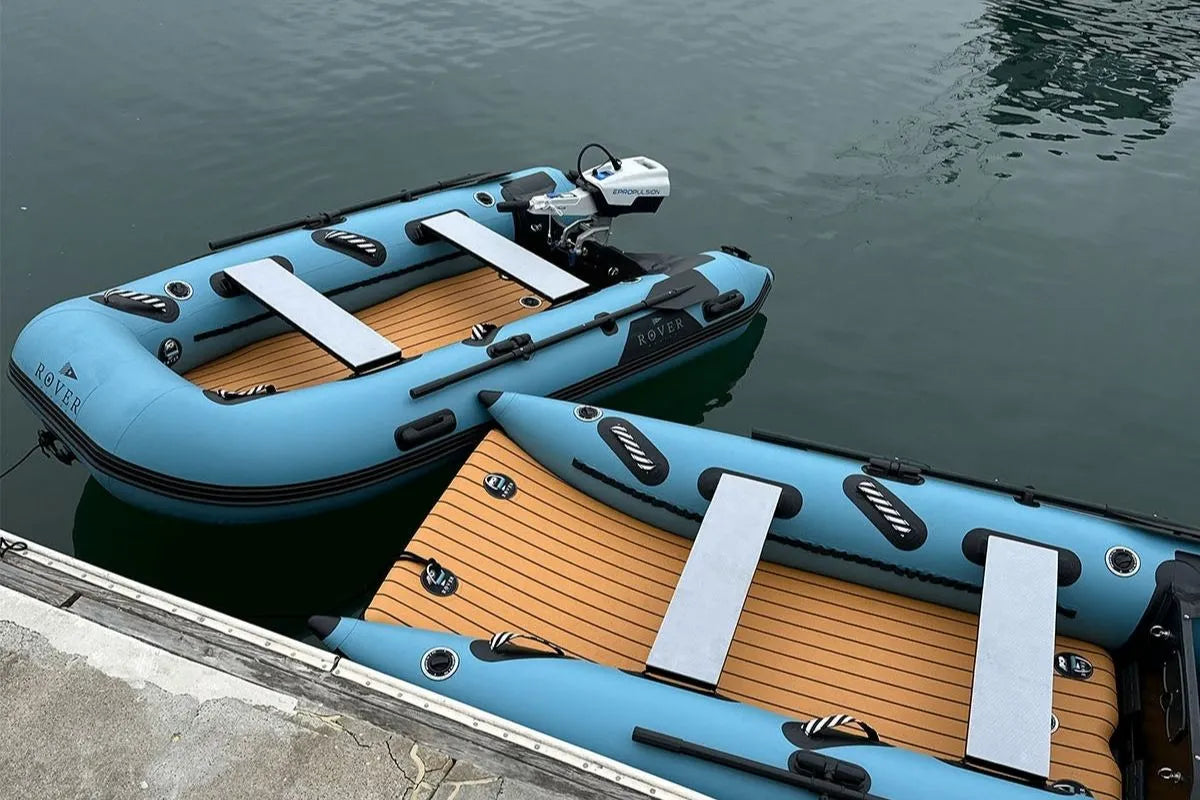
Every size deflates and rolls. An 8-foot Battle Boat weighs 86 lb and packs to 38 by 24 by 15 inches. The 10-foot goes to 45 by 28 by 18, and comes back out with a high-output dual-action pump in 10 to 15 minutes. An aluminum dinghy is its full dimensions permanently, so with no davits you are looking at an 8-foot hard-bottom dinghy chocked on the foredeck all season. To size a tender to your boat first, start with our September yacht tender size guide.

Side by side
Rowing
Aluminum hard dinghy:
Good. Tracks between strokes
Inflatable tender:
Fair in calm, poor into wind
Towing
Aluminum hard dinghy:
Excellent. Follows straight
Inflatable tender:
Good when trimmed correctly
Stability while boarding
Aluminum hard dinghy:
Lower. Tender at the rail
Inflatable tender:
High. Tubes resist heel immediately
Capacity per foot
Aluminum hard dinghy:
Moderate. Buoyancy is hull volume
Inflatable tender:
High. 600 / 1000 / 1200 lb at 8 / 10 / 12 ft
Abrasion on rock and concrete
Aluminum hard dinghy:
Excellent. Scratches, does not fail
Inflatable tender:
Fair. Wears with repeated dragging
Alongside your topsides
Aluminum hard dinghy:
Marks gelcoat in a chop
Inflatable tender:
None. The tube is the fender
Stowage
Aluminum hard dinghy:
Full size, always. Davits or chocks
Inflatable tender:
Packs to roughly 38 to 48 inches long by 24 to 32 wide by 15 to 20 deep depending on size
Setup time
Aluminum hard dinghy:
None
Inflatable tender:
10-15 min with a high-output pump
Field repair
Aluminum hard dinghy:
Not practical. Needs welding
Inflatable tender:
Patchable aboard with a kit
Repairs and warranty, stated honestly
A puncture sounds like a disaster and is not one. Our hulls divide their air into separate sealed chambers, 4+1 on most sizes and 3+2 on the 8-foot Battle Boat, plus a separately inflated drop-stitch floor. Lose one chamber and the boat still floats and still steers. You get home, clean the area, patch it on the dock, and the repair holds.
Aluminum does not puncture in normal use, but when it fails it fails harder. A holed hull, a cracked weld or a split seam is a welding job: find a fabricator who welds marine aluminum, haul the dinghy there, wait.
Coverage is the other place to look, because it tells you what a builder will stand behind. Our warranty covers the hull for 5 years against manufacturing defects, structural delamination and air leaks tied to manufacturing, the tubes and seams for 3 years against defects or delamination, and bolt-on accessories for 2 years.
Read the exclusions, because they are real and normal for the category. Punctures from use or handling are not covered. Neither is abrasion, dock rash, boat-to-boat scuffing, cosmetic damage from everyday misuse, improper storage or neglect. We warrant how the boat was built, not how it gets used. Claims go through the warranty form with photos and order information and can take up to 30 days to resolve.
The decision rule
The aluminum boat vs inflatable boat call comes down to how the tender gets used, not which hull is better in the abstract.
A hard dinghy is the better answer when you have davits or deck chocks, you row more than you motor, you tow long distances, you land on rock and concrete daily, and your topsides are workboat-honest rather than showroom.
An inflatable is the better answer when you have no davits, stowage is a locker, people board from a swim platform, you want maximum capacity in minimum length, and you would rather not explain a row of dings along the topsides to the next buyer.
Most cruising boats under 45 feet without davits land on the inflatable side, and it is the stowage line that puts them there. The next questions are length and hull type, covered in our yacht tender buying guide and our best yacht tender guide for 2026. Buying now and putting the boat away until spring? Start with our guide to winter storage.
Frequently asked questions
Which is better, an aluminum boat or an inflatable boat?
Neither wins outright. An aluminum dinghy rows better, tows straighter, shrugs off abrasion on rock and concrete, and needs no pump. An inflatable carries more load per foot, is far more stable when someone boards from a swim platform, will not mark topsides, and packs into a locker. Stowage decides it for most boats without davits.
Is an aluminum dinghy more durable than an inflatable?
It is more abrasion-resistant, which is not the same thing. Aluminum tolerates dragging on rock and concrete that wears fabric over time. An inflatable kept clean, dried and covered lasts for years and is patchable in the field. A holed or cracked aluminum hull needs welding by a fabricator.
Can you repair a punctured inflatable tender yourself?
Yes. Rover Marine hulls use separate sealed air chambers, in 4+1 and 3+2 layouts depending on model and size, plus a separately inflated drop-stitch floor, so one puncture does not sink the boat. Clean the area, apply a patch, let it cure, reinflate. Punctures from handling are not covered by warranty.
How long does it take to set up an inflatable tender?
Ten to fifteen minutes with a high-output pump, bringing the tubes to 3.5 psi and the drop-stitch floor to 10 psi. Owners who keep the boat inflated on davits skip that step. An aluminum dinghy needs no setup at all, a real advantage on short notice.
What size tender fits a locker or a small foredeck?
Deflated, an 8-foot Rover Marine boat packs to roughly 38 by 24 by 15 inches and a 10-foot to 45 by 28 by 18 inches, so both fit spaces no rigid dinghy of the same length will. An 8-foot hard-bottom dinghy occupies its full 8 feet permanently, which is why hard tenders need davits or chocks aboard.


Leave a comment
This site is protected by hCaptcha and the hCaptcha Privacy Policy and Terms of Service apply.