
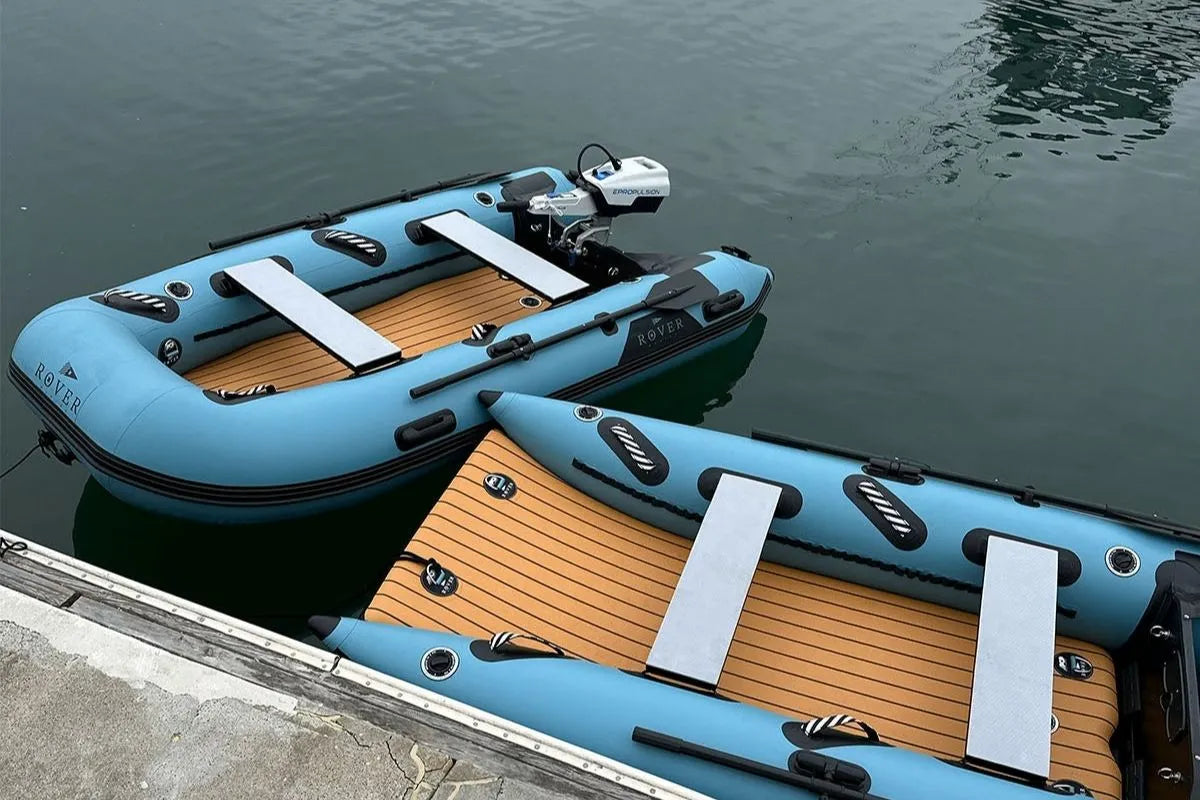
Choosing an outboard for an inflatable dinghy is not simply a matter of installing the largest motor the boat will accept. The right choice must balance power, motor weight, shaft length, range, noise, maintenance, storage, and the way the boat will actually be used.
Rover Marine Battle Boat and Battle Cat models support both gas and electric outboards. Every current size uses a 15-inch transom, while the maximum motor rating increases from 6 HP on the 8-foot boats to 20 HP on the 12-foot boats.
This guide explains those limits, compares gas and electric propulsion, reviews current Rover Marine electric options, and helps you build a complete setup around your crew, equipment, route, and water conditions.

Start With the Boat, Load, and Trip
The right motor begins with the complete setup, not a generic horsepower chart. Two owners using the same boat may need different propulsion because their passenger loads, routes, storage systems, and speed expectations are different.
- Exact Battle Boat or Battle Cat size.
- Number and combined weight of passengers.
- Fishing, diving, tender, or family use.
- Motor and battery or fuel weight.
- Expected distance and return reserve.
- Wind, current, waves, and water temperature.
- Charging or refueling availability.
- Ability to lift and store the motor safely.
Maximum Horsepower Is an Upper Limit
A boat rated for a 20 HP outboard does not require a 20 HP motor. A smaller motor may be the better fit for tender trips, harbor cruising, fishing, quiet family rides, or electric propulsion.
Current Rover Marine Motor Limits
Battle Boat and Battle Cat models share the same passenger capacity, maximum load, maximum motor rating, transom height, and inflation pressures by length.
| Boat Size | Capacity | Maximum Motor | Transom | Inflation Pressure |
|---|---|---|---|---|
| 8 Foot | 2 people / 600 lb | Up to 6 HP | 15 inches | 3.5 PSI tubes / 10 PSI floor |
| 10 Foot | 4 people / 1,000 lb | Up to 10 HP | 15 inches | 3.5 PSI tubes / 10 PSI floor |
| 12 Foot | 4 people / 1,200 lb | Up to 20 HP | 15 inches | 3.5 PSI tubes / 10 PSI floor |
Why Boat Weight Matters
| Model | 8 Foot | 10 Foot | 12 Foot |
|---|---|---|---|
| Battle Boat | 86 lb | 100 lb | 135 lb |
| Battle Cat | 84 lb | 98 lb | 130 lb |
The empty boat weight is only one part of the equation. The outboard, electric battery, fuel tank, passengers, anchor, seats, safety equipment, cooler, fishing gear, and dive equipment all count toward the published capacity.
Electric vs. Gas Outboards
Electric Outboards
- Much quieter than small combustion outboards.
- No direct exhaust at the motor.
- No onboard gasoline required.
- Simple starting and low-speed control.
- Fewer gas-engine maintenance tasks.
- Range depends on battery capacity and throttle.
- Charging access must be planned.
Gas Outboards
- Fast refueling where approved fuel is available.
- More choices across the full motor limits.
- Potentially longer practical range with extra fuel.
- Higher-output options for faster operation.
- Requires fuel-system and engine maintenance.
- Produces direct exhaust and more operating noise.
- Fuel must be transported and stored safely.
Electric Power May Be the Better Fit When
- Trips are short or predictable.
- Quiet operation matters.
- Charging is available between trips.
- You want to avoid gasoline fumes and storage.
- Tender runs, fishing, and harbor cruising are priorities.
Gas Power May Be the Better Fit When
- Longer practical range is required.
- Fast refueling is important.
- Charging access is limited.
- Higher sustained power is required.
- The selected motor remains within the boat's limits.
Transom Height and Shaft Length
Every current Battle Boat and Battle Cat size uses a 15-inch transom. A compatible short-shaft outboard is therefore the normal configuration.
Do Not Use the Rule “Go Shorter When Unsure”
Shaft length should be matched to the actual transom and motor manufacturer's installation instructions. A motor that is too short can ventilate or lose propeller grip. A motor that is too long can place the lower unit deeper than intended and increase drag.
Confirm the exact short-shaft or long-shaft model before ordering.
Why a Long Shaft Is Usually Wrong for These Boats
Rover Marine's current transom specification is 15 inches. Long-shaft motors are generally intended for taller transoms and should only be used when the boat setup specifically calls for the additional length.
Do Not Add an Extension Plate Without Approval
An aftermarket motor plate can change the load placed on the transom, motor height, leverage, trim, and steering behavior. Do not modify the motor mounting arrangement unless the complete setup is approved for the boat and motor.
Current Rover Marine Electric Outboard Options
Rover Marine currently carries portable short-shaft electric motors from ePropulsion and Torqeedo. The best choice depends on controls, battery platform, package type, preferred display, range requirements, and portability.
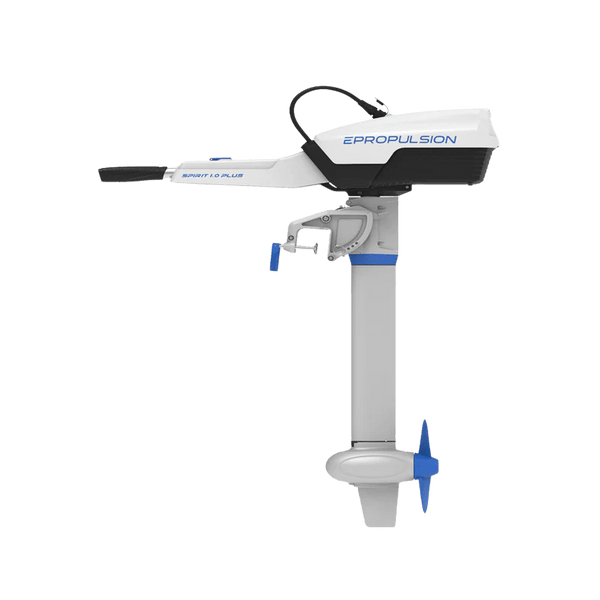
ePropulsion Spirit 1.0 Plus
The Spirit 1.0 Plus is a 1 kW portable electric outboard with a removable Spirit battery platform.
It can fit tender trips, marina use, fishing, family cruising, and boaters who value quiet operation and straightforward controls.
- Short-shaft configuration.
- 1 kW power platform.
- Removable battery system.
- Designed for marine use.
- External battery capability is available within the platform.

Torqeedo Travel 1103 S
The Travel 1103 S is a portable short-shaft electric outboard with an integrated removable battery platform and tiller display.
Rover Marine currently offers Essential and Extended Range packages, allowing buyers to choose the package that better matches their expected trips.
- Short-shaft configuration.
- 1,100-watt input power platform.
- Removable battery.
- GPS-enabled tiller display.
- Essential and Extended Range packages.
Electric Equivalent Ratings Need Context
Electric manufacturers may describe a motor as comparable to a gasoline horsepower class. This does not guarantee the same top speed, acceleration, planing behavior, or range as every gas motor carrying that horsepower number.
Compare actual power, battery capacity, motor weight, propeller, passenger load, and expected conditions.
Review all current listings in the Rover Marine electric outboard motor collection .
How to Plan Electric Range
Electric range changes with throttle, battery capacity, boat size, passenger load, wind, waves, current, temperature, propeller condition, inflation pressure, and battery health.
A fixed promise of two, four, or six hours is not reliable without a defined battery, power setting, boat, load, and test environment.
Battery Capacity
More usable battery energy generally provides more runtime, but it can also add cost, weight, charging time, and storage requirements.
Throttle Setting
High-power operation uses energy much faster than low-speed cruising. Small reductions in throttle can significantly affect runtime.
Conditions and Load
Headwinds, waves, current, heavy equipment, low inflation, and poor weight distribution can increase the energy required.
Basic Runtime Estimate
Approximate runtime can be estimated by dividing usable battery energy by average motor draw.
The result is only a planning estimate. Maintain a return reserve and account for changing conditions rather than planning to use the battery to its final percentage.
Do Not Assume Regenerative Charging
Regenerative charging is not a standard feature of every portable electric outboard. Do not include it in trip planning unless the exact motor, propeller, and operating setup support and document that function.
Choosing a Gas Outboard
Rover Marine does not need to publish an unverified list of “best” gas motors from unrelated manufacturers. Instead, compare current short-shaft outboards that remain within the boat's published power and load limits.
- Compatible 15-inch short-shaft configuration.
- Horsepower at or below the boat's maximum.
- Motor weight that fits the complete load plan.
- Reliable dealer and parts support.
- Starting method appropriate for the operator.
- Approved fuel tank and fuel-line arrangement.
- Saltwater-care instructions when applicable.
- Storage position approved by the manufacturer.
Two-Stroke vs. Four-Stroke
Do not assume every modern portable two-stroke requires owner-mixed fuel or that every market sells the same models. Engine availability and emissions requirements vary by manufacturer and location.
Compare the exact motor's weight, fuel system, maintenance schedule, emissions certification, dealer support, storage requirements, and warranty.
Motor Installation and Initial Setup
Follow the exact boat and motor manuals. Generic torque settings and trim instructions should not replace the manufacturer's installation procedure.
- Confirm the motor uses the correct 15-inch short-shaft configuration.
- Confirm horsepower and total installed weight remain within the boat's limits.
- Position the motor according to the motor manufacturer's mounting instructions.
- Tighten clamps or fasteners to the specification supplied with the motor.
- Attach and test the engine cutoff device.
- Route fuel lines, electrical cables, and controls away from sharp edges and passenger movement.
- Test steering, reverse, tilt, and trim functions before departure.
- Complete the initial water test in protected conditions with a light, balanced load.
Motor Security
A properly selected motor lock or security cable may help reduce theft at docks or during storage. Security equipment must not interfere with steering, tilt, the emergency cutoff system, or safe motor removal.
Spare Propeller and Tools
A spare propeller may be useful for longer or remote trips, but it is not a universal requirement. Carry only tools and replacement parts that match the exact motor and that the operator knows how to use safely.
Matching the Motor to Common Uses
| Use | Possible Motor Direction | What Matters Most |
|---|---|---|
| Yacht tender trips | Portable electric or small gas outboard | Weight, storage, noise, range, and ease of removal |
| Fishing | Electric or gas within the boat limit | Low-speed control, range, battery or fuel reserve |
| Family cruising | Electric or gas within the boat limit | Simple controls, passenger load, noise, and route |
| Diving | Motor sized for the complete loaded boat | Divers, tanks, weights, gear, range, and reboarding |
| Longer-distance travel | Gas or larger battery strategy | Weather, fuel or energy reserve, and return planning |
What About Offshore Use?
Do not describe a motor and boat combination as offshore capable from horsepower alone. Offshore suitability depends on weather, sea state, distance from shelter, communication equipment, operator experience, redundancy, fuel or battery reserve, and the exact boat.
What About Tubing or Watersports?
The maximum motor rating does not automatically approve towing a person. Towing requires a suitable boat, motor, tow point, hardware, steering system, and operating environment.
Confirm the intended activity directly with Rover Marine before installing tow hardware or pulling a rider.
Outboard Maintenance and Storage
Maintenance requirements vary by motor. Follow the exact manufacturer schedule rather than a generic monthly checklist.
Electric Motor Care
- Rinse appropriate components after saltwater use.
- Inspect the propeller for line, weeds, and damage.
- Check electrical connectors and mounting hardware.
- Use the approved charger.
- Follow the battery storage-charge instructions.
- Inspect anodes where included by the manufacturer.
Gas Motor Care
- Follow the approved freshwater flushing procedure.
- Inspect the propeller and lower unit.
- Check fuel lines, tank, clamps, and connections.
- Service engine oil where applicable.
- Maintain spark plugs, filters, and cooling systems as instructed.
- Complete seasonal service and storage procedures.
Battery Storage
Do not apply one universal 50-to-70-percent storage rule to every battery. Storage charge, temperature, inspection frequency, and charging procedures vary by battery chemistry and manufacturer.
Winterizing
Winterization depends on the motor. A gas outboard may require fuel, cooling, lubrication, and storage procedures. An electric outboard may require battery conditioning, approved charging, dry storage, and periodic inspection.
Use the exact manual for the motor rather than a general winterization formula.

Safety Equipment and Operating Requirements
Required equipment depends on the jurisdiction, boat, motor, operating area, time of day, and type of use.
- Properly sized life jackets for every person.
- Engine cutoff switch and lanyard when required.
- Sound-producing device.
- Navigation lights when required.
- Registration and documentation when applicable.
- Fire extinguisher when required for the setup.
- Communication and emergency equipment.
- Anchor and line appropriate for the operating area.
Registration requirements for a motorized inflatable vary by state and location. Confirm the rules with the state boating authority where the boat will be operated.
Current Rover Marine Warranty Coverage
Rover Marine publishes tiered factory coverage for eligible boats and covered components.
Coverage applies to qualifying manufacturing defects and remains subject to the full terms, exclusions, care requirements, documentation, and claim review process.
Motors, batteries, chargers, electronics, and other third-party products generally follow the warranties provided by their manufacturers.
Read the Complete Rover Marine WarrantyFrequently Asked Questions
What is the maximum motor for the 8-foot boats?
The 8-foot Battle Boat and Battle Cat support motors up to 6 HP. Each is rated for two people or 600 pounds and uses a 15-inch transom.
What is the maximum motor for the 10-foot boats?
The 10-foot Battle Boat and Battle Cat support motors up to 10 HP. Each is rated for four people or 1,000 pounds and uses a 15-inch transom.
What is the maximum motor for the 12-foot boats?
The 12-foot Battle Boat and Battle Cat support motors up to 20 HP. Each is rated for four people or 1,200 pounds and uses a 15-inch transom.
Do the 12-foot boats require a long-shaft motor?
No. Current Rover Marine specifications list a 15-inch transom on the 12-foot Battle Boat and Battle Cat. A compatible short-shaft motor is the normal fit.
Can I use a trolling motor as primary propulsion?
A trolling motor may work for low-speed positioning or short calm water trips, but suitability depends on the motor, boat, load, current, wind, and expected distance. Do not assume every thrust-rated trolling motor provides the control or range of a purpose-built outboard.
How fast will my Rover Marine boat go?
Speed depends on the exact boat, motor, propeller, total load, inflation pressure, weight distribution, trim, wind, waves, current, temperature, and elevation. A universal speed cannot be guaranteed.
How long will an electric battery run?
Runtime depends on battery capacity, average motor draw, throttle, boat size, total load, wind, current, waves, temperature, propeller condition, and battery health.
Can I use an electric outboard in saltwater?
Many current electric outboards are designed for marine and saltwater use. Follow the exact manufacturer's rinsing, anode, connector, battery, and storage instructions.
Does Rover Marine sell Minn Kota motors?
The current Rover Marine electric motor collection lists ePropulsion Spirit 1.0 Plus and Torqeedo Travel 1103 options. It does not currently list Minn Kota motors.
Does adding a motor require registration?
Registration rules vary by state and jurisdiction. Many locations require registration once propulsion is added, but owners should confirm the current rule with the authority where the boat will be used.
Which motor is best for my boat?
The best motor depends on the boat size, total load, trip distance, desired speed, charging or fuel access, storage, lifting ability, and typical conditions. Contact Rover Marine with those details for help reviewing the current options.
Read Rover Marine Owner Experiences
Specifications establish the boat's motor, load, pressure, and transom limits. Owner feedback can provide additional perspective on electric motor use, setup, transportation, storage, stability, and customer support.
Visit the Rover Marine reviews page and compare those experiences with your boat size, route, passenger load, and preferred propulsion.
Choose the Motor Around the Trips You Actually Take
Start with your Rover Marine model, passenger and equipment load, route, desired speed, storage, and access to charging or fuel. Then choose a compatible short-shaft outboard within the published motor limit.
Built for Water. Designed for Freedom.

Leave a comment
This site is protected by hCaptcha and the hCaptcha Privacy Policy and Terms of Service apply.