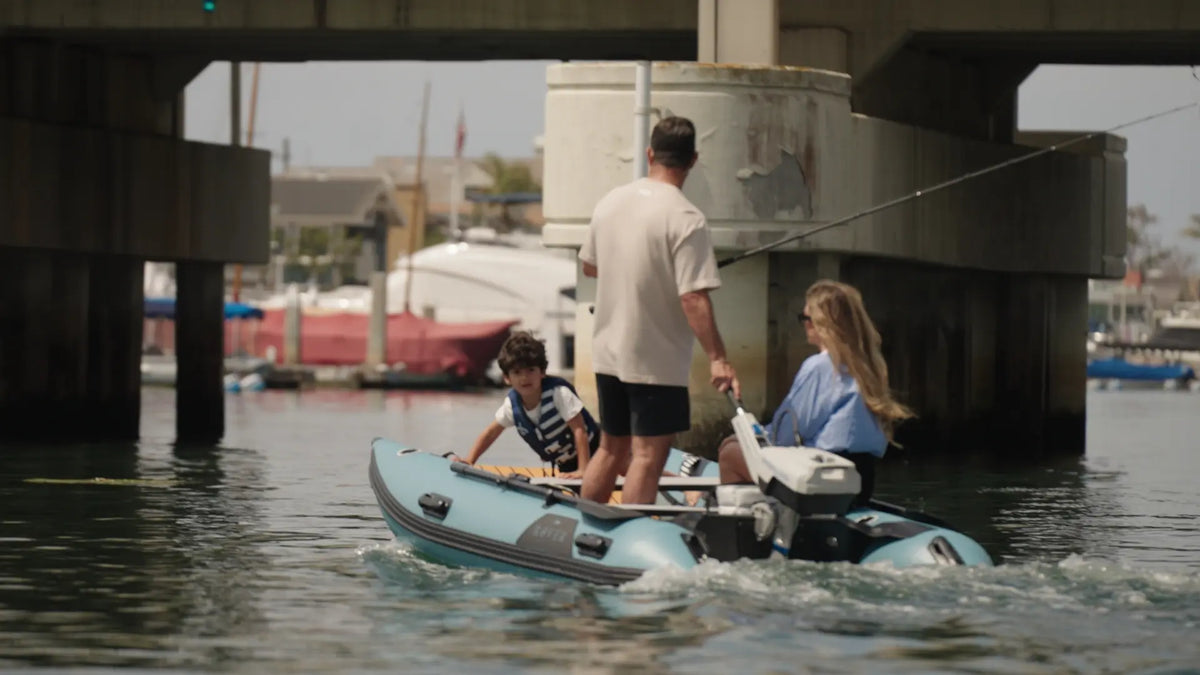
Marine businesses often need a small boat for equipment movement, crew support, dock service, tender duty, photography, inspections, fishing, diving, or short-distance transportation.
A fully inflatable boat can offer useful storage and transportation advantages because the hull can be deflated between assignments. That does not automatically make every inflatable suitable for every commercial operation.
Operators must evaluate the boat, motor, load, water conditions, operating procedures, insurance, required credentials, passenger rules, maintenance schedule, and applicable federal, state, and local regulations.

Where an Inflatable Dinghy May Fit a Business Operation
Rover Marine boats can be evaluated for several business-support roles. The correct use depends on the exact operation, the people aboard, the load, water conditions, and regulatory requirements.
Yacht and Marina Support
Potential roles include crew movement, provisioning, dock checks, equipment transfers, and short tender runs.
Dive and Water-Sports Support
A boat may be used to move equipment, support shore-based activity, provide surface assistance, or help staff reach nearby work areas.
Photography and Production
A portable inflatable may provide a low working position for approved photography, scouting, location access, and equipment movement.
Fishing and Environmental Work
Potential uses include equipment transport, shoreline access, observation, sampling support, and work in protected water.
Support Boat and Passenger Vessel Are Not the Same Thing
Using a boat to move company equipment or trained employees is different from carrying paying passengers or offering charter transportation.
Passenger-for-hire operations can trigger captain licensing, documentation, inspection, drug and alcohol program, safety-equipment, and insurance requirements. Confirm the planned operation before advertising or accepting payment.
Why Businesses Consider Fully Inflatable Boats
- Deflates into a smaller storage footprint.
- Can be moved between locations without a permanent hull trailer.
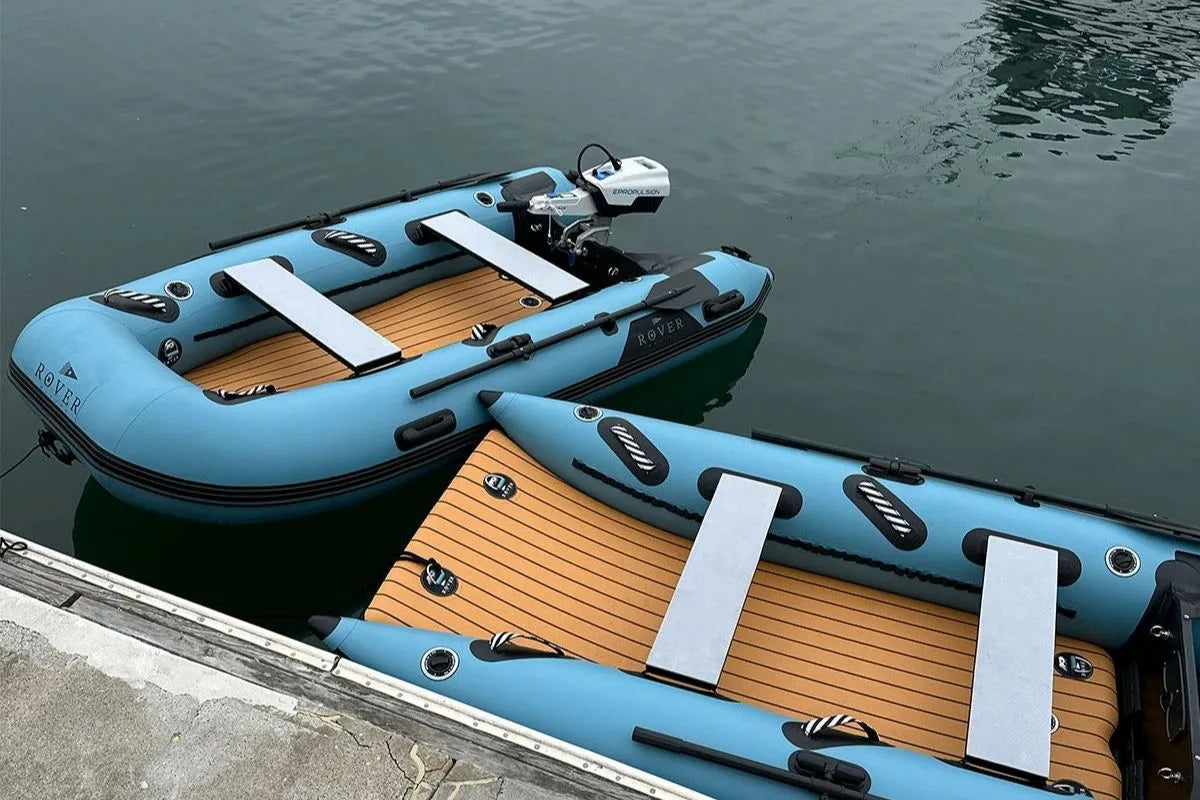
- Available with traditional or dual-pontoon hull layouts.
- Compatible with properly matched gas or electric outboards.
- Motor and battery can be removed for separate storage.
- May be stored indoors between operating seasons.
- Provides a firm high-pressure drop-stitch deck.
- Available in three lengths for different loads and storage limits.
Portability Still Requires Planning
A deflated boat is smaller than a permanent rigid hull, but it is not weightless. Current Rover Marine boats weigh between 84 and 135 pounds before adding the motor, battery, fuel, seats, anchor, safety equipment, and operational gear.
A business should plan how the boat will be lifted, moved, dried, inspected, transported, and stored without causing employee injuries or equipment damage.
Battle Boat vs. Battle Cat for Business Use

Battle Boat
The Battle Boat uses a traditional inflatable dinghy layout with a high-pressure drop-stitch floor.
Businesses may consider this layout for general tender duty, equipment movement, marina support, fishing, diving, and short-distance operations.
- Traditional inflatable hull layout.
- Available in 8-, 10-, and 12-foot sizes.
- Triple-layer reinforced 1100D PVC.
- Heat-welded seams.
- Gas and electric motor compatibility.

Battle Cat
The Battle Cat uses two parallel inflatable pontoons to create a wider catamaran-style stance.
Businesses may consider this layout when deck width, equipment organization, boarding, or initial stability are major priorities.
- Dual-pontoon inflatable hull layout.
- Available in 8-, 10-, and 12-foot sizes.
- Triple-layer reinforced 1100D PVC.
- Heat-welded seams.
- Gas and electric motor compatibility.
| Decision Factor | Battle Boat | Battle Cat |
|---|---|---|
| Hull layout | Traditional inflatable dinghy profile | Dual-pontoon catamaran-style profile |
| Deck shape | Familiar tender-style interior | Wider stance between parallel pontoons |
| Possible business fit | Tender runs, marina support, transport, and general utility | Fishing, diving, equipment work, and stability-focused use |
| Available sizes | 8, 10, and 12 feet | 8, 10, and 12 feet |
| Maximum capacity | Up to 4 people and 1,200 lb, depending on size | Up to 4 people and 1,200 lb, depending on size |
| Maximum power | Up to 20 HP on the 12-foot model | Up to 20 HP on the 12-foot model |
Current Rover Marine Specifications
Battle Boat and Battle Cat models share the same published capacities, maximum motor ratings, transom height, and inflation pressures by length.
| Size | Capacity | Maximum Motor | Transom | Pressure |
|---|---|---|---|---|
| 8 Foot | 2 people / 600 lb | Up to 6 HP | 15 inches | 3.5 PSI tubes / 10 PSI floor |
| 10 Foot | 4 people / 1,000 lb | Up to 10 HP | 15 inches | 3.5 PSI tubes / 10 PSI floor |
| 12 Foot | 4 people / 1,200 lb | Up to 20 HP | 15 inches | 3.5 PSI tubes / 10 PSI floor |
Boat Weight and Packed Dimensions
| Size | Packed Dimensions | Battle Boat Weight | Battle Cat Weight |
|---|---|---|---|
| 8 Foot | 38 x 24 x 15 inches | 86 lb | 84 lb |
| 10 Foot | 45 x 28 x 18 inches | 100 lb | 98 lb |
| 12 Foot | 48 x 32 x 20 inches | 135 lb | 130 lb |
Capacity Includes the Entire Operational Load
Employees, passengers, motor, battery, fuel, safety equipment, anchors, tools, cameras, dive equipment, coolers, samples, fishing equipment, and other cargo all count toward the published load limit.

How to Evaluate Total Cost of Ownership
The previous article included fixed five-year savings figures that were not based on documented Rover Marine customer data. A business should calculate its own operating costs instead.
Acquisition Costs
- Boat purchase price
- Motor and battery or fuel system
- Safety equipment
- Registration and documentation
- Training and operating procedures
Operating Costs
- Fuel or electricity
- Labor for setup and retrieval
- Cleaning and inspection
- Motor servicing
- Replacement parts and repairs
Business Costs
- Commercial insurance
- Captain or operator credentials
- Drug and alcohol program
- Storage and transportation
- Downtime and spare equipment
Questions for a Fleet Cost Comparison
- Will the boat be stored inflated or deflated?
- How many employees are needed for deployment?
- Will a trailer, cart, tender wheels, or lift be needed?
- How frequently will the boat be used?
- What level of motor service is required?
- How will wet boats be dried before storage?
- What downtime can the operation tolerate?
- What insurance policy covers the exact business activity?
Choosing Gas or Electric Power
A business should select propulsion around the route, payload, charging or fuel access, required speed, operating schedule, and water conditions.
Electric Outboards
- Quieter than comparable combustion motors.
- No direct exhaust at the motor.
- No onboard gasoline required.
- Range depends on battery capacity and throttle.
- Charging time and electrical access must be planned.
- Batteries require approved handling and storage procedures.
Gas Outboards
- Fast refueling where approved fuel is available.
- Broader choices across the published motor limits.
- Potentially longer practical range with additional fuel.
- Requires fuel storage and engine maintenance.
- Produces combustion exhaust and more operating noise.
- Fuel-system safety procedures are required.
Current Electric Options
Rover Marine offers short-shaft electric outboards through its electric outboard motor collection .
Current options include the ePropulsion Spirit 1.0 Plus and Torqeedo Travel 1103 S platforms. These portable motors may fit tender service, inspection work, marina travel, fishing, and predictable short-distance operations.
Do Not Choose a Motor From a Generic Mission Table
A statement such as “use 5 HP for diving” or “use 15 HP for patrol” ignores the boat size, passenger load, equipment, route, sea state, response-time requirement, and operator.
Start with the published boat limit and evaluate the complete mission.
Commercial Licensing and Regulatory Planning
Rover Marine product capacity is not the same as legal authorization to carry passengers for hire. A business must confirm whether its operation is recreational, private business use, bareboat charter, uninspected passenger service, or inspected passenger service.
Passenger-for-Hire Operations
A captain carrying paying passengers may need an appropriate U.S. Coast Guard Merchant Mariner Credential. Operators and crew may also be subject to drug and alcohol program requirements.
Vessels carrying more than six passengers for hire can be subject to Coast Guard inspection and Certificate of Inspection requirements. Rover Marine boats have published passenger limits of two or four people, depending on size, and those product limits must never be exceeded.
Confirm Requirements With the Correct Authorities
- U.S. Coast Guard sector or Officer in Charge, Marine Inspection
- State boating and registration authority
- Local port, harbor, park, or waterway authority
- Commercial marine insurance provider
- Qualified maritime attorney or compliance professional
- Motor and battery manufacturer
Review current federal boating regulations through the U.S. Coast Guard Boating Safety Division .
Commercial Inspection and Maintenance Planning
A high-use business boat should have written procedures based on the boat manual, motor manual, operating environment, and company safety program.
Before Each Operating Period
- Inspect tubes, seams, valves, handles, floor, and transom.
- Confirm tubes are inflated to 3.5 PSI.
- Confirm the drop-stitch floor is inflated to 10 PSI.
- Inspect the motor mount and fastening hardware.
- Check propeller condition and steering movement.
- Confirm battery charge or approved fuel supply.
- Verify required safety and communication equipment.
- Confirm the complete passenger and equipment load.
- Review weather, current, route, and operating limits.
After Use
- Rinse appropriate boat and motor components after saltwater use.
- Inspect the fabric for cuts, abrasion, punctures, or pressure loss.
- Inspect the propeller for line, weeds, and damage.
- Dry the boat before extended packed storage.
- Charge and store batteries according to the manufacturer manual.
- Service gas motors according to the exact manufacturer schedule.
- Record damage, repairs, operating hours, and service work.
Create a Written Inspection Log
A business may benefit from a log that records the operator, date, location, pressure, motor hours, battery state or fuel level, damage, repairs, safety-equipment checks, and reason a boat was removed from service.
Remove From Service When
- A chamber will not maintain pressure.
- A seam or transom shows structural movement.
- The floor shows unusual separation or deformation.
- The motor mount cannot be secured correctly.
- Required safety equipment is missing or damaged.
Request Professional Review When
- Damage extends into a seam.
- The transom or floor structure is affected.
- A large tear or repeated leak develops.
- The repair method is uncertain.
- The boat is used in a regulated operation.

How to Evaluate a Multi-Boat Fleet
Fleet planning should be based on actual operating data rather than generalized promises of savings.
- Number of boats needed during peak demand.
- Number of trained operators available.
- Motor and battery standardization.
- Spare pumps, valves, propellers, and repair materials.
- Charging capacity and electrical safety.
- Indoor drying and storage space.
- Repair turnaround and backup equipment.
- Written inspection and removal-from-service procedures.
Standardize Where Practical
Using the same boat size, motor platform, charger, propeller, and repair materials across several units may simplify training, inventory, and troubleshooting.
Mixed fleets can still make sense when separate locations or missions require different capacities and hull layouts.
Do Not Invent Fleet Performance Results
The previous article included unnamed charter and dive-resort case studies with specific savings, operating days, ratings, and passenger loads. Those claims should not be published without documented customer approval and supporting records.
Current Rover Marine Warranty Coverage
Rover Marine publishes tiered factory coverage for eligible boats and covered components.
Coverage applies to qualifying manufacturing defects and remains subject to the complete terms, exclusions, documentation requirements, and claim review process.
Punctures, abrasion, dock rash, accidents, misuse, improper storage, normal wear, lack of care, and other use-related damage are not automatically covered.
Motors, batteries, electronics, and other third-party equipment generally follow the warranty provided by their manufacturer.
Read the Complete Rover Marine WarrantyFrequently Asked Questions
Are Rover Marine boats certified commercial passenger vessels?
Rover Marine publishes boat capacities and motor limits, but those specifications do not automatically authorize a boat for commercial passenger service. Confirm the exact operation with the Coast Guard, state authority, insurer, and other applicable regulators.
Can a Rover Marine boat carry six paying passengers?
No current Rover Marine model is listed for six passengers. The 8-foot models are rated for two people. The 10-foot and 12-foot models are rated for four people. These limits include recreational, employee, and paying passengers.
What is the maximum capacity of the 12-foot models?
The 12-foot Battle Boat and Battle Cat are rated for four people or 1,200 pounds. The load includes the motor, battery or fuel, passengers, safety equipment, and operational gear.
Which model is better for equipment-heavy operations?
The Battle Cat's wider dual-pontoon layout may appeal to operators prioritizing deck width and initial stability. The Battle Boat may appeal to operators who prefer a traditional tender layout. Compare the exact equipment and operating conditions before choosing.
Can the boats be used with electric motors?
Yes. Current Battle Boat and Battle Cat models use 15-inch transoms, and Rover Marine offers compatible short-shaft electric options. Confirm range, complete package weight, charging, and operating conditions before deployment.
Can a business avoid using a trailer?
The boats can be deflated for transportation, which may remove the need for a permanent boat trailer in some operations. A trailer, cart, tender wheels, cargo van, lift, or other equipment may still be useful depending on the size and deployment method.
How many boats fit inside a cargo van?
There is no universal answer. Van dimensions, payload rating, boat size, packing method, motors, batteries, fuel, seats, pumps, and safety equipment all affect capacity. Measure and weigh the complete load before transport.
How quickly can a puncture be repaired?
Repair time depends on the damage, material preparation, adhesive, temperature, curing requirements, and location of the puncture. Do not promise a 15-minute return to service. Follow the approved repair method and curing time before operating.
How long will the boat last in commercial service?
There is no guaranteed commercial lifespan. Service life depends on operating frequency, UV exposure, saltwater care, abrasion, inflation, storage, cleaning, repairs, load, and maintenance.
Does Rover Marine offer fleet pricing?
Contact Rover Marine directly to discuss the number of units, models, motors, delivery schedule, and intended use. Do not assume a discount or package is available until it is confirmed in writing.
What warranty applies to business use?
Review the current Rover Marine warranty page and contact Rover Marine with the intended operation. Warranty coverage is subject to the current terms, exclusions, care requirements, and claim review.
Discuss the Operation Before Ordering
Businesses should provide Rover Marine with the expected load, passenger count, equipment, motor preference, water conditions, storage method, transport plan, and frequency of use.
Rover Marine can explain current product specifications and available equipment. Regulatory approval, commercial licensing, insurance, inspection, and operating procedures must be confirmed with the appropriate professionals and authorities.
Contact Rover MarineBuild the Fleet Around the Real Operation
Start with the job, crew, passengers, equipment, route, storage, and regulatory requirements. Then choose the boat size, hull layout, motor, and support equipment that fit the complete mission.
Built for Water. Designed for Freedom.

Leave a comment
This site is protected by hCaptcha and the hCaptcha Privacy Policy and Terms of Service apply.