
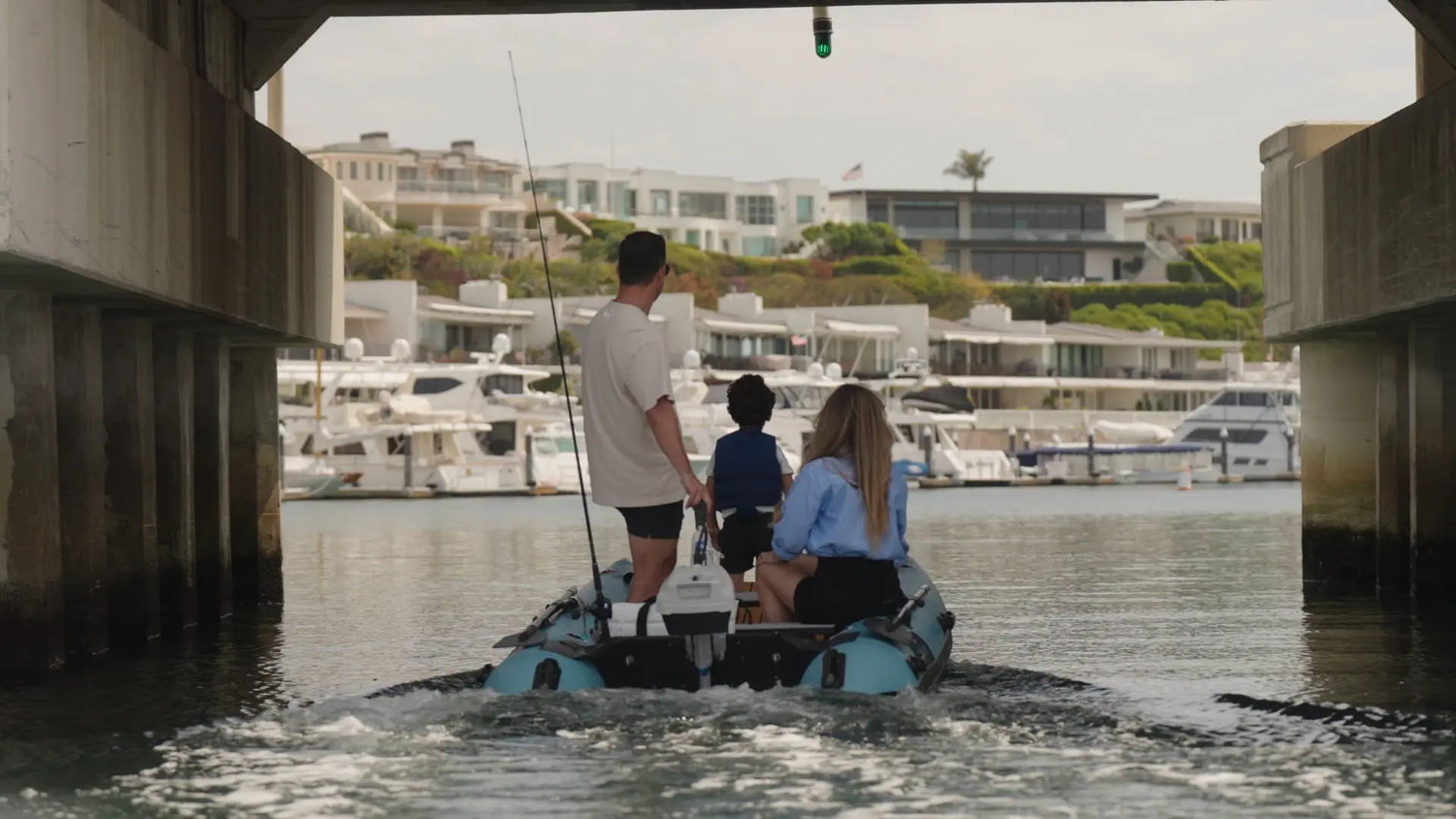
What the Law Actually Requires on Your Inflatable Boat in 2026
Most boaters know they need a life jacket. Few know the full picture—what’s federally required, what’s state-specific, what applies to motorized vs. non-motorized vessels, and what the actual penalties are for non-compliance. This guide breaks down the U.S. Coast Guard legal requirements for recreational vessels in 2026, specifically as they apply to Rover Marine’s Battle Boat and Battle Cat.
Important: Federal USCG requirements are the minimum standard. Florida and other coastal states layer additional requirements on top. Always verify current state regulations at Florida Fish and Wildlife Conservation Commission (FWC) before operating.
How USCG Classifies Your Boat: Why It Matters
USCG safety requirements are tied to vessel class, which is determined by length. Every Rover Marine model—Battle Boat and Battle Cat in 8ft, 10ft, and 12ft configurations—falls into Class A:
| USCG Vessel Class | Length | Rover Marine Models |
|---|---|---|
| Class A | Under 16ft | All Battle Boat and Battle Cat models (8ft, 10ft, 12ft) |
| Class 1 | 16ft to under 26ft | Not applicable — no Rover Marine models reach 16ft |
All Rover Marine boats are Class A vessels. This is the most common recreational vessel class and carries the most straightforward federal requirements. State requirements (Florida FWC) may add additional obligations on top.
Requirement 1: Personal Flotation Devices (PFDs)
Federal Law (46 CFR Part 25.25) — Class A Vessels
- One USCG-approved wearable PFD (Type I, II, or III) for every person on board—no exceptions
- PFDs must be the correct size for the intended wearer—adult PFDs cannot be used for children
- PFDs must be in serviceable condition—no torn straps, missing buckles, or waterlogged foam
- PFDs must be readily accessible—not stored in a sealed bag under gear
- Class A vessels are not federally required to carry a Type IV throwable device—though it is strongly recommended
Florida State Law (Additional Requirements)
- Children under 6 years old must wear a USCG-approved PFD at all times while underway on vessels under 26ft
- All persons being towed (water skiing, tubing) must wear a PFD
- PFDs must be Coast Guard-approved—novelty or decorative flotation devices do not qualify

PFD Types Explained
| Type | Buoyancy | Best For | USCG Compliant? |
|---|---|---|---|
| Type I | 22+ lbs | Offshore, rough water, unconscious wearer | Yes |
| Type II | 15.5 lbs | Near-shore, calm water, children | Yes |
| Type III | 15.5 lbs | Inshore, active use, fishing, water sports | Yes — most common for recreational use |
| Type IV | 16.5 lbs | Throwable device only — not wearable | Yes — not required on Class A but strongly recommended |
| Type V | Varies | Special use (kayaking, sailing harness) | Only if worn and labeled for intended activity |
Rover Marine recommendation: Type III PFDs for adults. Type II for children and non-swimmers. Carry a Type IV throwable ring buoy or cushion on all models—not federally required for Class A but it’s a fast MOB recovery tool that costs $15-$25.
Requirement 2: Fire Extinguishers
Federal Law (33 CFR Part 175.10) — Class A Vessels
For Class A vessels with outboard motors and no enclosed engine compartments or built-in fuel tanks—which describes all Rover Marine inflatable configurations—a fire extinguisher is not federally required. However:
- If your Battle Boat or Battle Cat has any enclosed compartment where fuel vapors could accumulate, a B-1 extinguisher becomes required
- USCG-approved B-1 extinguisher required if: enclosed fuel tank, enclosed engine compartment, or enclosed living space
Rover Marine position: Carry a USCG-approved B-1 fire extinguisher on every mission regardless. Electric motors eliminate gas fire risk but lithium-ion batteries carry thermal runaway risk—a dry chemical extinguisher can suppress a Li-ion fire in its early stages. A $25 extinguisher is cheap insurance on a $3,000+ motor investment.
Fire Extinguisher Compliance Requirements
- Must be USCG-approved (look for USCG approval number on label)
- Must be mounted in an accessible location—not buried in a storage bag
- Pressure gauge must be in the green zone
- Must be re-inspected or replaced per manufacturer schedule (typically annually)
- B-1 rating minimum—effective against flammable liquids and electrical fires
Requirement 3: Visual Distress Signals (VDS)
Federal Law (33 CFR Part 175.110) — Class A Vessels
VDS requirements apply to vessels operating on coastal waters, the Great Lakes, territorial seas, and waters connected to them up to a point where they are less than 2 miles wide. This covers virtually all South Florida ICW and coastal operations.
| Operating Area | Day Requirement | Night Requirement |
|---|---|---|
| Coastal waters, ICW, territorial seas | Day signals required (or combination device) | Night signals required (or combination device) |
| Inland lakes and rivers (non-coastal) | Not required during day | Night signals required |
USCG-Approved VDS Options
- Pyrotechnic flares (combination day/night): Most common. Must be unexpired (42-month limit from manufacture date stamped on flare). Minimum 3 combination signals required for coastal ops.
- Electronic Visual Distress Signal (EVDS): Non-expiring LED strobe devices approved as night signals. Must be paired with a day signal device.
- Orange distress flag: USCG-approved day signal. 3ft x 3ft minimum with black square and ball on orange background.
- ACR ResQLink 400 PLB: Not technically a VDS under USCG regs, but triggers SAR response via satellite. Carry in addition to—not instead of—required VDS.
Penalty for non-compliance: Operating without required VDS on coastal waters is a federal violation—fines up to $5,000 per violation under 46 USC §4311.
Requirement 4: Sound-Producing Devices
Federal Law (33 CFR Part 175.115 and COLREGS)
| Vessel Length | Requirement | Practical Option |
|---|---|---|
| Under 39.4ft (12m) — all Rover Marine models | Must have a sound-producing device capable of a 4-second blast audible for ½ mile | USCG-approved whistle or air horn |
- A Fox 40 Marine Pealess Whistle meets this requirement and costs ~$8-$12 at West Marine
- Attach to PFD so it’s always on your body—not in a bag
- Sound signals are also required by COLREGS for fog, restricted visibility, and maneuvering situations
Requirement 5: Navigation Lights
Federal Law (33 CFR Part 83 — COLREGS Inland Rules)
Navigation lights are required when operating between sunset and sunrise, or in periods of restricted visibility. All Rover Marine models (8ft, 10ft, 12ft) are under 7 meters and fall under the “power-driven vessel under 7 meters” category when motoring:
| Light | Color | Position | Arc |
|---|---|---|---|
| Masthead/Bow Light | White | Forward | 225° |
| Sternlight | White | Aft | 135° |
| Sidelights | Red (port) / Green (starboard) | Bow sides | 112.5° each |
Practical option: Portable clip-on navigation light sets (Attwood, Perko, or similar) mount to the gunwale without drilling. Available at West Marine for ~$30-$60. Required for early morning fishing runs, dusk returns, and any night operation.
At anchor after dark: A white all-round anchor light visible for 2 miles is required. A battery-powered anchor light hung from a bow line meets this requirement.
Requirement 6: Vessel Registration and Numbers
Federal and Florida State Law
- All motorized vessels in Florida must be registered with the Florida Department of Highway Safety and Motor Vehicles (FLHSMV)
- Registration numbers must be displayed on both sides of the bow in block letters at least 3 inches high, in a color contrasting with the hull
- Registration decal must be displayed within 6 inches of the registration number
- Registration certificate must be carried on board at all times
- Florida registration fees vary by vessel length, renewed annually
- Exception: Non-motorized inflatables used exclusively on private waters may not require registration—verify with FLHSMV
Requirement 7: Kill Switch / Engine Cut-Off Device (ECOS)
Federal Law — Effective April 1, 2021 (P.L. 116-92)
- Operators of motorized vessels under 26ft must use an Engine Cut-Off Switch (ECOS) lanyard or wireless ECOS when the vessel is on plane or moving at greater than no-wake speed
- The lanyard must be attached to the operator’s person, PFD, or clothing
- Applies to all Rover Marine models when running at speed with a motor
- Penalty: Up to $100 civil penalty per violation
- One of the most commonly cited violations on the ICW—USCG and FWC actively enforce it
What’s NOT Federally Required But Strongly Recommended
| Item | Why It Matters |
|---|---|
| VHF Radio (handheld) | Primary distress communication—cell service fails on the water. Channel 16 monitored by USCG 24/7. |
| Float Plan | Filed with shore contact—triggers search if you don’t return. Free at floatplancentral.cgaux.org |
| First Aid Kit | No federal requirement—but saltwater wounds infect fast and help may be 30+ minutes away |
| Anchor & Rode | Not federally required—but motor failure without an anchor means drifting into a channel |
| PLB / EPIRB | Not required on recreational vessels—but the ACR ResQLink 400 triggers SAR via satellite when VHF and cell both fail |
| Inflatable Repair Kit | Not federally required—but a puncture without patches and HH-66 cement means swimming home |
USCG Compliance Quick-Reference: All Rover Marine Models (Class A)
| Requirement | All Battle Boat & Battle Cat Models (8ft, 10ft, 12ft — Class A) |
|---|---|
| Wearable PFDs | Required — 1 per person on board |
| Throwable Type IV | Not federally required for Class A — strongly recommended |
| Fire Extinguisher | Required only if enclosed fuel tank or engine compartment present |
| Visual Distress Signals | Required on coastal waters and ICW |
| Sound Device | Required |
| Navigation Lights | Required at night and restricted visibility |
| Kill Switch (ECOS) | Required when on plane or above no-wake speed |
| Registration | Required (motorized vessels) |
USCG Boarding: What to Expect
- What they inspect: PFDs (count, condition, accessibility), registration numbers and certificate, fire extinguisher, VDS, sound device, navigation lights (if operating at night), kill switch lanyard
- Civil penalties: Range from $100 (kill switch) to $5,000+ (VDS violations) per violation
- Vessel detention: Officers can require you to return to shore if the vessel is deemed unsafe
- Free Vessel Safety Check: USCG Auxiliary offers free inspections—pass and receive a VSC decal that reduces likelihood of routine boardings. Schedule at cgaux.org
Frequently Asked Questions
What USCG vessel class are all Rover Marine boats?
All Rover Marine Battle Boat and Battle Cat models—in 8ft, 10ft, and 12ft configurations—are Class A vessels (under 16ft). No Rover Marine model reaches 16ft, so Class 1 requirements do not apply.
Do I need a fire extinguisher on my Battle Boat with an electric motor?
Not federally required for a Class A inflatable with an outboard motor and no enclosed compartments. However, Rover Marine strongly recommends carrying a USCG-approved B-1 extinguisher regardless. Lithium-ion batteries carry thermal runaway risk, and a dry chemical extinguisher can suppress a Li-ion fire in its early stages. It’s a $25 investment on a $3,000 motor.
What happens if my flares are expired during a USCG inspection?
Expired flares do not count toward your VDS requirement. You’ll be cited for non-compliance and face civil penalties up to $5,000. Check expiry dates at the start of every season—pyrotechnic flares expire 42 months from manufacture date stamped on the flare body.
Do I need to register my inflatable boat in Florida?
Yes, if it’s motorized. All motorized vessels in Florida must be registered with FLHSMV regardless of size. Registration numbers must be displayed on both sides of the bow. Non-motorized inflatables used exclusively on private waters may be exempt—verify with FLHSMV.
Is the kill switch lanyard really enforced?
Yes—actively. The ECOS law (effective April 2021) is one of the most commonly cited violations on the ICW. USCG and FWC officers specifically look for it during boardings. Attach the lanyard to your wrist or PFD before every underway operation at speed.
Where can I get a free vessel safety check?
The USCG Auxiliary offers free Vessel Safety Checks at cgaux.org. Pass and receive a VSC decal—reduces likelihood of routine boardings. Takes about 30 minutes.
Questions about compliance for your specific Rover Marine model?
Contact Rover Marine at 844-207-6837 (M-F, 10am-4pm PST) or visit the contact page.
Stay Legal. Stay Safe. Deploy Ready.
Every Rover Marine model is a Class A vessel—the most common recreational vessel class with straightforward federal requirements. Know them, carry the gear, and deploy with confidence. The Battle Boat and Battle Cat are built to perform—make sure your compliance is built to match.
Questions about motors, safety gear, or which model fits your mission? Call 844-207-6837 (M-F, 10am-4pm PST) or visit the contact page.
Deploy. Launch. Dominate. Stay legal out there.
See the Battle Boat and Battle Cat in real-world operations on our YouTube channel.

Leave a comment
This site is protected by hCaptcha and the hCaptcha Privacy Policy and Terms of Service apply.