
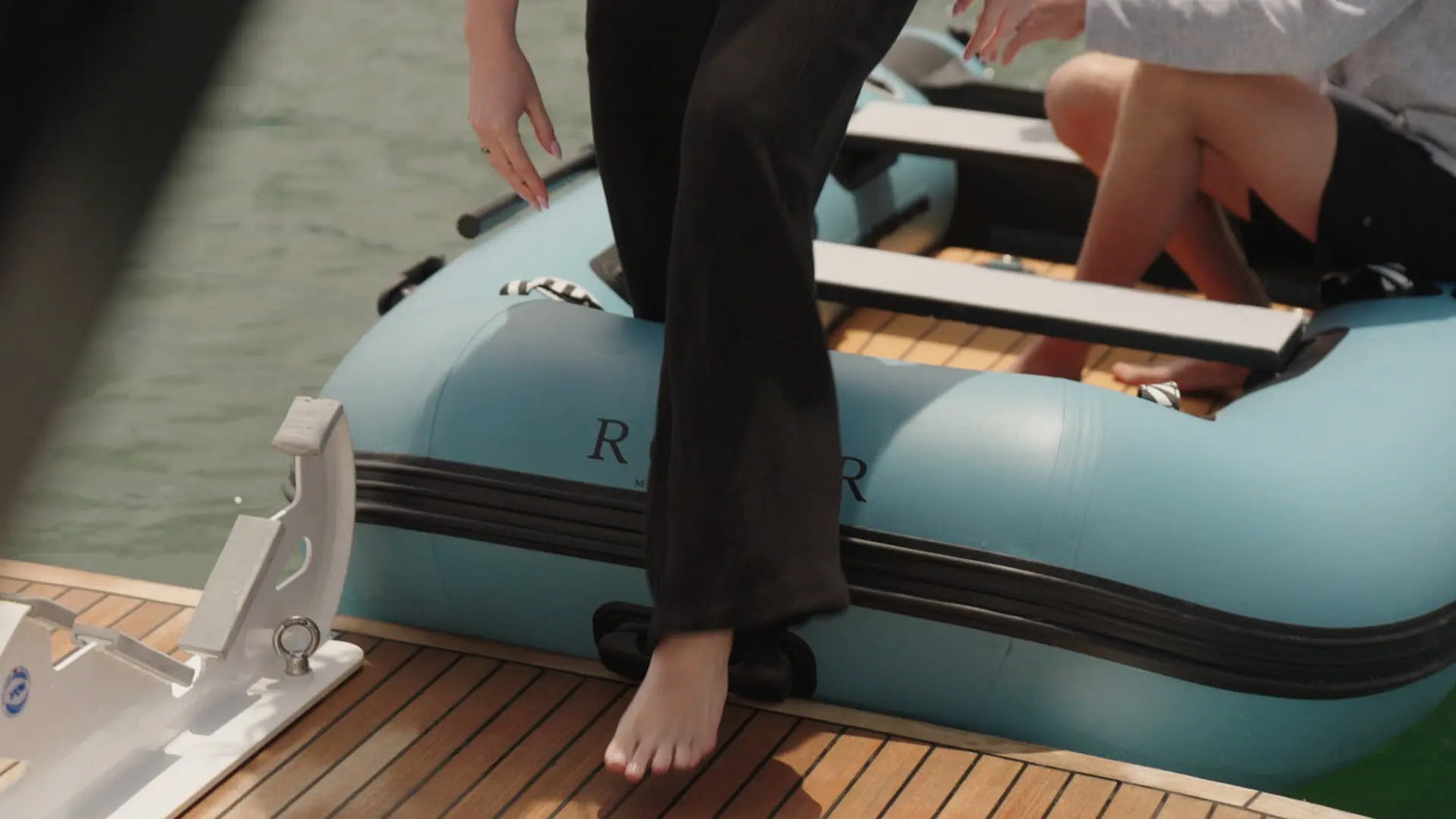
Your Emergency Kit Is Your Last Line of Defense. Pack It Right.
The water doesn’t care how good your boat is. A military-grade Battle Boat or Battle Cat gives you a serious platform—but no boat is immune to punctures, sudden weather, motor failure, or man-overboard situations. Your marine emergency kit is what keeps a bad situation from becoming a fatal one.
This guide covers exactly what to pack, how to pack it, and what to do when things go wrong on the water. No filler. No generic advice. Specific gear, specific procedures, specific to inflatable boat operations in 2026.
USCG-Required Safety Equipment: The Non-Negotiables
The U.S. Coast Guard mandates specific safety equipment on all motorized recreational vessels. These aren’t suggestions—they’re federal law. Operating without them risks fines, liability, and your life.
| Item | Requirement | Rover Marine Notes |
|---|---|---|
| USCG-Approved PFDs | One per person on board | Type I, II, or III — must fit properly. Type II for children and non-swimmers. |
| Throwable Device (Type IV) | Required on vessels 16ft+ | Ring buoy or horseshoe buoy — accessible within arm’s reach |
| Sound-Producing Device | Required on all vessels | Whistle or horn — attach to PFD so it’s always on your body |
| Visual Distress Signals | Required for coastal/offshore ops | Pyrotechnic flares (42-month expiry) or electronic PLB |
| Fire Extinguisher | Required with enclosed fuel tanks | Recommended for all boats — Li-ion batteries carry thermal runaway risk |
| Navigation Lights | Required for night operations | Red/green bow + white stern — portable clip-on lights available |
| Kill Switch Lanyard | Required on most motorized vessels | Attach to wrist or PFD before every underway operation |
The American Boat & Yacht Council (ABYC) provides additional safety standards beyond USCG minimums—including specific guidance on lithium battery installations and electric propulsion systems.
Inflatable-Specific Emergency Gear: What Standard Kits Miss
Generic marine emergency kits are designed for fiberglass boats. Inflatable boats have specific failure modes that require specific gear. Here’s what every Battle Boat and Battle Cat owner needs beyond the USCG basics:
Inflatable Repair Kit (Mission Critical)
- PVC Repair Patches: Manufacturer-supplied or cut from matching PVC fabric. Carry at least 4 patches of varying sizes (2” x 2” minimum)
- HH-66 Vinyl Cement: Industry-standard PVC adhesive. One tube per kit. Check that adhesive hasn’t dried out before each season.
- Valve Tool (Valve Wrench): Tightens or replaces Halkey-Roberts and Boston valves on the water. A loose valve is the most common cause of pressure loss—often fixable in 60 seconds with the right tool.
- Gorilla Tape (Marine Grade): Temporary field patch for larger tears until proper repair can be made ashore. Not a permanent fix—but buys you time to get off the water safely.
- Manual High-Pressure Pump: The POP Board Co. Dual Action Hand Pump is the recommended backup pump for Rover Marine owners. Re-inflates chambers on the water without a power source.
Emergency Repair Procedure: Puncture on the Water
- Identify which chamber is losing pressure (floor, port pontoon, starboard pontoon)
- If floor: redistribute weight to bow, reduce speed, head to shore immediately
- If pontoon: boat remains functional on remaining chambers — head to shore at reduced speed
- Once ashore or at anchor: dry the area, apply HH-66 to patch and surface, press firmly, hold 2-3 minutes
- Allow 24 hours cure time before re-inflation to rated PSI (floor up to 10 PSI, pontoons 3 PSI)
- Gorilla Tape as field patch if HH-66 isn’t available — temporary only

First Aid Kit: What to Pack for On-Water Injuries
A standard drugstore first aid kit isn’t sufficient for marine use. Pack a waterproof kit with these specific items:
Waterproof First Aid Kit Contents
- Wound care: Sterile gauze pads (4x4”), adhesive bandages (multiple sizes), medical tape, elastic bandage wrap
- Antiseptic: Betadine wipes or antiseptic spray — saltwater wounds infect fast
- Blister treatment: Moleskin or blister pads — common on long fishing days
- Eye wash: Saline eye wash for fuel, salt spray, or debris exposure
- Pain relief: Ibuprofen and aspirin (aspirin for suspected cardiac events)
- Seasickness: Dramamine or meclizine tablets — impaired passengers are a safety risk
- Tweezers: For hook removal and splinter extraction
- CPR face shield: Compact, single-use — no excuse not to have one
- Emergency blanket (mylar): Hypothermia risk even in Florida waters in winter months
- Nitrile gloves (2 pairs): Infection control when treating others
Container: Store in a hard-shell waterproof case (Pelican or equivalent) or a sealed dry bag. Label it clearly. It should be accessible in under 30 seconds.
Communication & Distress Signaling
VHF Radio — Your Primary Distress Tool
A handheld VHF radio is the single most important communication tool on the water. Channel 16 is the international distress frequency—monitored by the USCG and all commercial vessels 24/7. Cell service fails on the water. VHF doesn’t.
- Recommended: Standard Horizon HX210 or Icom M25 — both waterproof, float, and available at West Marine for ~$100-$150
- MAYDAY procedure: Channel 16 — “MAYDAY MAYDAY MAYDAY, this is [vessel name], position [GPS coordinates or landmark], nature of distress, number of persons aboard, request immediate assistance”
- Store in: Waterproof case or dry bag — accessible without opening the emergency kit
Visual Distress Signals
- Pyrotechnic Flares (Orion Coastal Kit): USCG-approved, includes aerial and handheld flares. Replace every 42 months — check expiry stamp before every season. Available at West Marine. ~$30-$40
- ACR ResQLink 400 PLB: Personal Locator Beacon — non-expiring, registers with NOAA, triggers SAR response via satellite. Available at ACR Electronics. ~$300. The best single investment for offshore or remote water ops.
- Signal Mirror: Compact, no batteries, visible up to 10 miles in sunlight. Backup to flares. ~$5-$10
Emergency Procedures: What to Do When Things Go Wrong
Man Overboard (MOB)
- Shout “MAN OVERBOARD” — alert all passengers immediately
- Throw throwable device (Type IV ring buoy) toward the person in the water
- Assign a spotter — one person keeps eyes on the MOB at all times, never looks away
- Reduce speed, circle back — approach from downwind/downcurrent
- Deploy boarding ladder — a person in the water cannot climb over an inflatable gunwale without assistance
- Call MAYDAY on VHF Channel 16 if person is injured or you cannot recover them
- Treat for hypothermia — wrap in emergency blanket, remove wet clothing
Rapid Deflation / Puncture
- Identify affected chamber immediately
- Redistribute weight away from deflating section
- Reduce speed — do not run at full throttle on a compromised hull
- Head to nearest shore, dock, or shallow water
- Deploy anchor if needed to stop drift while assessing damage
- Use repair kit if safe to do so — otherwise call for assistance on VHF Channel 16
Motor Failure
- Check battery charge (electric motors) or fuel level (gas motors) first
- Check kill switch lanyard — most “motor failures” are a disconnected lanyard
- Deploy anchor to prevent drift into hazards
- Use oars/paddles to maneuver if available
- Call for assistance on VHF Channel 16 or via cell phone
- File float plan before departure — someone ashore should know your expected return time
Capsizing (Rare on Inflatables — But Know the Procedure)
- Stay with the boat — an inflatable will not sink even fully swamped
- Account for all passengers immediately
- Activate PLB or fire flares if available
- Signal passing vessels with whistle and signal mirror
- Call MAYDAY on VHF if radio is accessible in waterproof case
Battle Boat vs Battle Cat: Emergency Kit Differences
| Scenario | Battle Boat (V-Hull) | Battle Cat (Catamaran) |
|---|---|---|
| Puncture Response | Single pontoon loss — boat lists but remains functional. Head to shore. | Single pontoon loss — boat tilts significantly. Redistribute weight, reduce speed, head to shore immediately. |
| Stability in Emergency | Good — V-hull tracks well even partially deflated | Superior — wide catamaran stance provides more stability during emergency maneuvers |
| MOB Recovery | Approach from stern — use boarding ladder over transom | Approach from stern — wider deck makes recovery easier with multiple helpers |
| Capsize Risk | Very low — V-hull self-rights in most conditions | Extremely low — catamaran design resists capsize even in heavy wakes |
| Repair Kit Priority | Valve tool + patches for single pontoon repair | Valve tool + patches for dual pontoon system — carry extra patches |

How to Pack Your Emergency Kit: The 30-Second Rule
Your emergency kit is useless if you can’t access it in 30 seconds under stress. Pack it this way:
- Layer 1 — On your body: PFD (worn), whistle (clipped to PFD), kill switch lanyard (attached to wrist)
- Layer 2 — Immediately accessible: VHF radio in waterproof case, flares in accessible dry bag, throwable device clipped to gunwale
- Layer 3 — Emergency kit bag: First aid kit, repair kit (patches, HH-66, valve tool, Gorilla Tape), manual pump, fire extinguisher
- Layer 4 — Navigation bag: PLB, signal mirror, emergency blanket, backup phone in waterproof case
Container: Use a brightly colored dry bag or waterproof case for the emergency kit. Red or orange is ideal—visible in the water if the bag goes overboard. Label it “EMERGENCY KIT” in permanent marker.
Pre-Departure Emergency Kit Checklist
Run this before every mission:
- ☐ PFDs on board and properly fitted (one per person)
- ☐ Kill switch lanyard attached to operator
- ☐ VHF radio charged and on Channel 16
- ☐ Flares present and not expired (check date stamp)
- ☐ First aid kit stocked and accessible
- ☐ Repair kit present (patches, HH-66, valve tool, Gorilla Tape)
- ☐ Manual pump on board
- ☐ Fire extinguisher pressure gauge in green zone
- ☐ Float plan filed with shore contact (name, destination, expected return)
- ☐ Weather check completed (NOAA forecast)
- ☐ All passengers briefed on emergency procedures
Maintenance Schedule: Keeping Your Kit Battle-Ready
After Every Mission
- Restock any used first aid supplies immediately
- Rinse VHF radio and PLB with freshwater if exposed to saltwater
- Check repair kit — replace used patches and verify HH-66 cap is sealed
Monthly
- Check flare expiry dates
- Test VHF radio battery charge
- Inspect fire extinguisher pressure gauge
- Verify PLB registration is current at beaconregistration.noaa.gov
Annually
- Replace all expired flares
- Replace expired first aid supplies (check all dates)
- Re-certify fire extinguisher if required
- Test PLB self-test function (does not trigger SAR response)
- Complete USCG-approved boating safety course refresher

Frequently Asked Questions
What’s the most important item in a marine emergency kit for an inflatable boat?
The repair kit (patches, HH-66 vinyl cement, valve tool) is the most inflatable-specific critical item—it addresses the primary failure mode of your vessel. Beyond that, a VHF radio and USCG-approved PFDs are non-negotiable for any motorized vessel. All three should be on every Rover Marine boat before it leaves the dock.
How do I fix a puncture on the water?
Identify the affected chamber, redistribute weight away from it, reduce speed, and head to shore or anchor. Once stable: dry the area, apply HH-66 to both the patch and the surface, press firmly for 2-3 minutes, allow 24 hours to cure before re-inflating to rated PSI. Use Gorilla Tape as a temporary field patch if HH-66 isn’t available.
Do I need a VHF radio if I have a cell phone?
Yes. Cell service is unreliable on the water—especially on the ICW, offshore, and in remote areas. VHF Channel 16 is monitored by the USCG and all commercial vessels 24/7. A handheld VHF (Standard Horizon HX210 or Icom M25, ~$100-$150 at West Marine) is your primary distress communication tool. Cell phone is backup only.
What’s the difference between a PLB and a flare?
Flares are visual signals—effective in daylight or darkness when someone is looking in your direction. They expire every 42 months. A PLB (Personal Locator Beacon) like the ACR ResQLink 400 transmits your GPS coordinates via satellite to NOAA’s SAR system—no one needs to see you. PLBs don’t expire and are the superior distress tool for offshore and remote water ops. Carry both if possible.
How often should I replace flares?
USCG-approved pyrotechnic flares expire 42 months from manufacture date (stamped on the flare body). Replace before expiration—expired flares are not USCG-compliant and may not function reliably. Check dates at the start of every season.
What should I do if my electric motor fails on the water?
Check the kill switch lanyard first (most common cause). Then check battery charge. Deploy anchor to prevent drift. Use oars or paddles if available. Call for assistance on VHF Channel 16. This is why filing a float plan before departure matters—someone ashore knows your expected return time and will initiate a search if you don’t check in.
Where can I get a complete emergency kit recommendation for my Rover Marine boat?
Contact Rover Marine at 844-207-6837 (M-F, 10am-4pm PST) or visit the contact page. Tell us your model, size, and primary use case and we’ll build you a complete kit list.
Pack It. Know It. Deploy Ready.
A marine emergency kit isn’t something you assemble once and forget. It’s a living system—checked before every mission, restocked after every use, and updated as your operations evolve. Rover Marine’s Battle Boat and Battle Cat give you a military-grade platform. Your emergency kit is what backs it up when the mission goes sideways.
Questions about safety gear, emergency procedures, or motor options? Call 844-207-6837 (M-F, 10am-4pm PST) or visit the contact page.
Deploy. Launch. Dominate. Come home safe.
See the Battle Boat and Battle Cat in real-world operations on our YouTube channel.


Leave a comment
This site is protected by hCaptcha and the hCaptcha Privacy Policy and Terms of Service apply.