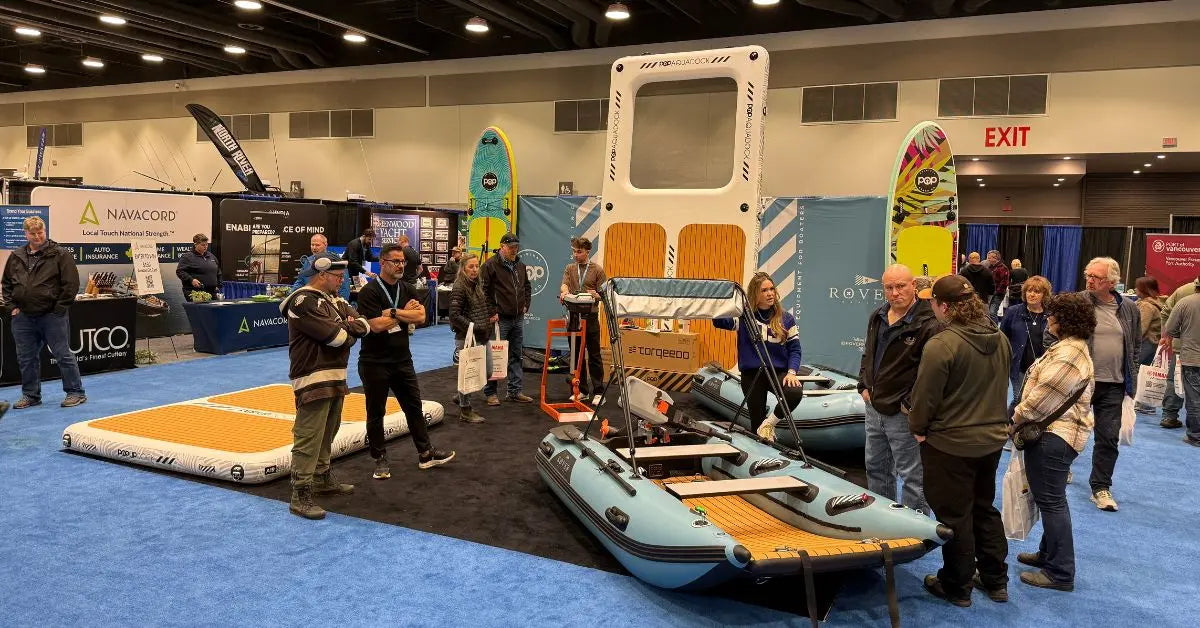
Boat shows give buyers something online listings cannot: the chance to compare deck space, floor firmness, transom construction, carrying weight, seat placement, and storage requirements in person.
Feedback from Canadian boaters has reinforced a clear trend. Many owners are looking for an alternative to permanent rigid tenders, trailers, marina storage, and boats that occupy valuable space throughout the year.
Rover Marine works with Canadian Board Co. to make the Battle Boat and Battle Cat available to Canadian customers with local product guidance, shipping, and water-safety equipment.
What Canadian Boaters Asked About Most
Canadian boaters use small boats in very different environments, from protected lakes and cottage shorelines to marinas, rivers, bays, yacht tenders, and coastal routes.
The most useful boat-show conversations were not about broad claims that one boat type is replacing another. They focused on practical ownership questions.
Where Will It Be Stored?
Buyers wanted to know whether the boat could fit inside a garage, vehicle, yacht locker, cottage storage room, or recreational vehicle.
How Much Can It Carry?
Passenger weight, motor, battery or fuel, coolers, fishing equipment, dive gear, and safety equipment all affect the correct size.
Which Hull Fits the Activity?
The Battle Boat and Battle Cat serve different layout preferences, even though they share the same capacities and motor limits by size.
Why In-Person Comparison Helps
A product photograph cannot fully show how much room remains after passengers and gear are aboard. Seeing the boat in person helps buyers understand the deck, seats, handles, floor, transom, and packed size.
Why Fully Inflatable Boats Appeal to Canadian Owners
A fully inflatable boat can be deflated and stored in a smaller space than a permanent rigid hull. That can be valuable for cottage owners, yacht owners, urban residents, recreational vehicle travelers, and boaters who do not want to maintain a trailer.
Compact Storage
The boat can be packed away between trips instead of occupying a permanent trailer, marina slip, or outdoor storage space.
Flexible Transportation
Depending on the selected size and vehicle, the deflated boat may be transported in a cargo area, recreational vehicle, yacht locker, or trailer.
Removable Propulsion
The motor, electric battery, fuel tank, and related equipment can be removed and stored separately from the hull.
Several Types of Use
One inflatable boat may serve as a yacht tender, fishing platform, dive-support boat, family cruiser, or cottage boat.

Battle Boat vs. Battle Cat
The Battle Boat and Battle Cat are both fully inflatable and available in 8-foot, 10-foot, and 12-foot sizes. Their main difference is the hull and deck layout.
| Decision Factor | Battle Boat | Battle Cat |
|---|---|---|
| Hull layout | Traditional inflatable dinghy profile | Dual-pontoon catamaran-style profile |
| Common priorities | Tender use, cruising, fishing, and general recreation | Deck width, initial stability, fishing, and equipment room |
| Available sizes | 8, 10, and 12 feet | 8, 10, and 12 feet |
| Maximum capacity | Up to 4 people and 1,200 lb, depending on size | Up to 4 people and 1,200 lb, depending on size |
| Maximum motor | Up to 20 HP on the 12-foot model | Up to 20 HP on the 12-foot model |
| Transom | 15 inches on all current sizes | 15 inches on all current sizes |
| Storage | Fully inflatable and packable | Fully inflatable and packable |

Current Capacity and Motor Limits
| Size | Capacity | Maximum Motor | Pressure |
|---|---|---|---|
| 8 Foot | 2 people / 600 lb | Up to 6 HP | 3.5 PSI tubes / 10 PSI floor |
| 10 Foot | 4 people / 1,000 lb | Up to 10 HP | 3.5 PSI tubes / 10 PSI floor |
| 12 Foot | 4 people / 1,200 lb | Up to 20 HP | 3.5 PSI tubes / 10 PSI floor |
Battle Cat: A Wider Dual-Pontoon Platform
The Rover Marine Battle Cat uses two parallel inflatable pontoons to create a catamaran-style stance.
The wider layout may appeal to anglers, divers, cottage owners, and families who prioritize deck width and initial stability.

Where the Battle Cat May Fit
- Fishing where deck width and initial stability are priorities.
- Dive support when the complete equipment load remains within capacity.
- Cottage and lake use in conditions appropriate for the boat.
- Family cruising with balanced passenger and equipment placement.
- Tender use where the packed dimensions fit the storage plan.
Stability Does Not Remove the Need for Load Control
Passenger movement, standing, motor weight, waves, wind, speed, pressure, and uneven gear placement can still affect stability.
Stay within the published limits and keep heavy equipment secured and balanced.
Battle Boat: A Traditional Inflatable Tender Layout
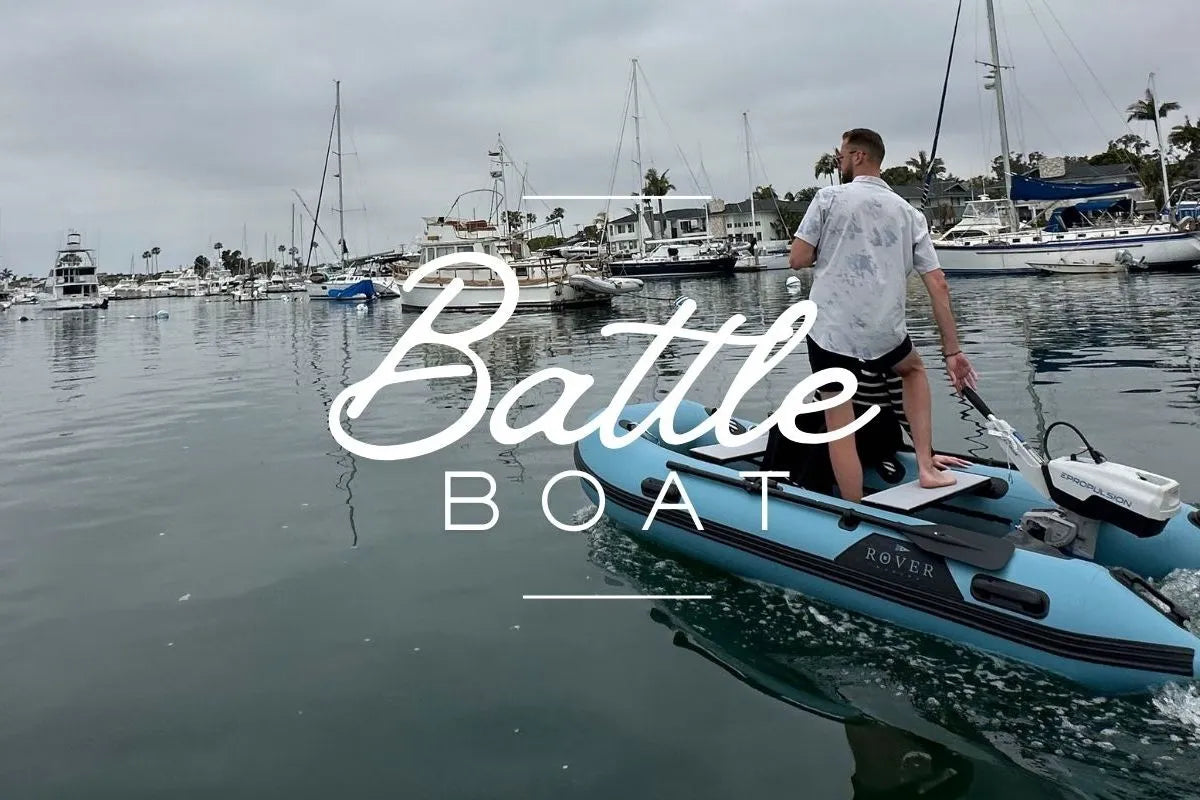
The Rover Marine Battle Boat uses a traditional inflatable dinghy profile with a high-pressure drop-stitch floor.
It can fit yacht tender duty, cottage trips, fishing, diving, family cruising, marina transportation, and general recreational use.

Where the Battle Boat May Fit
- Yacht tender runs between the vessel, dock, and shoreline.
- Cottage use on lakes and protected waterways.
- Owners who prefer a traditional inflatable dinghy profile.
- Fishing, diving, and family cruising.
- Portable setups using gas or electric propulsion.
How to Compare Inflatable Boat Quality
Buyers should be careful with both unusually cheap products and broad marketing claims. Two boats can look similar online while having very different specifications, materials, chambers, transoms, included equipment, replacement parts, support, and warranty terms.
Rather than making unsupported claims about unnamed competitors, compare details that can be confirmed before purchase.
- Published passenger and weight capacity.
- Clear maximum motor ratings.
- Confirmed transom height.
- Published boat weights and packed dimensions.
- Separate air-chamber information.
- Tube and floor pressure specifications.
- Written warranty terms and exclusions.
- Replacement parts and repair support.
- Reachable customer-service contact information.
- Product photos showing the actual hull layout.
Specifications Matter
Buyers should be able to confirm capacity, pressure, motor limits, transom height, boat weight, packed size, and included equipment.
Support Matters
Owners may need help with motor fit, inflation, replacement parts, repair guidance, storage, maintenance, or choosing the right model.
Buy the Complete Ownership Experience
The lowest purchase price may not represent the lowest long-term cost when replacement parts, customer support, repair guidance, warranty service, and local shipping are difficult to access.
Why Canadian Distribution Matters
Canadian Board Co. gives Canadian customers a local source for Rover Marine boats, guidance, shipping, and compatible safety equipment.
That can simplify questions about delivery, Canadian water-safety products, local operating conditions, and selecting the correct boat and motor combination.
Canadian Customers
Visit Canadian Board Co. for Canadian availability, local shipping, and support.
United States Customers
Use the Rover Marine product pages and contact the Rover Marine team for help choosing the correct model and setup.
Water Safety for Canadian Boaters
Safety requirements vary by boat, motor, passenger, operating area, and type of use. Canadian boaters should confirm current federal, provincial, local, and waterway-specific rules before launching.
Canadian Board Co. maintains a water-safety collection that includes Canadian-approved PFD options, signaling equipment, and related accessories.
Common Safety Planning Considerations
- A properly fitted Canadian-approved PFD for each person.
- A sound-signaling device.
- Required lighting and visual signals.
- Communication equipment appropriate for the route.
- An anchor and line suited to the operating area.
- A first-aid kit and emergency plan.
- Cold-water protection when conditions require it.
- Enough fuel or battery reserve for the return trip.
- Motorized-vessel registration where required.
- Operator certification where required.
Inflatable Belt PFDs Have Specific Restrictions
A belt-pack PFD is not automatically appropriate for every passenger or activity. Confirm the product approval, age restrictions, wearing requirements, vessel type, and intended use before relying on one.
Preparing the Boat for the Canadian Season
Boats stored through a Canadian winter should be inspected before the first launch of the season.
- Unpack the boat in a clean area.
- Inspect tubes, seams, valves, handles, floor, seats, and transom.
- Inflate the tubes to 3.5 PSI.
- Inflate the drop-stitch floor to 10 PSI.
- Allow the boat to sit and check for pressure loss.
- Inspect the motor, propeller, battery, fuel system, and mounting hardware.
- Review required safety equipment and documentation.
- Complete the first trip in protected conditions.

Frequently Asked Questions
Who sells Rover Marine boats in Canada?
Canadian Board Co. represents Rover Marine for Canadian customers and provides Canadian shipping, local product guidance, and related water-safety equipment.
What is the difference between the Battle Boat and Battle Cat?
The Battle Boat uses a traditional inflatable dinghy layout. The Battle Cat uses two parallel inflatable pontoons to create a wider catamaran-style stance.
Is the Battle Cat better for fishing?
The Battle Cat may appeal to anglers who prioritize deck width and initial stability. The better choice still depends on the number of anglers, equipment, motor, storage, and typical water conditions.
Can I stand in a Battle Cat?
The wider dual-pontoon stance may support more confident movement than a narrower layout, but standing depends on passenger balance, speed, waves, wind, pressure, load placement, and individual ability. Use conservative judgment and a properly fitted PFD.
Is the Battle Boat a fiberglass RIB?
No. The Battle Boat is fully inflatable and uses a high-pressure drop-stitch floor. It does not have a permanent fiberglass lower hull.
What motor can each size use?
The 8-foot models support motors up to 6 HP, the 10-foot models up to 10 HP, and the 12-foot models up to 20 HP.
What shaft length do Rover Marine boats use?
Current Battle Boat and Battle Cat models use 15-inch transoms. A compatible short-shaft motor is the normal fit.
Can I use an electric outboard?
Yes. Rover Marine boats can use compatible electric outboards within their published limits. Confirm the shaft length, motor package, battery weight, expected route, and return reserve.
Can these boats be used in Canadian saltwater?
Yes. Rinse the boat, transom, hardware, and accessories with fresh water after saltwater use. Follow the motor manufacturer's separate saltwater care instructions.
What pressure should the boats use?
Current Battle Boat and Battle Cat models use 3.5 PSI in the tubes and 10 PSI in the high-pressure drop-stitch floor.
Where can Canadian customers find safety gear?
Canadian Board Co. maintains a Canadian water-safety collection with approved PFD options and related equipment.
Where can U.S. customers ask for help?
Use the Rover Marine contact page and include the expected passenger load, equipment, storage dimensions, motor preference, and typical water conditions.
Choose the Boat Around Your Water, Storage, and Crew
Start with passenger and equipment weight, storage space, transportation, motor choice, route, and typical conditions. Then compare the Battle Boat and Battle Cat without exceeding the published limits.

Leave a comment
This site is protected by hCaptcha and the hCaptcha Privacy Policy and Terms of Service apply.