
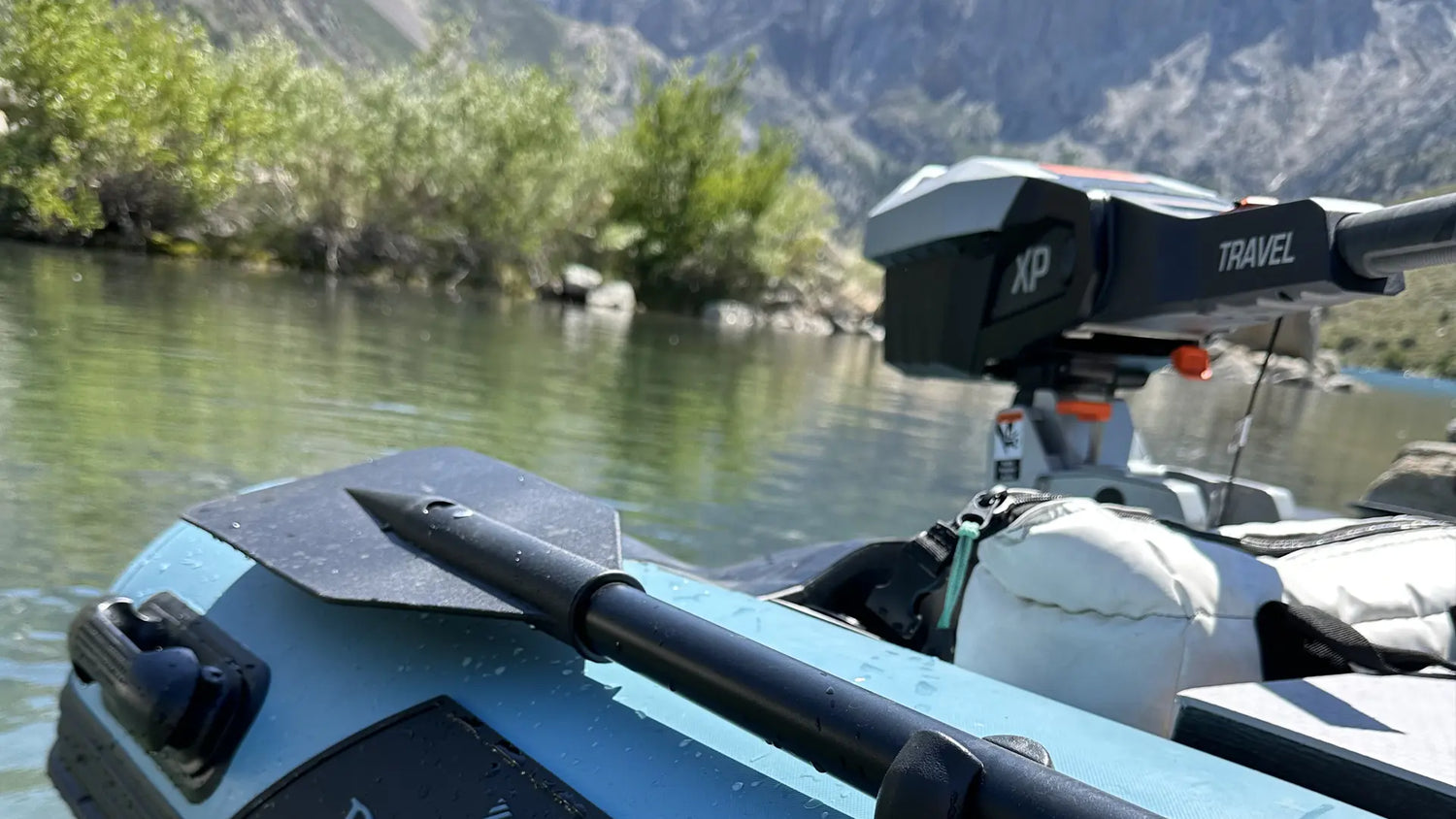
The best engine for an inflatable dinghy is not always the largest motor the boat can support. The correct choice depends on the boat size, hull design, total load, expected speed, trip distance, shaft length, motor weight, water conditions, charging access, and fuel access.
A short yacht-to-shore run may work well with a compact electric outboard. A longer trip with heavier gear may require a gas motor or more battery capacity. The safest approach is to begin with the boat's exact published limits and then match the motor to the way the boat will actually be used.
This guide covers current motor limits for the Rover Marine Battle Boat and Battle Cat , plus electric and gas comparisons, shaft length, motor weight, range, maintenance, and warranty information.

Start With the Boat, Not the Motor
The boat's published specifications establish the upper motor limit, passenger capacity, total weight capacity, transom height, and inflation pressure. These limits should be confirmed before comparing individual electric or gas outboards.
Rover Marine Battle Boat and Battle Cat models use triple-layer reinforced 1100D PVC, heat-welded seams, high-pressure drop-stitch floors, and 15-inch transoms. The tubes inflate to 3.5 PSI and the floors inflate to 10 PSI.
- Confirm the maximum horsepower for the exact boat size.
- Confirm the motor uses the correct short-shaft configuration.
- Include motor, battery, and fuel weight in the total load.
- Count passengers, coolers, anchors, and equipment.
- Plan for wind, current, waves, and the return trip.
- Consider how the motor will be lifted and stored.
Maximum Motor Rating Does Not Mean Required Motor Size
The 12-foot Battle Boat and Battle Cat support motors up to 20 HP. That does not mean every owner needs a 20 HP motor. Tender runs, fishing, quiet harbor cruising, and electric use may work well with less power.
Electric vs. Gas Dinghy Motors
Electric and gas outboards solve different problems. Electric motors prioritize quiet operation, clean onboard use, and simplified routine maintenance. Gas motors prioritize fast refueling, longer practical range, and access to higher power levels.
| Decision Factor | Electric Outboard | Gas Outboard |
|---|---|---|
| Starting | Electric start with immediate throttle response. | Manual or electric start, depending on the motor. |
| Noise | Much quieter than a comparable combustion motor. | Produces combustion and exhaust noise. |
| Exhaust | Zero exhaust emissions at the motor. | Produces direct combustion exhaust. |
| Range | Depends on battery capacity, throttle, load, and conditions. | Can be extended by safely carrying additional fuel. |
| Refueling | Requires charging or a charged replacement battery. | Fuel can be added quickly where safe and permitted. |
| Routine care | Battery, propeller, connectors, mounting, rinsing, and inspection. | Fuel, cooling, ignition, oil where applicable, and engine service. |
| Storage | No gasoline smell or onboard fuel can. | Requires approved fuel storage and ventilation. |
| Common fit | Tender runs, fishing, harbors, calm lakes, and predictable trips. | Longer runs, higher power needs, and fast refueling. |
Choose Electric When
- Quiet operation matters.
- Trips are predictable and charging is available.
- You want to avoid gasoline and exhaust fumes.
- Fishing, tender work, or relaxed cruising are the priority.
- A removable battery makes transportation easier.
Choose Gas When
- You need longer practical range.
- Fast refueling is important.
- You regularly carry heavier loads.
- You need more sustained output than a portable electric system provides.
- Charging access is limited or unavailable.

Current Battle Boat and Battle Cat Motor Limits
Battle Boat and Battle Cat models use the same capacity, maximum motor, pressure, and transom specifications by length. The boat weights and chamber layouts differ.
| Boat Size | Capacity | Maximum Motor | Transom | Pressure |
|---|---|---|---|---|
| 8 Foot | 2 people / 600 lb | Up to 6 HP | 15 inches | 3.5 PSI tubes / 10 PSI floor |
| 10 Foot | 4 people / 1,000 lb | Up to 10 HP | 15 inches | 3.5 PSI tubes / 10 PSI floor |
| 12 Foot | 4 people / 1,200 lb | Up to 20 HP | 15 inches | 3.5 PSI tubes / 10 PSI floor |
Battle Boat Weight
| Specification | 8 ft Battle Boat | 10 ft Battle Boat | 12 ft Battle Boat |
|---|---|---|---|
| Boat weight | 86 lb | 100 lb | 135 lb |
| Air chambers | 3 + 2 | 4 + 1 | 4 + 1 |
| Maximum motor | Up to 6 HP | Up to 10 HP | Up to 20 HP |
Battle Cat Weight
| Specification | 8 ft Battle Cat | 10 ft Battle Cat | 12 ft Battle Cat |
|---|---|---|---|
| Boat weight | 84 lb | 98 lb | 130 lb |
| Air chambers | 4 + 1 | 4 + 1 | 4 + 1 |
| Maximum motor | Up to 6 HP | Up to 10 HP | Up to 20 HP |
How Much Horsepower Does Your Dinghy Need?
The published maximum horsepower is the upper limit, not a universal recommendation. The right amount of power depends on the normal load, expected speed, trip distance, water conditions, and whether the motor needs to be removed after each use.
8-Foot Models
The 8-foot Battle Boat and Battle Cat support motors up to 6 HP. These boats are rated for two people or 600 pounds.
Smaller electric or gas motors may be appropriate for calm-water tender runs, fishing, and short recreational trips.
10-Foot Models
The 10-foot Battle Boat and Battle Cat support motors up to 10 HP. These boats are rated for four people or 1,000 pounds.
The 10-foot size offers a useful balance of room, motor capability, and portability for family, fishing, diving, and tender use.
12-Foot Models
The 12-foot Battle Boat and Battle Cat support motors up to 20 HP. These boats are rated for four people or 1,200 pounds.
The larger size provides more capacity and room, but it is also heavier to move, store, and launch.
Does a 12-Foot Boat Need 20 HP?
No. Up to 20 HP is the maximum supported motor rating. An owner using the boat for harbor cruising, tender duty, fishing, or electric operation may choose a smaller properly matched motor.
A higher-power motor may increase speed and acceleration, but it also adds weight, fuel or battery demand, cost, and maintenance.
Why Underpowered and Overpowered Are Both Problems
A motor with too little practical thrust for the load and conditions may struggle against current or wind. A motor that exceeds the boat's published limit can overload the transom, change handling, and create a serious safety risk.
Stay within the boat manufacturer's limits and choose the motor according to the trip rather than assuming more power is always better.
What Shaft Length Fits Rover Marine Dinghies?
Every current Battle Boat and Battle Cat size uses a 15-inch transom. A compatible short-shaft motor is therefore the normal fit.
Use the Short-Shaft Version
Short-shaft and long-shaft motors from the same product family are not interchangeable for every boat. Confirm the exact model listing before ordering.
Rover Marine currently lists short-shaft ePropulsion and Torqeedo options for Battle Boat and Battle Cat setups.
Why the Wrong Shaft Length Causes Problems
A shaft that is too short can allow the propeller to ventilate or lose effective thrust. A shaft that is too long can place the lower unit deeper than intended, increase drag, and change handling.
- Confirm the boat's 15-inch transom specification.
- Confirm the motor listing says short shaft.
- Review the motor manufacturer's installation instructions.
- Do not order from the model name alone.
- Contact Rover Marine before purchasing when uncertain.
Current Electric Outboard Options
Rover Marine's electric motor collection currently includes short-shaft options from ePropulsion and Torqeedo, along with separate long-shaft Torqeedo listings for boats that require additional shaft length.

| Motor | Configuration | General Fit | Important Check |
|---|---|---|---|
| ePropulsion Spirit 1.0 Plus Short Shaft | 1 kW portable electric outboard with removable battery platform | Tender runs, fishing, calm lakes, and harbor cruising | Confirm range, battery weight, and complete package weight. |
| Torqeedo Travel 1103 S Essential | Short-shaft Travel system with removable battery and tiller display | Tender service, fishing, portable cruising, and protected water | Confirm the Essential package provides enough battery margin. |
| Torqeedo Travel 1103 S Extended Range | Short-shaft Travel platform with extended-range package | Owners who want more battery margin for longer outings | Include the complete package weight in total boat capacity. |
ePropulsion Spirit 1.0 Plus
The Spirit 1.0 Plus is a 1 kW electric outboard with a removable battery platform. It is a strong fit for quiet tender runs, fishing, marina use, and recreational cruising where the planned distance matches the available battery capacity.
Torqeedo Travel 1103 S
The Travel 1103 S is a portable electric platform with an integrated removable battery and onboard tiller display. Rover Marine offers both Essential and Extended Range short-shaft packages.
View all current options on the Rover Marine electric outboard motor collection .
How to Plan Electric Outboard Range
Electric range is affected by battery capacity, throttle setting, boat size, passenger and gear weight, hull inflation, wind, current, waves, temperature, propeller condition, and battery health.
High throttle uses energy much faster than low-speed cruising. A motor may operate for several hours at reduced power but for a much shorter period at full output.
Basic Runtime Estimate
Approximate runtime in hours = usable battery energy in kWh ÷ average motor draw in kW.
This is only a planning estimate. Real conditions, battery losses, reserve, temperature, and changing throttle will affect the result.
Factors That Reduce Range
- Running near full throttle.
- Strong headwinds or opposing current.
- Heavy passengers and equipment.
- Underinflated tubes or floor.
- Cold weather or an aging battery.
- A damaged or fouled propeller.
- Frequent acceleration and speed changes.
- Waves, chop, and rougher water.
Do Not Use a Generic Percentage Reduction
The original article recommended assuming a fixed 20 to 40 percent loss from ideal range. Actual loss can be smaller or much larger depending on conditions. Use the motor's onboard range information, current battery state, route, forecast, and a conservative reserve.
Protect Battery Life
Battery charging and storage requirements vary by manufacturer and battery chemistry. Follow the instructions for the exact battery rather than using a universal state-of-charge rule.
- Use the approved charger.
- Avoid damaged batteries or connectors.
- Store the battery within the recommended temperature range.
- Follow the manufacturer's long-term storage charge guidance.
- Protect terminals from moisture, impact, and contamination.
- Inspect the battery before each outing.
How Motor Weight Affects the Dinghy
Motor and battery weight affect stern trim, freeboard, carrying capacity, transportation, and how easily the setup can be mounted or removed.
A heavier motor leaves less capacity available for passengers and gear. It can also make the stern sit lower, particularly when passengers or fuel are placed toward the rear.
Before Buying
- Check the complete motor weight.
- Include the battery when comparing electric packages.
- Include the fuel tank and fuel for gas packages.
- Confirm the loaded boat remains below capacity.
- Plan how the motor will be lifted and stored.
Before Launching
- Balance passengers and equipment.
- Secure the battery or fuel tank.
- Inspect the transom and mounting hardware.
- Confirm steering and throttle movement.
- Use assistance or lifting equipment when needed.
Electric and Gas Outboard Maintenance
Maintenance schedules vary by manufacturer and motor model. The correct manual should always take priority over a generic monthly or annual checklist.
Electric Outboard Care
- Rinse appropriate components after saltwater use.
- Inspect the propeller for fishing line or damage.
- Keep electrical and data connections clean and dry.
- Charge and store the battery as instructed.
- Inspect the motor mount, tiller, and hardware.
- Install firmware updates when applicable.
Gas Outboard Care
- Follow the published service schedule.
- Inspect fuel lines, tank, vent, and connectors.
- Flush or rinse after saltwater use as instructed.
- Inspect the propeller and lower unit.
- Use proper fuel storage and winterization procedures.
- Check cooling-water flow during operation.
Shared Pre-Launch Checks
- Inspect the transom and motor mount.
- Confirm the engine cutoff device works.
- Check the propeller area.
- Confirm the tubes are at 3.5 PSI.
- Confirm the floor is at 10 PSI.
- Verify the load is balanced and within capacity.
- Carry the required safety equipment.
- Plan enough fuel or battery reserve for the return.
Which Motor Fits Different Uses?
Yacht Tender
Electric power can be a strong fit for short, predictable dock-to-shore trips where quiet operation and simple storage are priorities.
Gas may be preferable when the tender regularly travels farther or charging is unavailable.
Fishing
Electric outboards provide quiet low-speed control and eliminate fuel fumes. Gas provides quick refueling and may be better for longer runs.
Stability, total load, and the safe return margin matter more than selecting the maximum motor.
Diving
Dive equipment, tanks, weights, passengers, motor, and battery or fuel all count toward capacity.
Choose a setup that leaves sufficient room and weight capacity for safe reboarding and equipment handling.
Current Rover Marine Warranty Coverage
The previous article contained outdated blanket three-year warranty language. Rover Marine now publishes tiered factory coverage for eligible boats and covered components.
Coverage applies to qualifying manufacturing defects and remains subject to the complete terms, exclusions, documentation requirements, and claim review process.
Motors, batteries, electronics, and other third-party equipment generally follow the warranty provided by their manufacturer.
Read the Complete Rover Marine WarrantyFrequently Asked Questions
What motor can the 8-foot Battle Boat or Battle Cat use?
The 8-foot Battle Boat and Battle Cat support motors up to 6 HP. Both are rated for two people or 600 pounds and use a 15-inch transom.
What motor can the 10-foot models use?
The 10-foot Battle Boat and Battle Cat support motors up to 10 HP. Both are rated for four people or 1,000 pounds and use a 15-inch transom.
What motor can the 12-foot models use?
The 12-foot Battle Boat and Battle Cat support motors up to 20 HP. Both are rated for four people or 1,200 pounds and use a 15-inch transom.
Does the 12-foot boat require a 20 HP motor?
No. Up to 20 HP is the maximum supported power. A smaller properly matched motor may be appropriate for tender duty, fishing, harbor cruising, or electric operation.
Do Rover Marine boats use short-shaft motors?
Yes. Current Battle Boat and Battle Cat specifications list a 15-inch transom for every size. A compatible short-shaft motor is the normal fit.
How long will an electric outboard run?
Runtime depends on battery capacity, throttle, boat size, passenger and gear load, wind, current, waves, temperature, propeller condition, and battery health. Use the onboard range information and maintain a safe reserve.
How long does an electric outboard battery last?
Battery service life varies by battery chemistry, cycle count, charging habits, temperature, storage, use, and manufacturer. There is no reliable universal three-to-five-year lifespan.
Can gas outboards be used in saltwater?
Many marine gas outboards are designed for saltwater use, but care requirements vary. Follow the motor manufacturer's flushing, corrosion protection, maintenance, and storage instructions.
What should I do if an electric motor stops?
Stay calm, maintain flotation, check the engine cutoff device, battery state, visible connections, and the motor display. Do not open or repair a battery on the water. Follow the manufacturer manual and use your backup propulsion, communication, or emergency plan.
What warranty covers the boat and motor?
Eligible Rover Marine boat coverage consists of five years for the hull, three years for tubes and seams, and two years for eligible covered accessories. Motors and batteries generally follow their manufacturers' warranties.
Read Rover Marine Owner Experiences
Product specifications establish the limits. Owner feedback can provide additional insight into setup, transportation, stability, motor use, and customer service.
Visit the Rover Marine reviews page and compare those experiences with your crew, storage, range, and propulsion needs.
Choose the Motor Around the Trip You Actually Take
Start with the exact boat size and published limits. Then compare shaft length, motor weight, range, charging or fuel access, water conditions, and how the complete setup will be transported and maintained.
Built for Water. Designed for Freedom.


Leave a comment
This site is protected by hCaptcha and the hCaptcha Privacy Policy and Terms of Service apply.