Rover Marine vs Sea Eagle: Military-Grade Construction vs Mid-Range Performance
The drop-stitch inflatable boat market in 2026 presents a clear choice: mid-range brands like Sea Eagle ($800-$3,500) offering good value with standard construction, or Rover Marine's tactical Battle Boat and Battle Cat delivering military-grade construction, superior materials, and tactical design at $1,999-$2,749. This comprehensive comparison analyzes why serious boaters choose Rover Marine's premium drop-stitch engineering over Sea Eagle's mid-range inflatables—and why the tactical upgrade delivers better long-term value.
Whether you're evaluating fishing platforms, yacht tenders, or dive boats, this expert analysis provides the specifications, pricing, and performance data you need to understand why Rover Marine's military-grade construction justifies the investment over Sea Eagle's budget-friendly approach.
Understanding the Brands: Rover Marine vs Sea Eagle Positioning
Rover Marine: Military-Grade Tactical Performance
Rover Marine targets serious boaters, anglers, yacht owners, and water-sports enthusiasts who demand military-grade construction, tactical design, and long-term reliability. The Battle Boat and Battle Cat are engineered for harsh marine environments, saltwater use, and daily operations.
Rover Marine Positioning:
- Price Range: $1,999-$2,749 (premium value)
- Construction: Military-grade PVC, drop-stitch floors (up to 10 PSI), reinforced seams
- Pontoons: 3 PSI for optimal buoyancy and handling
- Lifespan: 7-10 years with proper maintenance
- Target User: Serious boaters, yacht owners, professional anglers, dive operators
- Color Options: Blue, Gray, Black (tactical aesthetics)
- Design Philosophy: Tactical performance, no compromises
Sea Eagle: Mid-Range Value Inflatables
Sea Eagle targets budget-conscious buyers and recreational users looking for good value drop-stitch inflatables. Sea Eagle boats use standard PVC construction and aluminum floors to balance performance and affordability.
Sea Eagle Positioning:
- Price Range: $800-$3,500 (mid-range value)
- Construction: Standard PVC, drop-stitch floors (lower PSI), basic seams
- Lifespan: 5-7 years in regular use
- Target User: Recreational boaters, budget-conscious buyers, casual users
- Color Options: Usually gray or green (limited customization)
- Design Philosophy: Value-oriented, good enough performance

Rover Marine Battle Boat & Battle Cat: Complete Specifications
Battle Boat: V-Hull Inflatable Dinghy
The Battle Boat delivers military-grade performance with V-hull inflatable design and reinforced pontoons for superior speed and maneuverability:
| Size | Weight | Capacity | Inflated Dimensions | Hull Design | Floor PSI | Pontoon PSI | Color Options | Price |
|---|---|---|---|---|---|---|---|---|
| 8ft | 86 lb | 2 people / 600 lb | 8ft x 4.5ft x 15in | V-hull inflatable | Up to 10 PSI | 3 PSI | Blue, Gray | $1,999 |
| 10ft | 100 lb | 4 people / 1000 lb | 10ft x 5ft x 18in | V-hull inflatable | Up to 10 PSI | 3 PSI | Blue, Gray | $2,250 |
| 12ft | 135 lb | 4 people / 1200 lb | 12ft x 5.5ft x 20in | V-hull inflatable | Up to 10 PSI | 3 PSI | Blue, Gray | $2,450 |
V-Hull Advantages: The Battle Boat's V-hull inflatable design cuts through water more efficiently, provides better tracking, and delivers superior speed compared to flat-bottom designs. Ideal for speed-priority missions, tight maneuvering, and solo operations.
Battle Cat: Dual-Pontoon Catamaran
The Battle Cat delivers superior stability with dual-pontoon catamaran design:
| Size | Weight | Capacity | Inflated Dimensions | Hull Design | Floor PSI | Pontoon PSI | Color Options | Price |
|---|---|---|---|---|---|---|---|---|
| 8ft | 84 lb | 2 people / 600 lb | 8ft x 4.5ft x 15in | Dual-pontoon catamaran | Up to 10 PSI | 3 PSI | Blue, Black | $2,299 |
| 10ft | 98 lb | 4 people / 1000 lb | 10ft x 5ft x 18in | Dual-pontoon catamaran | Up to 10 PSI | 3 PSI | Blue, Black | $2,499 |
| 12ft | 130 lb | 4 people / 1200 lb | 12ft x 5.5ft x 20in | Dual-pontoon catamaran | Up to 10 PSI | 3 PSI | Blue, Black | $2,749 |
Catamaran Advantages: The Battle Cat's dual-pontoon design provides 30-40% more lateral stability than V-hull designs, wider deck space, and superior performance in rough water. Ideal for flats fishing, offshore runs, and multi-person trips.
Rover Marine vs Sea Eagle: Head-to-Head Comparison
| Feature | Rover Marine Battle Boat 10ft | Sea Eagle FishSkiff 16 (comparable) | Rover Marine Advantage |
|---|---|---|---|
| Hull Design | V-hull inflatable (speed & tracking) | Flat-bottom inflatable (stability) | Better speed, tracking, maneuverability |
| Construction | Military-grade PVC, reinforced seams | Standard PVC, basic seams | Superior UV/saltwater resistance |
| Floor Type | Drop-stitch (up to 10 PSI) - rigid platform | Drop-stitch (6-8 PSI) - less rigid | Higher PSI = more rigidity |
| Pontoon PSI | 3 PSI (engineered optimal pressure) | 2-3 PSI (standard) | Engineered for performance |
| Weight | 100 lb | 110-130 lb (heavier construction) | 10-30 lbs lighter, easier handling |
| Capacity | 4 people / 1000 lb | 4 people / 1000-1200 lb | Comparable capacity, lighter boat |
| Lifespan | 7-10 years (military-grade PVC) | 5-7 years (standard PVC) | 2-5 years longer lifespan |
| Color Options | Blue, Gray (tactical aesthetics) | Gray, Green (limited options) | Tactical customization |
| Price | $2,250 | $2,000-$2,800 | Comparable pricing, better quality |
| Design Philosophy | Tactical performance, no compromises | Value-oriented, good enough | Premium materials, tactical design |
Material Durability: Military-Grade vs Standard PVC
Rover Marine's Military-Grade Construction
Material Advantages:
- UV Resistance: Military-grade PVC withstands 7-10 years of sun exposure
- Saltwater Grade: Engineered for daily saltwater use without degradation
- Abrasion Resistance: Handles rocky landings, beach launches, rough handling
- Reinforced Seams: Commercial-grade construction prevents separation under stress
- Drop-Stitch Floors: Up to 10 PSI creates rigid, fiberglass-like platforms
- Pontoons: 3 PSI engineered for optimal buoyancy and handling
- V-Hull Design (Battle Boat): Cuts through water efficiently, superior tracking and speed
- Dual-Pontoon Design (Battle Cat): Maximum stability for standing operations
Sea Eagle's Standard PVC Construction
Material Characteristics:
- UV Resistance: Standard PVC lasts 5-7 years in sun exposure
- Saltwater Use: Adequate for occasional saltwater, not engineered for daily use
- Abrasion Resistance: Good for recreational use, less durable than military-grade
- Basic Seams: Standard construction adequate for recreational use
- Drop-Stitch Floors: 6-8 PSI provides good rigidity but less than Rover Marine
- Flat-Bottom Design: Good stability but less speed and tracking than V-hull
- Value Focus: Balances cost and performance for budget-conscious buyers
Hydroelastic Inflatable Boat Design for Enhanced Performance
Inflatable boats are considerably more flexible than conventional metal or composite vessels. The RNLI have developed an inflatable boat, the IB1, with improved performance which has been attributed to its flexibility or hydroelasticity. Current design methodologies for planing vessels predict the performance assuming it is rigid. Designing an entirely hydroelastic boat presents completely new design challenges and will require new design methodologies in the future. This paper considers how to approach an entirely hydroelastic planing vessel and how to divide the boat into practical problems. A design approach taking into account hydroelasticity could potentially improve the performance further by decreasing boat motions, reducing added resistance in waves and minimising the slamming accelerations.
Hydroelastic inflatable boats: relevant literature and new design considerations, PA Wilson, 2012
Electric Outboard Motor Compatibility
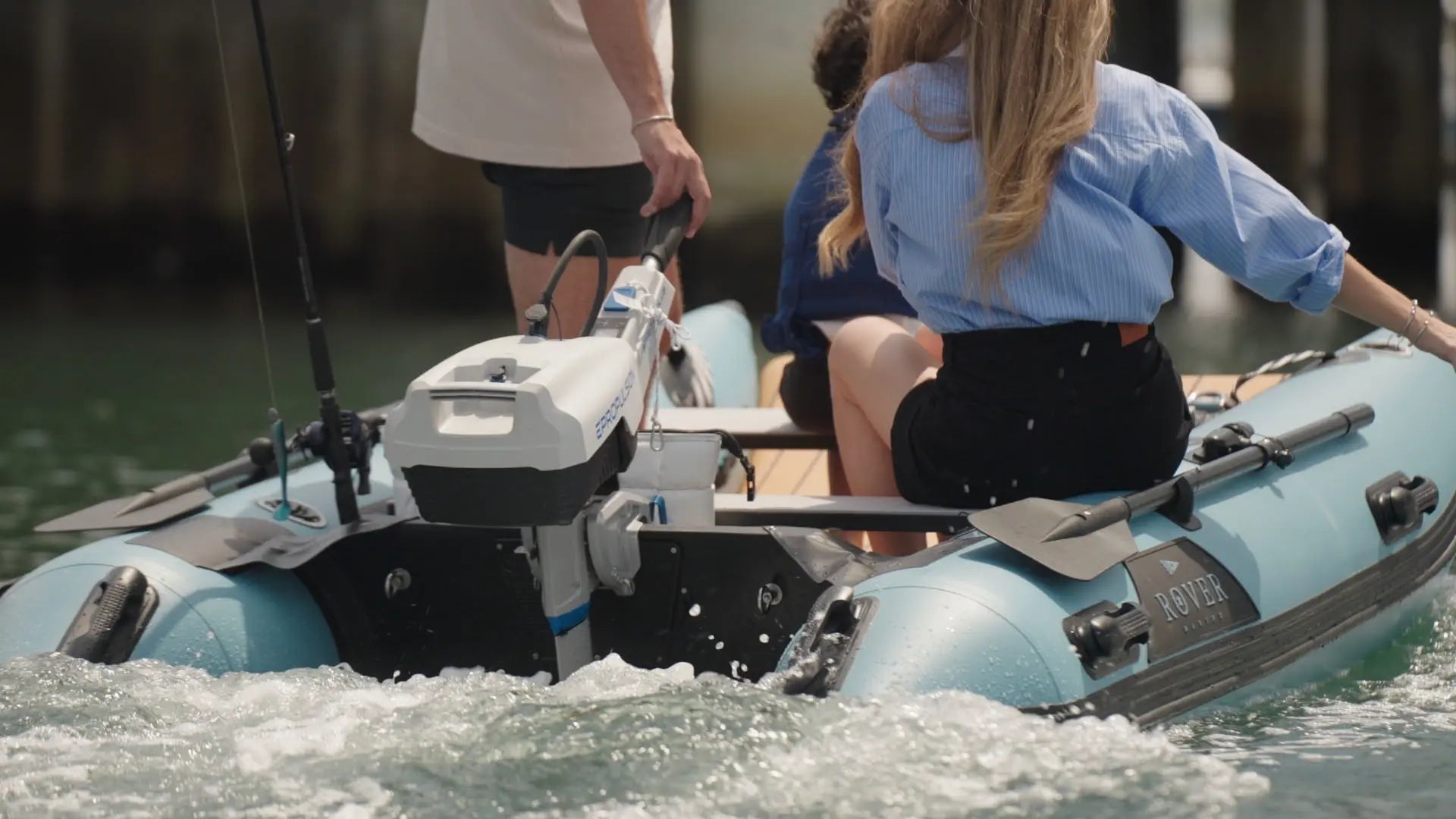
Both Rover Marine and Sea Eagle boats are compatible with electric outboard motors, delivering eco-friendly propulsion:
ePropulsion Spirit 1.0 Plus & Torqeedo Travel 1103 S
| Specification | ePropulsion Spirit 1.0 Plus | Torqeedo Travel 1103 S |
|---|---|---|
| Power Output | 1 kW (3 HP equivalent) | 1.1 kW (3.3 HP equivalent) |
| Total Weight | 42.6 lbs | ~35 lbs |
| Performance on Rover Marine | Excellent (100 lb boat = better speed/range) | Excellent (100 lb boat = better efficiency) |
| Performance on Sea Eagle | Good (110-130 lb boat = reduced performance) | Good (heavier boat = less efficiency) |
| Price | $2,999 | Varies by package |
The ePropulsion Spirit 1.0 Plus and Torqeedo Travel 1103 S deliver optimal performance on Rover Marine's lightweight platforms.
The American Boat & Yacht Council (ABYC) recognizes electric propulsion as a key advancement in sustainable marine recreation.
Sustainable Electric Outboard Design for Recreational Boats
To help industries in their sustainable and circular transition from internal combustion engine production to electric motor production, the deployment of (i) a sound environmental impact assessment methodology, such as life cycle analysis, coupled with (ii) Design for Re-X tools, such as circularity indicators, is instrumental. To demonstrate the industrial relevance and complementary of both approaches, two consecutive workshops are conducted with a major original equipment manufacturer of recreational boats and their associated engines.
Life cycle assessment and circular economy indicators to design sustainable electric outboards: results from workshops with industrial experts, M Saidani, 2023
Total Cost of Ownership: 7-Year ROI Analysis
| Cost Category | Rover Marine Battle Boat 10ft | Sea Eagle FishSkiff 16 | Rover Marine Advantage |
|---|---|---|---|
| Initial Purchase | $2,250 | $2,400 | -$150 (slightly lower) |
| Maintenance (7 years) | $700-$1,400 | $900-$1,800 | +$200-$400 savings |
| Repairs (7 years) | $200-$400 (minor) | $500-$1,000 (more frequent) | +$300-$600 savings |
| Replacement | $0 (still functional after 7 years) | $2,400 (Year 6-7 replacement likely) | +$2,400 savings |
| 7-Year Total Cost | $3,150-$4,050 | $6,200-$7,600 | $3,050-$3,550 SAVINGS |
| Condition After 7 Years | Still functional (3+ more years) | Replaced once, degrading again | Better long-term value |
ROI Insight: Rover Marine costs slightly less upfront and saves $3,050-$3,550 over 7 years while delivering superior performance, durability, and lifespan. Military-grade construction eliminates replacement cycles that Sea Eagle requires.
Best Use Cases: Rover Marine vs Sea Eagle
When Rover Marine Excels
Speed-Priority Missions (Battle Boat): V-hull design delivers superior speed, tracking, and maneuverability for yacht tenders, solo operations, tight cover navigation
Stability-Priority Missions (Battle Cat): Dual-pontoon catamaran provides maximum standing stability for flats fishing, offshore runs, water sports
Serious Fishing: Standing stability (up to 10 PSI floor), tactical aesthetics, durable construction for daily saltwater use
Yacht Tenders: Lightweight portability, tactical design, V-hull speed for guest transport
Dive Operations: Military-grade construction handles gear weight, saltwater exposure, daily operations
Saltwater Use: UV-resistant, saltwater-grade PVC lasts 7-10 years vs Sea Eagle's 5-7 years
Long-Term Investment: Better ROI over 7+ years, no replacement cycles
Tactical Aesthetics: Blue, Gray, Black color options vs Sea Eagle's limited gray/green
When Sea Eagle Works
Budget Entry: Lower upfront cost for casual recreational use
Freshwater Only: Adequate for lakes and rivers with minimal saltwater exposure
Occasional Use: Good enough for weekend warriors who boat 10-20 days/year
Wide Model Range: More size options for specific needs
Safety & Regulatory Compliance
USCG Requirements
According to the U.S. Coast Guard, all motorized vessels must carry:
- USCG-Approved PFDs: One Type I, II, or III life jacket per person
- Sound-Producing Device: Whistle or horn (vessels under 39.4 feet)
- Visual Distress Signals: Flares or signal mirror (coastal/offshore ops)
- Fire Extinguisher: Required if equipped with enclosed fuel tanks
- Navigation Lights: Red/green bow + white stern for night operations
- Kill Switch Lanyard: Prevents runaway boat if operator falls overboard
Both Rover Marine and Sea Eagle boats meet USCG recreational vessel standards when properly equipped.
Frequently Asked Questions
Is Rover Marine worth the extra cost over Sea Eagle?
Yes. Rover Marine costs about the same upfront ($2,250 vs $2,400 for comparable models) but saves $3,050-$3,550 over 7 years while delivering 2-5 years longer lifespan (7-10 years vs 5-7 years). Military-grade PVC withstands saltwater and UV exposure that degrades Sea Eagle's standard PVC faster. For serious boaters, Rover Marine delivers better long-term ROI.
What's the advantage of Battle Boat's V-hull design?
The Battle Boat's V-hull inflatable design cuts through water more efficiently than flat-bottom designs, providing better tracking, superior speed, and improved maneuverability. Ideal for yacht tenders, solo operations, and speed-priority missions. The Battle Cat's dual-pontoon catamaran design prioritizes stability over speed for fishing and multi-person trips.
How long do Rover Marine boats last compared to Sea Eagle?
Rover Marine: 7-10 years with proper maintenance (military-grade PVC). Sea Eagle: 5-7 years in regular use (standard PVC). Rover Marine's military-grade construction delivers 2-5 years longer lifespan, eliminating replacement cycles.
What's the difference in floor rigidity?
Rover Marine: Drop-stitch floors inflate up to 10 PSI for maximum rigidity (fiberglass-like performance). Sea Eagle: Drop-stitch floors inflate to 6-8 PSI (good rigidity but less than Rover Marine). Higher PSI = more rigid standing platform for fishing and water sports.
Can both brands handle saltwater?
Yes, but Rover Marine excels. Rover Marine's military-grade, saltwater-grade PVC is engineered for daily saltwater use (7-10 year lifespan). Sea Eagle's standard PVC is adequate for occasional saltwater but degrades faster (5-7 year lifespan). For daily saltwater boating, Rover Marine is the clear choice.
What color options does Rover Marine offer vs Sea Eagle?
Rover Marine: Battle Boat (Blue, Gray), Battle Cat (Blue, Black) - tactical aesthetics with customization. Sea Eagle: Usually gray or green with limited customization. Rover Marine's tactical color choices provide personalization and functional design.
Which brand is better for fishing?
Rover Marine. Drop-stitch floors (up to 10 PSI) create more rigid standing platforms for casting and sight fishing. Military-grade construction handles daily saltwater use. Battle Boat's V-hull provides speed for reaching fishing spots, Battle Cat's catamaran provides standing stability. Sea Eagle's 6-8 PSI floors are good but less rigid for standing operations.
What's the warranty difference?
Both brands offer manufacturer warranties covering material defects. For specific warranty terms, contact Rover Marine at 844-207-6837 (M-F, 10am-4pm PST) or visit the contact page.

Deploy Your Rover Marine Battle Boat Today
The choice between Rover Marine and Sea Eagle comes down to priorities: Sea Eagle offers mid-range value ($800-$3,500) with standard PVC construction and 5-7 year lifespan, while Rover Marine delivers military-grade performance ($1,999-$2,749) with 7-10 year lifespan, V-hull design (Battle Boat) or dual-pontoon catamaran (Battle Cat), and tactical customization. Over 7 years, Rover Marine actually costs LESS ($3,050-$3,550 savings) while delivering superior durability, performance, and value.
For serious boaters, anglers, yacht owners, and anyone using saltwater environments, the Battle Boat and Battle Cat eliminate replacement cycles, deliver rigid drop-stitch performance (up to 10 PSI floors), and provide tactical color customization that mid-range brands cannot match.
Ready to upgrade from mid-range to military-grade performance? Contact our team at 844-207-6837 (M-F, 10am-4pm PST) for personalized recommendations and to explore our Blue, Gray, and Black color options.
Deploy. Launch. Dominate. No compromises required.
See the Battle Boat's V-hull design and Battle Cat's catamaran stability outperform mid-range inflatables on our YouTube channel—real comparisons, real performance, real results.


Leave a comment
This site is protected by hCaptcha and the hCaptcha Privacy Policy and Terms of Service apply.