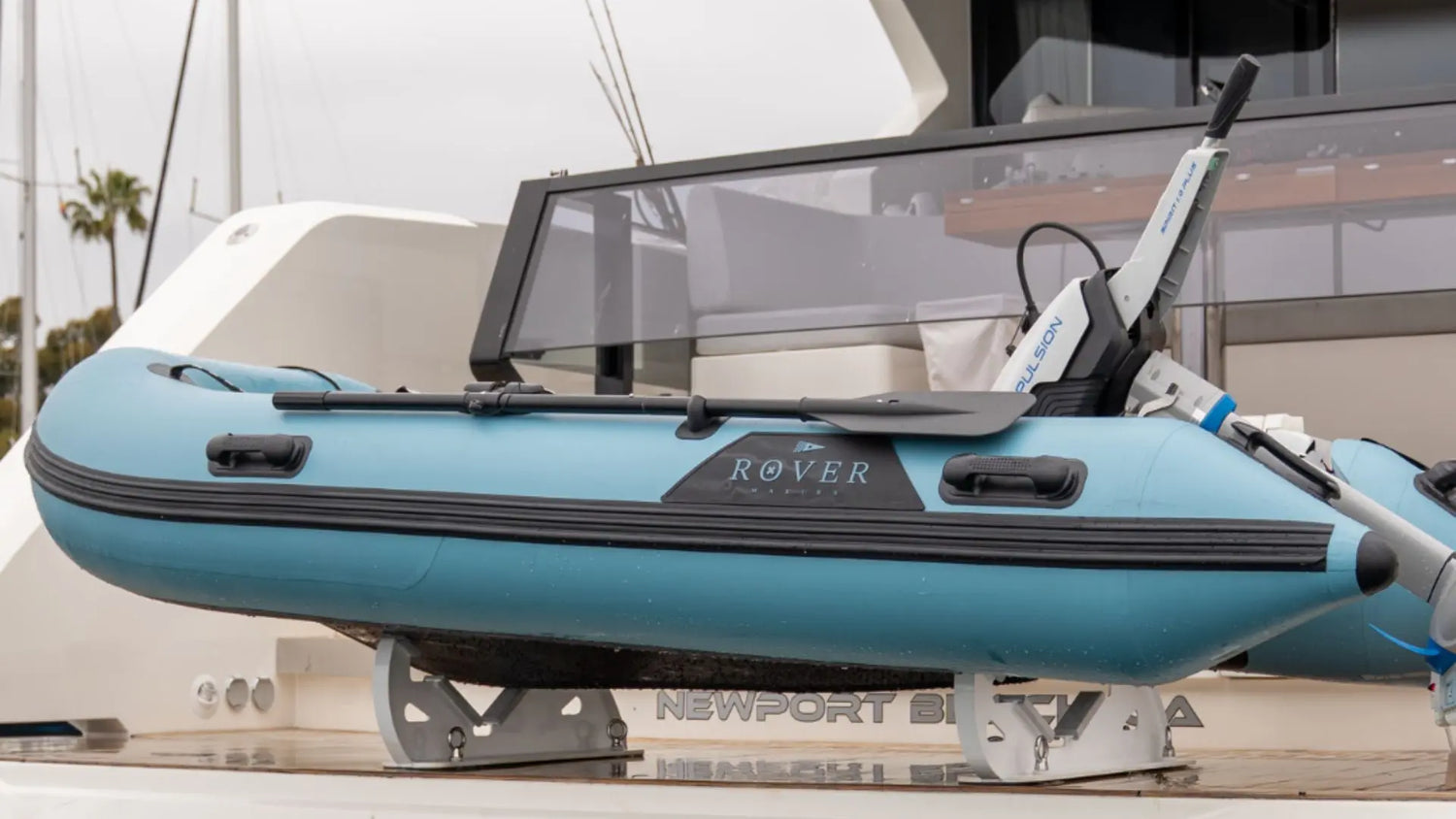
The difference between a small and large inflatable dinghy is not just two or four feet of length. Size changes width, tube height, hull weight, packed dimensions, passenger and load ratings, motor ceiling, working room, and the number of people needed to move the boat comfortably.
Rover Marine offers a useful three-step comparison: 8 ft, 10 ft, and 12 ft models in both Battle Boat and Battle Cat layouts. This guide compares the practical consequences of each size without pretending that larger is always better.
Small vs. large inflatable dinghy: quick answer
Small: 8 ft
4 ft wide, 15 in tubes, 2 people, 600 lb, up to 6 HP. Current hull weights are 86 lb Battle Boat and 84 lb Battle Cat.
Medium: 10 ft
5 ft wide, 18 in tubes, 4 people, 1,000 lb, up to 10 HP. Current hull weights are 100 lb Boat and 98 lb Cat.
Large: 12 ft
5.5 ft wide, 20 in tubes, 4 people, 1,200 lb, up to 20 HP. Current hull weights are 135 lb Boat and 130 lb Cat.
Exact dimensions, capacity, and motor limits
| Size | Inflated dimensions | Rated capacity | Maximum motor | Current hull weight |
|---|---|---|---|---|
| 8 ft | 8 x 4 x 15 in | 2 people / 600 lb | Up to 6 HP | 86 lb Boat / 84 lb Cat |
| 10 ft | 10 x 5 x 18 in | 4 people / 1,000 lb | Up to 10 HP | 100 lb Boat / 98 lb Cat |
| 12 ft | 12 x 5.5 x 20 in | 4 people / 1,200 lb | Up to 20 HP | 135 lb Boat / 130 lb Cat |
Length is only the most visible change. Width grows from 4 ft to 5 ft and then 5.5 ft, while tube height increases from 15 to 18 and 20 in. That changes the exterior footprint and the way interior working space feels. The deck layout also differs between the traditional Battle Boat and dual-pontoon Battle Cat.
Passenger ratings increase from two on the 8 ft to four on the 10 and 12 ft models. The 12 ft boat does not add a fifth passenger rating; it adds 200 lb of load headroom over the 10 ft. That distinction matters for buyers carrying heavier activity gear rather than more people.
Maximum power rises sharply with size. The 8 ft ceiling is 6 HP, the 10 ft ceiling is 10 HP, and the 12 ft ceiling is 20 HP. A higher limit provides configuration options but can increase motor purchase price, installed weight, fuel or battery needs, and handling effort.
How size changes launching and handling

Carrying and setup
The difference between 84 and 135 lb is meaningful before the motor or gear is added. An 8 ft hull may be manageable for a strong two-person lift in situations where the 12 ft hull needs a cart, wheels, davit, or more hands. Do not assign a universal “one-person portable” label to any size.
Turning and low-speed control
Shorter boats generally have a smaller footprint and can feel easier to place in confined areas. Longer boats create more hull length for load distribution but require more room to rotate and dock. Wind, current, load placement, hull layout, and motor response can dominate these general tendencies.
Trim sensitivity
In a compact hull, one passenger moving or a heavy stern-mounted motor can represent a larger portion of the overall weight distribution. Larger boats give more fore-and-aft space for organizing load, but they still require deliberate placement. Keep heavy items low and secured.
Ride expectations
More length, width, and tube volume change how a boat interacts with chop and wakes, but no dimension guarantees comfort or safety. Slow down for conditions, distribute weight, use the correct pressure, and operate within the route, weather, and crew’s ability.
Which size fits common activities?
Yacht or sailboat tender
An 8 ft model can suit short two-person transfers when deck or locker space is tight. A 10 ft model adds capacity for guests and provisions. A 12 ft model may fit frequent larger loads but requires a more demanding stowage and lifting plan.
Fishing
Count tackle, cooler, anchor, battery or fuel, and the space needed to handle equipment. Two anglers with substantial gear may prefer more than an 8 ft footprint even while remaining under 600 lb.
Diving and snorkeling
Cylinders, weights, fins, exposure gear, and reboarding equipment add weight and consume deck area. Size for the complete kit and a safe reboarding routine, not simply the number of divers.
Family day use
The 10 and 12 ft models list four-person ratings. The 12 ft adds load headroom and dimensions, while the 10 ft reduces hull weight and packed size. Decide whether the normal family load justifies the larger platform.
Solo operation
A solo operator must consider both on-water control and shoreside movement. A smaller hull may simplify launch and recovery, while a larger boat may be impractical without wheels or mechanical help. Motor weight and the path from storage to water often decide the answer.
Packed size can decide before water performance does
| Size | Deflated dimensions | Battle Boat weight | Battle Cat weight | Storage question |
|---|---|---|---|---|
| 8 ft | 38 x 24 x 15 in | 86 lb | 84 lb | Will it clear the locker, hatch, or vehicle opening? |
| 10 ft | 45 x 28 x 18 in | 100 lb | 98 lb | Can the normal crew move it through the full route? |
| 12 ft | 48 x 32 x 20 in | 135 lb | 130 lb | Are a cart, wheels, davit, or dedicated rack required? |
Measure the narrowest point between storage and launch: vehicle door, companionway, dock gate, stair turn, locker lip, or elevator. Add handling clearance. A package that mathematically fits a space may still be too awkward to place without damage.
Plan for drying. Long-term folded storage should follow manufacturer guidance and avoid trapped moisture, excessive heat, sharp surfaces, chemical exposure, and crushing loads. The storage plan affects longevity and should be part of the size decision.
If the boat will remain inflated, confirm support points, cover or UV strategy, drainage, tie-down method, and protection from dock abrasion. Inflatable does not mean maintenance-free.
How size changes total cost
A larger hull can cost more directly, but the bigger difference may be the system around it. Higher motor capacity can lead to a more expensive motor, larger battery or fuel supply, heavier transport gear, more storage space, and more complicated launching.
A small boat can keep those costs controlled. It becomes false economy if the normal crew and gear make every trip crowded or require a second purchase. Focus on cost per useful trip, not the hull price alone.
Review support terms before deciding. The current Rover Marine warranty differentiates hull, tube and seam, accessory, and third-party coverage and excludes common owner or environmental damage such as punctures, abrasion, dock rash, misuse, accidents, normal wear, and improper storage.
Small, medium, or large decision matrix
| Decision factor | 8 ft | 10 ft | 12 ft |
|---|---|---|---|
| Normal crew | 1 to 2 | Up to 4 | Up to 4 |
| Load ceiling | 600 lb | 1,000 lb | 1,200 lb |
| Storage priority | Highest | Balanced | Requires most room |
| Hull lifting effort | Lowest of three | Moderate | Highest of three |
| Motor headroom | Up to 6 HP | Up to 10 HP | Up to 20 HP |
| Best fit | Compact tender or two-person use | Mixed use and four-person capacity | Recurring heavy gear or maximum load headroom |
- Count normal passengers and all gear.
- Choose the smallest capacity that leaves practical reserve.
- Measure the entire storage and launch route.
- Confirm the normal crew can move the hull weight.
- Check whether the size’s motor ceiling supports the mission.
- Compare Battle Boat and Battle Cat deck layouts in that size.
- Budget for the complete motor, safety, transport, and care system.
How size affects daily ownership beyond the specifications
A larger boat takes more space while cleaning, drying, repairing, and packing. It may need a bigger clear floor area and more time to inspect. A smaller boat can simplify those tasks, but tight working space may require more deliberate gear organization.
Accessories scale differently. The same anchor, PFD, pump, and safety kit may serve multiple sizes, while a larger motor, energy source, cover, cart, or storage rack can increase with the hull. When comparing budgets, separate fixed equipment from size-driven equipment.
Frequency matters. If the boat is launched several times a week, a difference of 30 to 50 lb and several inches of packed height can shape ownership more than occasional onboard room. If the boat stays assembled on a supported storage system, working capacity may matter more than pack-down convenience.
Resale value cannot be guaranteed, but clear records, proper care, complete equipment, and a hull sized for common use can make a package easier to evaluate. Do not choose a size mainly from an assumed future resale premium.
Frequently asked questions
Is an 8 ft inflatable dinghy big enough for two adults?
It is rated for two people and 600 lb, but comfort depends on body size, motor system, safety gear, and activity equipment.
Can a 10 ft Rover Marine dinghy carry four people?
Current 10 ft models list four people and 1,000 lb. Leave reserve and consider usable room.
Does the 12 ft model carry more people than the 10 ft?
Both list four people. The 12 ft raises the load ceiling from 1,000 to 1,200 lb and increases dimensions and motor headroom.
How much heavier is the 12 ft hull?
Current 12 ft weights are 135 lb for Battle Boat and 130 lb for Battle Cat, compared with 86 and 84 lb at 8 ft.
Which size is easiest to store?
The 8 ft has the smallest packed dimensions at 38 x 24 x 15 in. Measure the actual storage route before deciding.
Which size is best for fishing?
Choose based on anglers, tackle, cooler, anchor, motor system, and working room. There is no universal fishing size.
Which size is best as a tender?
The best tender size balances transfer load with mothership storage, lifting, and davit limits.
Does a larger inflatable always ride better?
No. Size influences behavior, but load, pressure, layout, motor setup, wind, current, and waves all matter.
What are the motor limits?
Up to 6 HP for 8 ft, 10 HP for 10 ft, and 20 HP for 12 ft models.
Do all sizes use the same shaft length?
Current models list a 15-inch transom across all sizes, normally matched with a short-shaft motor.
Are Battle Boat and Battle Cat weights the same?
They are close but not identical. Current listed weights are 86/100/135 lb for Battle Boat and 84/98/130 lb for Battle Cat.
Should I size for the heaviest trip I can imagine?
Size for recurring credible use. A rare extreme trip may not justify making every normal launch heavier and harder.
Choose the size you will actually use
Balance people, gear, motor headroom, packed dimensions, and the crew available to launch. The right size is the one that fits both the water and the route to it.

Leave a comment
This site is protected by hCaptcha and the hCaptcha Privacy Policy and Terms of Service apply.